
Grinding method for superhard silicon carbide ceramic nano mirror
A super-hard silicon carbide and nano-mirror technology, which is applied to optical surface grinders, grinding machine parts, grinding/polishing equipment, etc. De-fine and fine-grinding process, simple effect of the device
- Summary
- Abstract
- Description
- Claims
- Application Information
AI Technical Summary
Problems solved by technology
Method used
Image

Examples
Embodiment
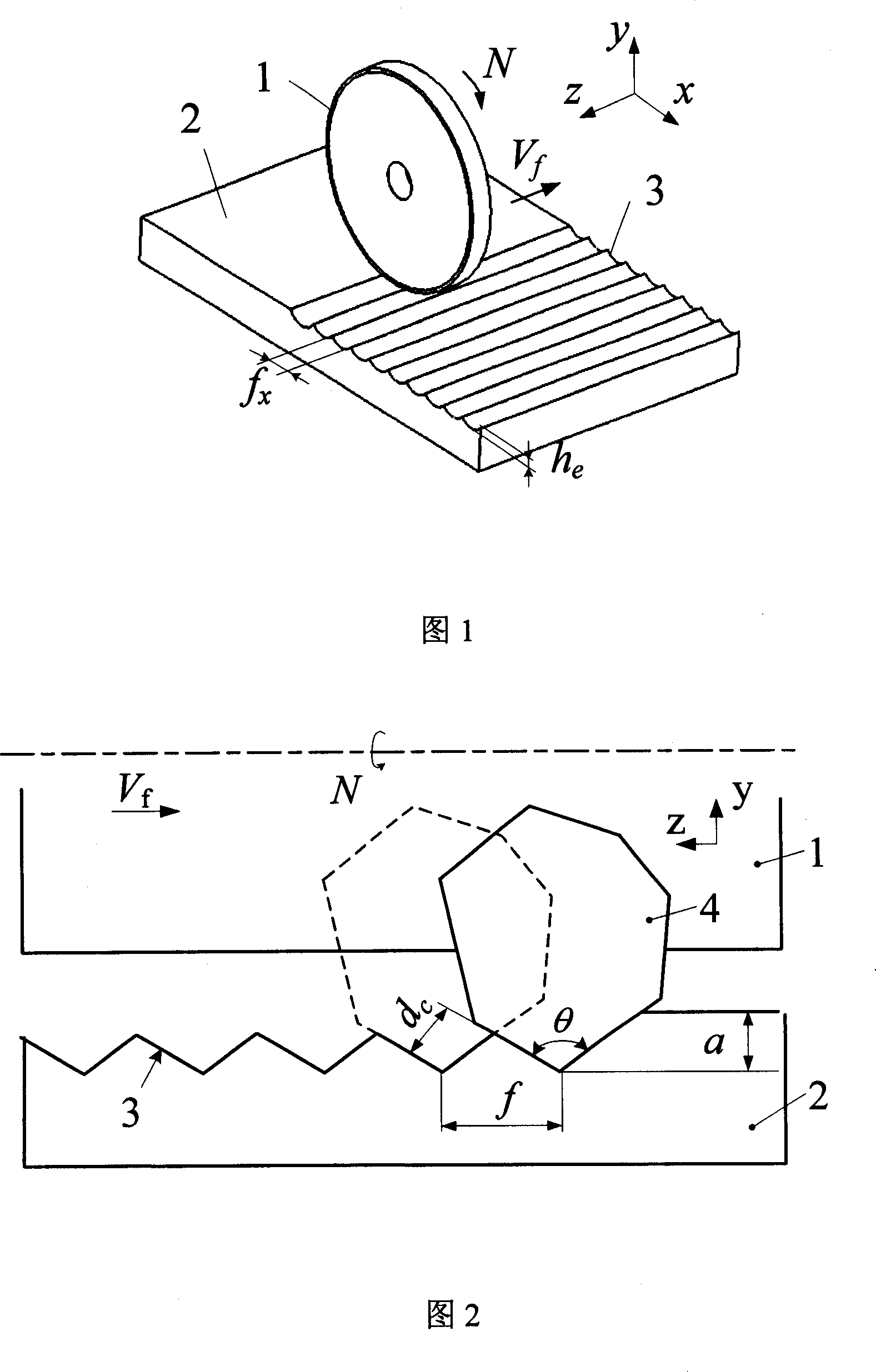
[0037] A #180 rough diamond grinding wheel with a diameter of 180 mm is used on a CNC precision grinding machine (SMRART B818), and the CNC system is used to drive the grinding wheel to travel along the axis of the grinding wheel to perform nano-mirror grinding on reaction sintered silicon carbide ceramics (RB-SiC). Use #180GC grinding stone to sharpen #180 diamond grinding wheel, so that the diamond abrasive grains on the working surface of the grinding wheel can fully emerge and maintain a certain edge height. The sharpening condition is: N=1500r / min, V f =600mm / min, f x =5mm, a=0.3mm, Σa=4mm, BM2 grinding fluid. After sharpening, use cast iron to trim the working surface of the diamond grinding wheel that has been edged to increase the number of effective abrasive grains n g , to increase the average edge angle θ of abrasive grains. Cast iron dressing conditions are: N=3000r / min, V f =1500mm / min, f x =0.1mm, a=5μm, Σa=0.1mm, BM2 grinding fluid.
[0038] During the gri...
PUM
| Property | Measurement | Unit |
|---|---|---|
| surface roughness | aaaaa | aaaaa |
| surface roughness | aaaaa | aaaaa |
| diameter | aaaaa | aaaaa |
Abstract
Description
Claims
Application Information
 Login to View More