Information processing system and non-transitory computer readable medium
a technology of information processing system and computer readable medium, which is applied in the direction of digital output to print units, instruments, visual presentations, etc., can solve the problems of increasing post-processing burden, wasting paper, and increasing the time needed to complete the plurality of print jobs, so as to reduce the transport speed of each print job
- Summary
- Abstract
- Description
- Claims
- Application Information
AI Technical Summary
Benefits of technology
Problems solved by technology
Method used
Image

Examples
first exemplary embodiment
[0027]
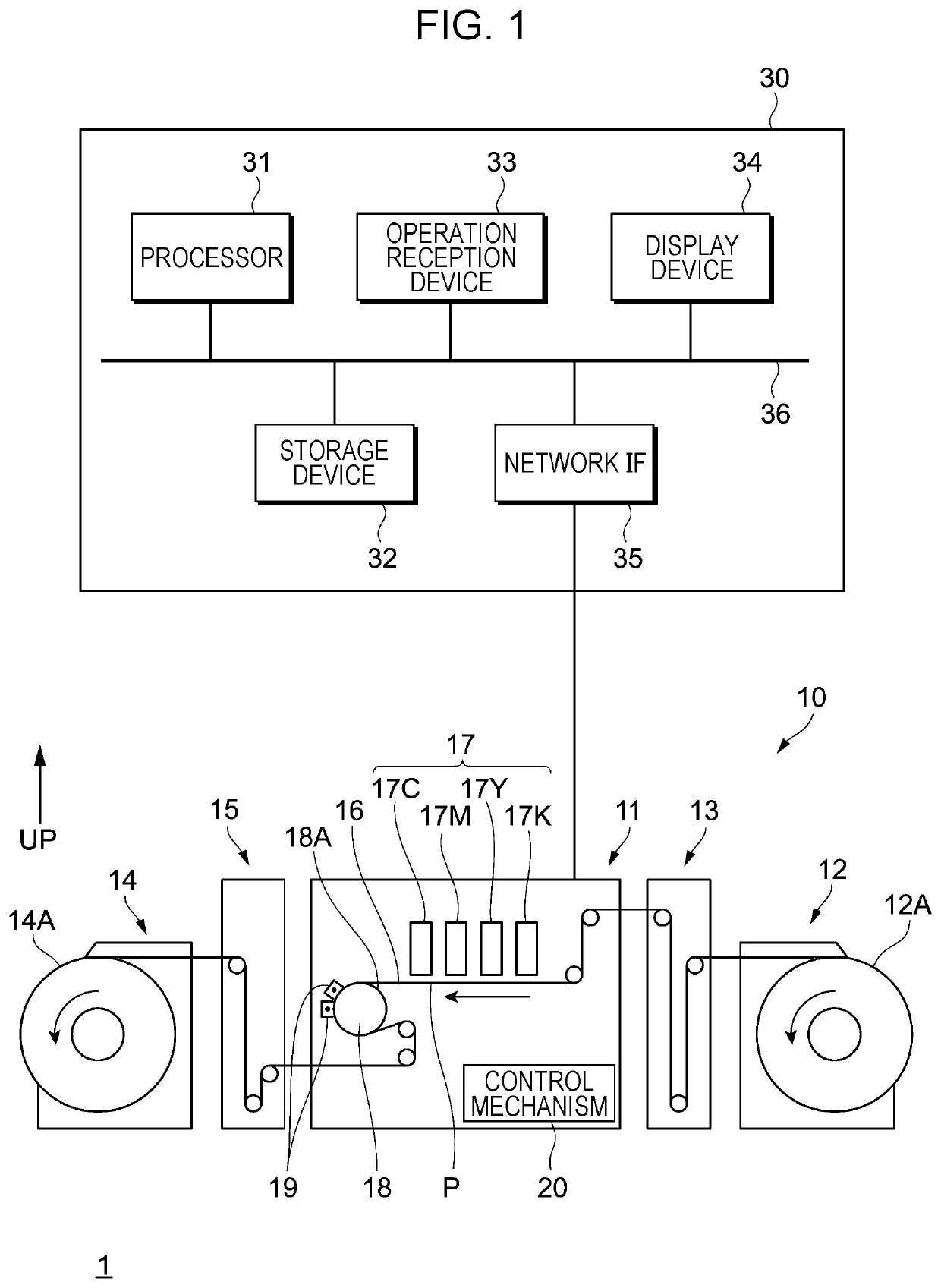
[0028]FIG. 1 schematically illustrates an example of the overall configuration of an image forming system 1 according to a first exemplary embodiment.
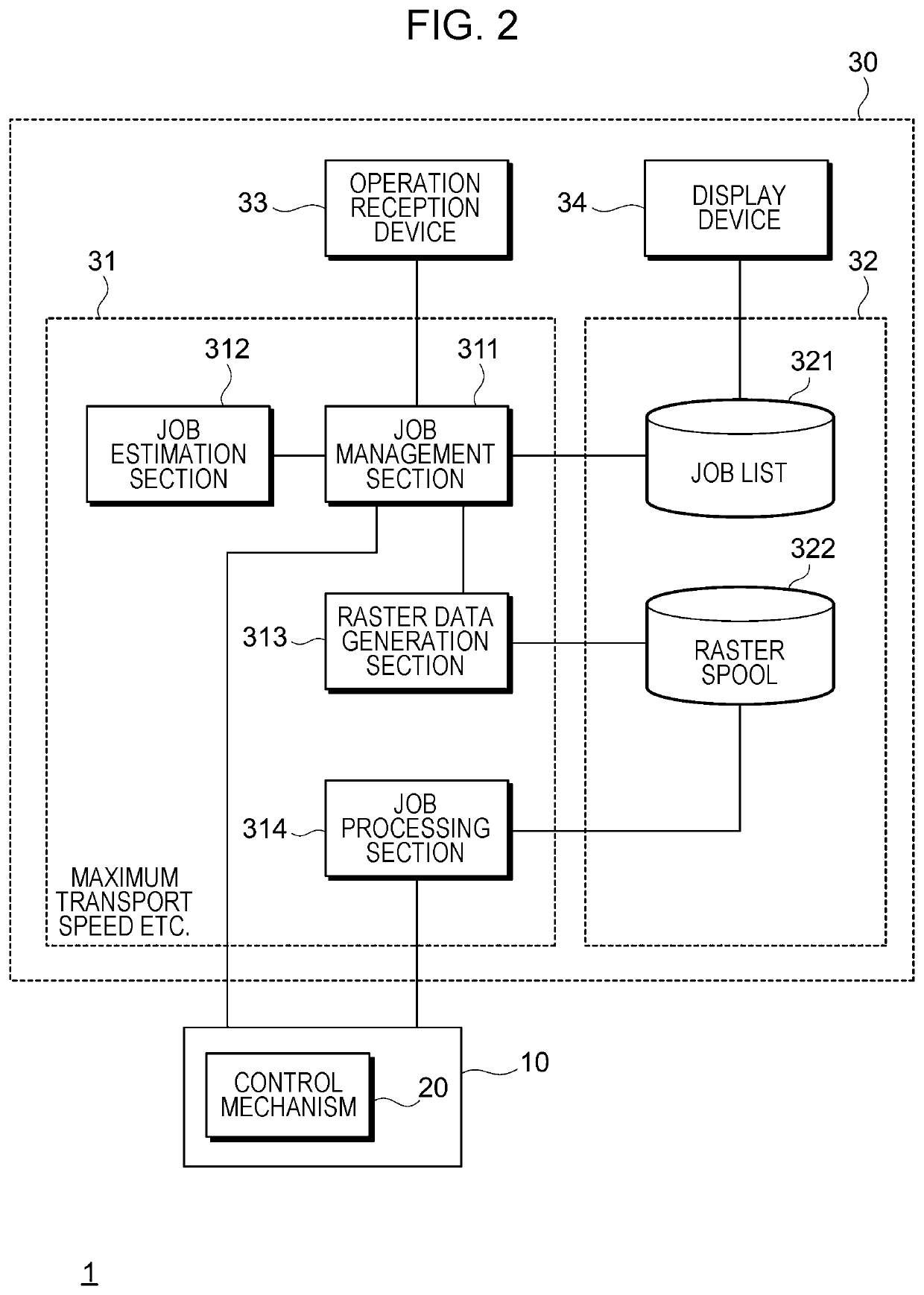
[0029]The image forming system 1 illustrated in FIG. 1 includes an image forming apparatus 10 that forms an image on a long band-like piece of paper P (hereinafter referred to as “continuous feed paper P”) drawn from rolled paper, and a management server 30 that controls the formation of an image by the image forming apparatus 10. The management server 30 is an example of an information processing system.
[0030]
[0031]The image forming apparatus 10 illustrated in FIG. 1 includes: an image forming unit 11 that forms an image on the continuous feed paper P; a pre-processing unit 12 that houses the continuous feed paper P to be supplied to the image forming unit 11; a buffer unit 13 disposed between the image forming unit 11 and the pre-processing unit 12 to adjust the amount of transport etc. of the continuous feed paper P to be supp...
second exemplary embodiment
[0132]Subsequently, a second exemplary embodiment will be described. The configuration of the image forming system for use in the present exemplary embodiment is also the same as that according to the first exemplary embodiment.
[0133]In the case of the first exemplary embodiment, print jobs are scheduled in the order of selection by the user. In the case of the second exemplary embodiment, however, print jobs are rearranged in the ascending order of the maximum transport speed in the case where the variable transport speed mode is selected.
[0134]FIG. 13 is a flowchart illustrating an overview of transport speed control executed by the management server 30 (see FIG. 1) according to the second exemplary embodiment. Symbol S in the drawing denotes “step”. Portions in FIG. 13 corresponding to those in FIG. 10 are denoted by the corresponding reference numerals.
[0135]FIG. 13 is different from FIG. 10 in that the processor (see FIG. 1) rearranges the print jobs in the ascending order of t...
third exemplary embodiment
[0143]Subsequently, a third exemplary embodiment will be described. The configuration of the image forming system for use in the present exemplary embodiment is also the same as that according to the first exemplary embodiment.
[0144]In the case of the first exemplary embodiment discussed earlier, it is assumed that there is enough time for the transport speed to be reduced after reaching the maximum transport speed, before the time to execute the next print job. However, enough time may not be secured for an increase or a reduction of the transport speed, depending on the content of the print jobs. In this case, the maximum transport speeds corresponding to the print jobs may not be reached. In the case with a speed reduction, in particular, there is a higher possibility that the maximum transport speeds are not reached.
[0145]FIG. 16 illustrates an example of transport speed control according to the third exemplary embodiment. Portions in FIG. 16 corresponding to those in FIG. 12 ar...
PUM
 Login to View More
 Abstract
Description
Claims
Application Information
 Login to View More
 - R&D
- Intellectual Property
- Life Sciences
- Materials
- Tech Scout
- Unparalleled Data Quality
- Higher Quality Content
- 60% Fewer Hallucinations
Browse by: Latest US Patents, China's latest patents, Technical Efficacy Thesaurus, Application Domain, Technology Topic, Popular Technical Reports.
© 2025 PatSnap. All rights reserved.Legal|Privacy policy|Modern Slavery Act Transparency Statement|Sitemap|About US| Contact US: help@patsnap.com