While mobile devices can access Grid computing services, the computational resources is generally limited to the traditional servers on the wired network, and the computational resource does not generally extend into the mobile domain.
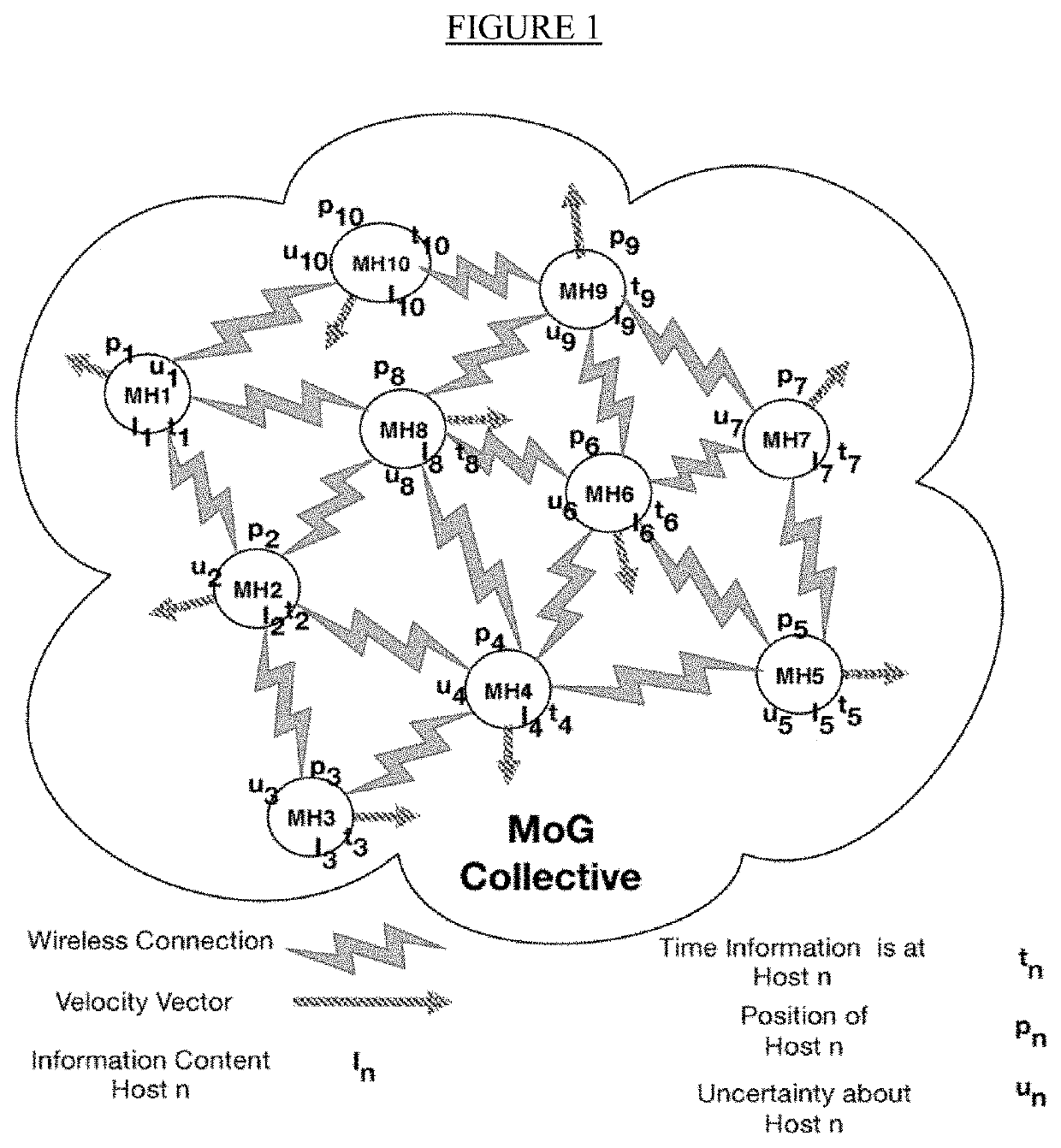
And when considering the practical E-MoG described herein, performance-limiting challenges exist, as shown in FIG. 1.
Nodes hosting subtask computation or action may fail to exchange intermediate computation results with their collaborating peers, causing the overall job to be delayed or aborted altogether, if that job cannot be completed in an agreed upon time or with sufficient reliability.
Hence, on which nodes to store which checkpoints for optimal low-latency recovery, called the E-MoG's checkpoint arrangement, becomes a dynamic and important problem in the E-MoG, as opposed to the traditional grid computing systems.
But as effective and powerful as these traditional grid services may be, they can only provide a subset of the computational functionality critically needed in the mobile domain.
Such IMD is considered to be remote from the traditional Grid services, where remoteness can be induced due to spatial, temporal, complexity, or scalability limitations of these traditional Grid services.
Spatial remoteness is when the data or what needs to be processed or interacted with is too far away, especially away from Internet access, or in a place very dangerous or very difficult to access, i.e. outer space, the south pole, inside a damaged nuclear reactor, or when the phenomenon producing the data are too small, i.e. microscopic to be easily accessible, to name a few.
Temporal remoteness is when the data or what needs to be processed or interacted with can be reached, but it cannot be reach quickly enough or with small enough latency to make dynamic real-time interaction practical, e.g. a rapidly changing phenomenon or process requiring real-time control, where the control system, due to its sluggish latency is effectively remote from the phenomenon or process.
If a phenomenon or process is remote in complexity and / or in scale, it may not be possible to provide sufficient tracking sensors or sufficient processing or control, or it may not be possible to bring sufficient resources to bear to the phenomenon in order to match its scale variation or complexity.
However, certain critical needs are arising in the mobile environment requiring some novel Grid computing functionality for which there is no sufficient solution in traditional Grid computing approaches.
In trying to provide these critical services via traditional methods, i.e. by uploading mobile data from mobile sensors in the field, processing that data on traditional servers in wired Grids, and then trying to get a response back out to the mobile domain in sufficient time for nearly real-time interaction with mobile phenomena, traditional methods fall short.
This is due to ever increasing challenges plaguing traditional systems.
Secondly, these same hops are becoming increasingly more congested with inbound and outbound traffic making them not able to scale well with prolific increases in mobile sensing devices.
Thirdly, traditional methods face both increasing levels of security and an increasing number of security checkpoints between sensors and processing servers.
What all this means is that traditional methods will face round-trip closed loop latencies and latency variations that make tightly coupled interaction with mobile data and mobile phenomena infeasible, effectively temporally remote, and the problem is not getting any better.
Moreover, there are many scenarios where the traditional method of a mobile device submitting sensed or other data for processing to the Grid or Cloud and then waiting for a processed response, simply will not work.
Still other scenarios include mission-critical situations involving first responders in disasters or rural areas, or even collaborative munitions where provision of a protected or working infrastructure is not practical.


 Login to View More
  Login to View More