

Device-to-device network
a network and device technology, applied in the field of network technology and the communication of data, can solve the problems of consumers' resistance to storing all of their data on a central server, lack of security, and new technologies that have not kept pace with the needs of consumers
Active Publication Date: 2002-07-04
HARMAN INT IND INC
View PDF28 Cites 285 Cited by
- Summary
- Abstract
- Description
- Claims
- Application Information
AI Technical Summary
Problems solved by technology
However, these new technologies have not kept pace with the needs of consumers.
However, consumers have shown resistance to storing all of their data on a central server.
One shortcoming of the existing peer-to-peer systems is the lack of security.
Additionally, the use of content is restrained by the inability to access the content from more than one device.
Because these devices are unable to communicate with each other, the consumer is not able to listen or view media when not in direct contact with the device receiving or storing the content.
For example, a PDA is currently incapable of accessing TV programming from a cable TV subscription.
As a result, content providers miss out on an opportunity to provide media to a consumer who desires it and is willing to pay for it.
The process includes identifying the devices that the user is authorized to access and allowing communication with those devices and not allowing communication with the devices that the user is not authorized to access.
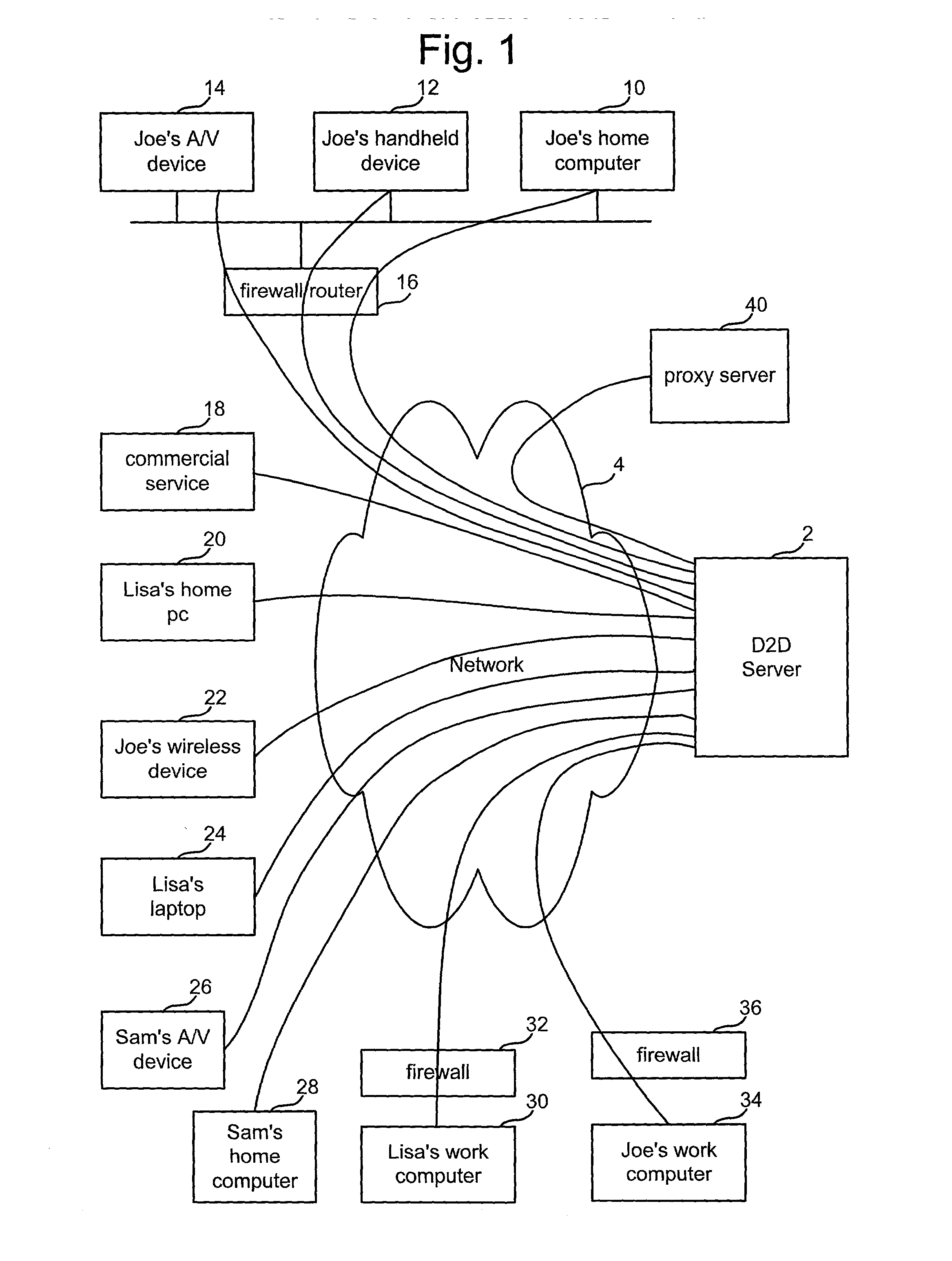
The system identifies the devices that are logged into the network using the first user identification and allowing communication with those devices, while not allowing communication with devices that are logged into the network using other identifications.
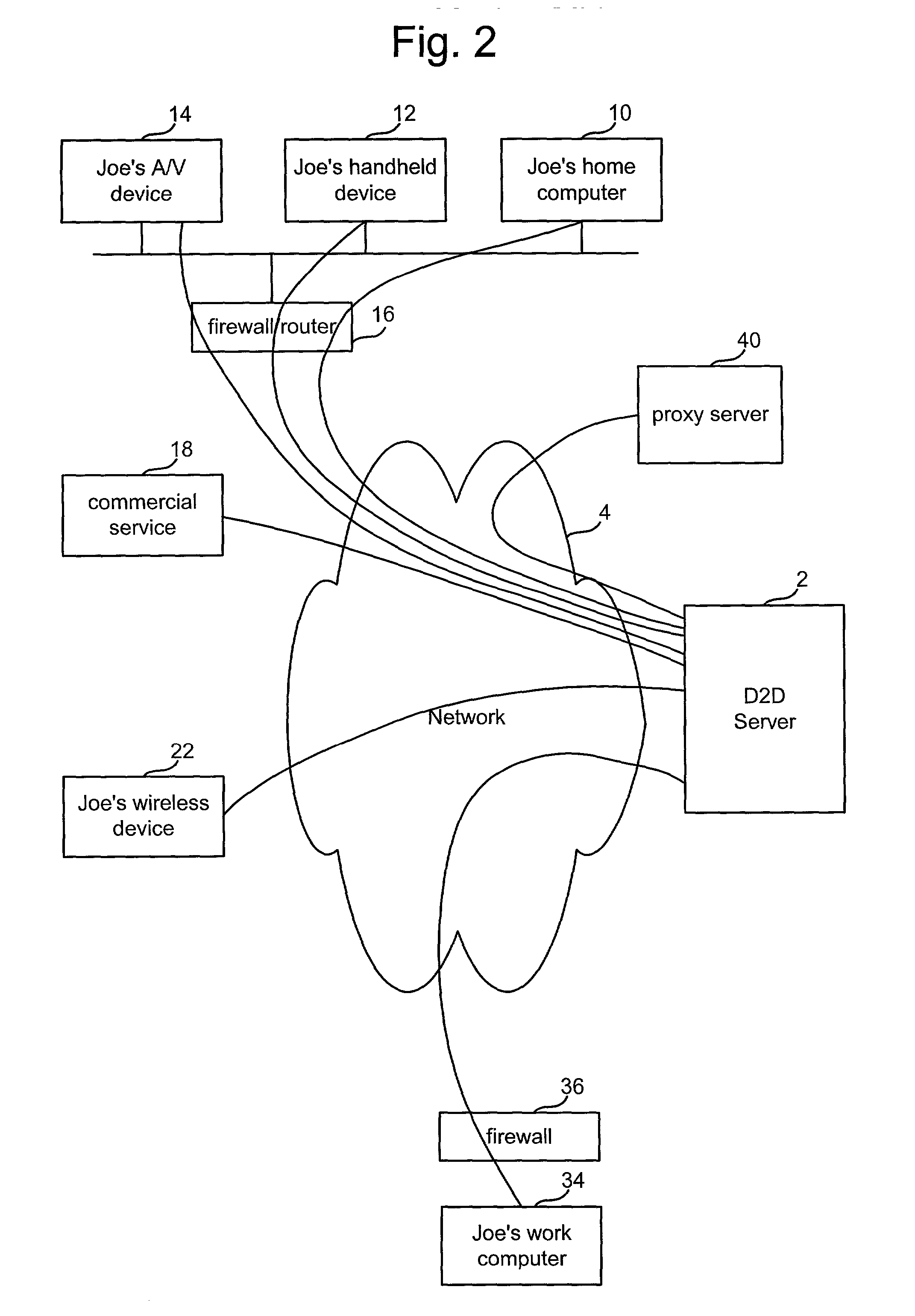
Thus, these devices can only see the devices depicted in FIG. 2.
Lisa's devices will not be able to see Sam's devices or Joe's devices.
If the server was used to transfer data, then the server may become overloaded and the network will no longer function with reasonable performance.
Thus, a device outside of the LAN using conventional technology cannot initiate a communication with any of the devices inside the LAN.
Conceivably, content providers may not want content to move off devices that the content was delivered to.
Method used
the structure of the environmentally friendly knitted fabric provided by the present invention; figure 2 Flow chart of the yarn wrapping machine for environmentally friendly knitted fabrics and storage devices; image 3 Is the parameter map of the yarn covering machine
View moreImage
Smart Image Click on the blue labels to locate them in the text.
Smart ImageViewing Examples

Examples
Experimental program
Comparison scheme
Effect test
Embodiment Construction
has been presented for purposes of illustration and description. It is not intended to be exhaustive or to limit the invention to the precise form disclosed. Many modifications and variations are possible in light of the above teaching. The described embodiments were chosen in order to best explain the principles of the invention and its practical application to thereby enable others skilled in the art to best utilize the invention in various embodiments and with various modifications as are suited to the particular use contemplated. It is intended that the scope of the invention be defined by the claims appended hereto.
the structure of the environmentally friendly knitted fabric provided by the present invention; figure 2 Flow chart of the yarn wrapping machine for environmentally friendly knitted fabrics and storage devices; image 3 Is the parameter map of the yarn covering machine
Login to View More PUM
 Login to View More
 Abstract
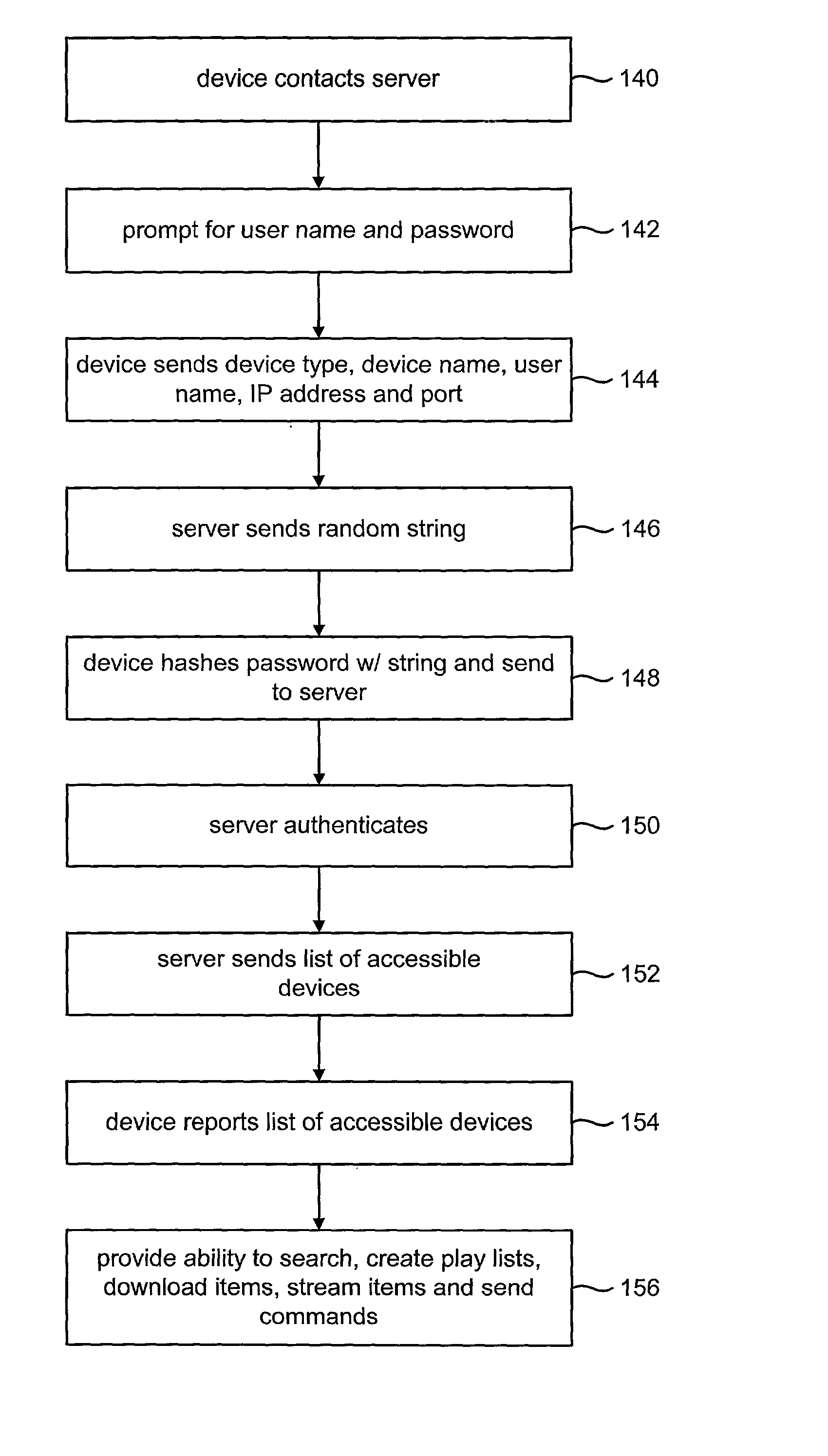
A device to device network allows an entity to seamlessly access content stored on various devices. Many devices can be registered on a network; however, an entity will only have access to devices for which the entity is authorized to access. In one embodiment, the entity can only access devices that have been authenticated with the same username. While using the device-to device network, an entity can transfer files, stream files, create and use play lists, send commands to various devices and explore the contents of various devices.
Description
[0001] This application claims the benefit of U.S. Provisional Application No. 60 / 233,741, "Personal Device-to-Device Networking," filed on Sep. 19, 2000, incorporated herein by reference.[0002] 1. Field of the Invention[0003] The present invention is directed to networking technology and the communication of data.[0004] 2. Description of the Related Art[0005] With the emergence of broadband technologies and the maturity of digital content, consumer adoption of digital music, images, video and other content has been growing. New technologies have been created to address how to distribute, store and access digital content. However, these new technologies have not kept pace with the needs of consumers.[0006] Early attempts to provide services to those interested in digital music relied on a model that included a central point to store and serve audio files. However, consumers have shown resistance to storing all of their data on a central server. Alternatively, many consumers have uti...
Claims
the structure of the environmentally friendly knitted fabric provided by the present invention; figure 2 Flow chart of the yarn wrapping machine for environmentally friendly knitted fabrics and storage devices; image 3 Is the parameter map of the yarn covering machine
Login to View More Application Information
Patent Timeline
 Login to View More
 Patent Type & AuthorityApplications(United States)
IPC IPC(8): H04L29/06H04L29/08
CPCH04L63/029H04L63/083H04L2463/101H04L67/1002H04L67/1001
InventorBUSAM, VINCENT R.RON, SHACHARSIEGRIST, SCOTT R.LAU, DANNIE C.BENYAMIN, DANIEL
OwnerHARMAN INT IND INC