
Wireless LAN with load balancing
a load-balancing and wireless technology, applied in the field of wireless lans with load-balancing, can solve the problems of cell size limitation by physical constraints, cell traffic load not being taken into account, and degradation of traffic within the cell
- Summary
- Abstract
- Description
- Claims
- Application Information
AI Technical Summary
Problems solved by technology
Method used
Image

Examples
Embodiment Construction
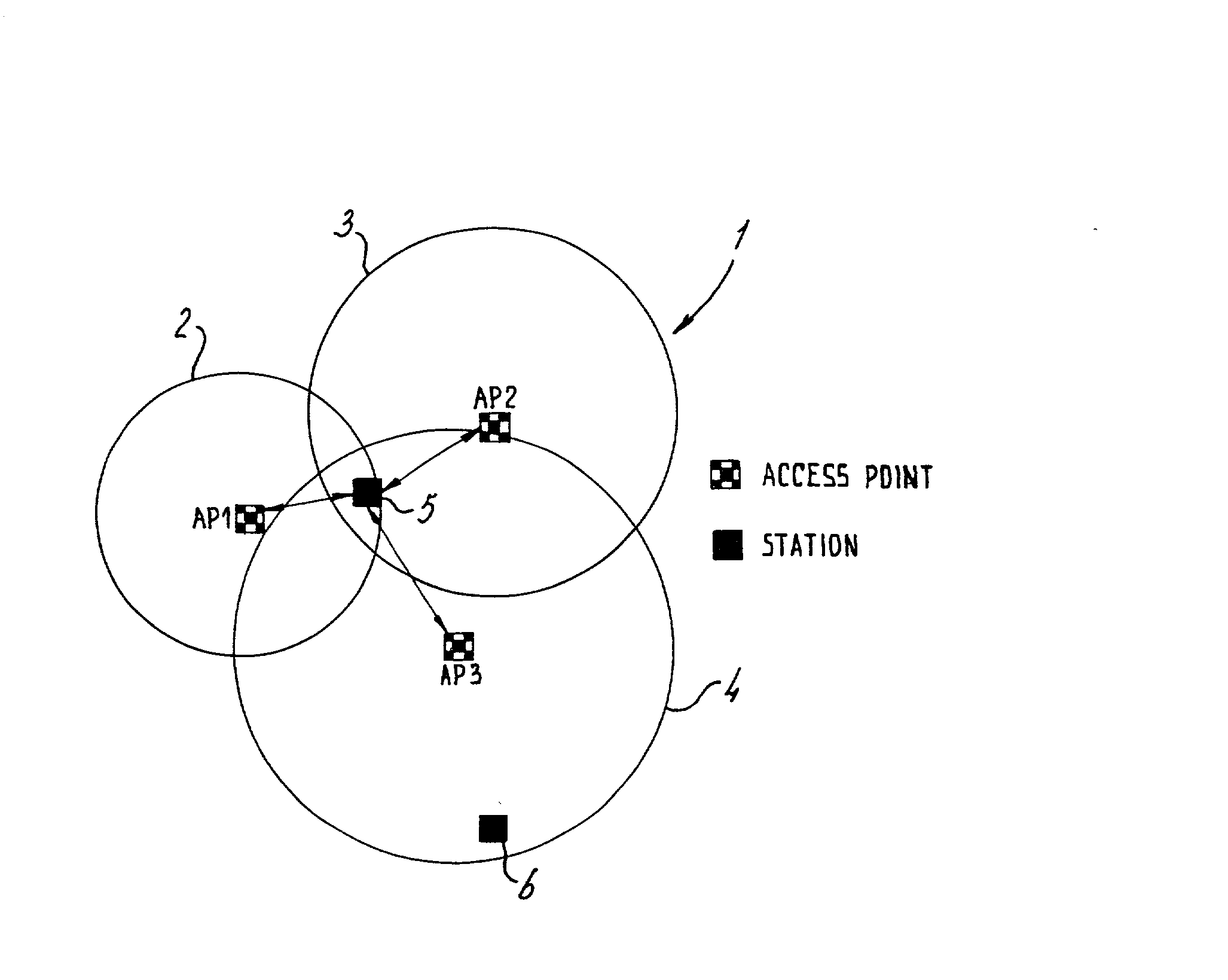
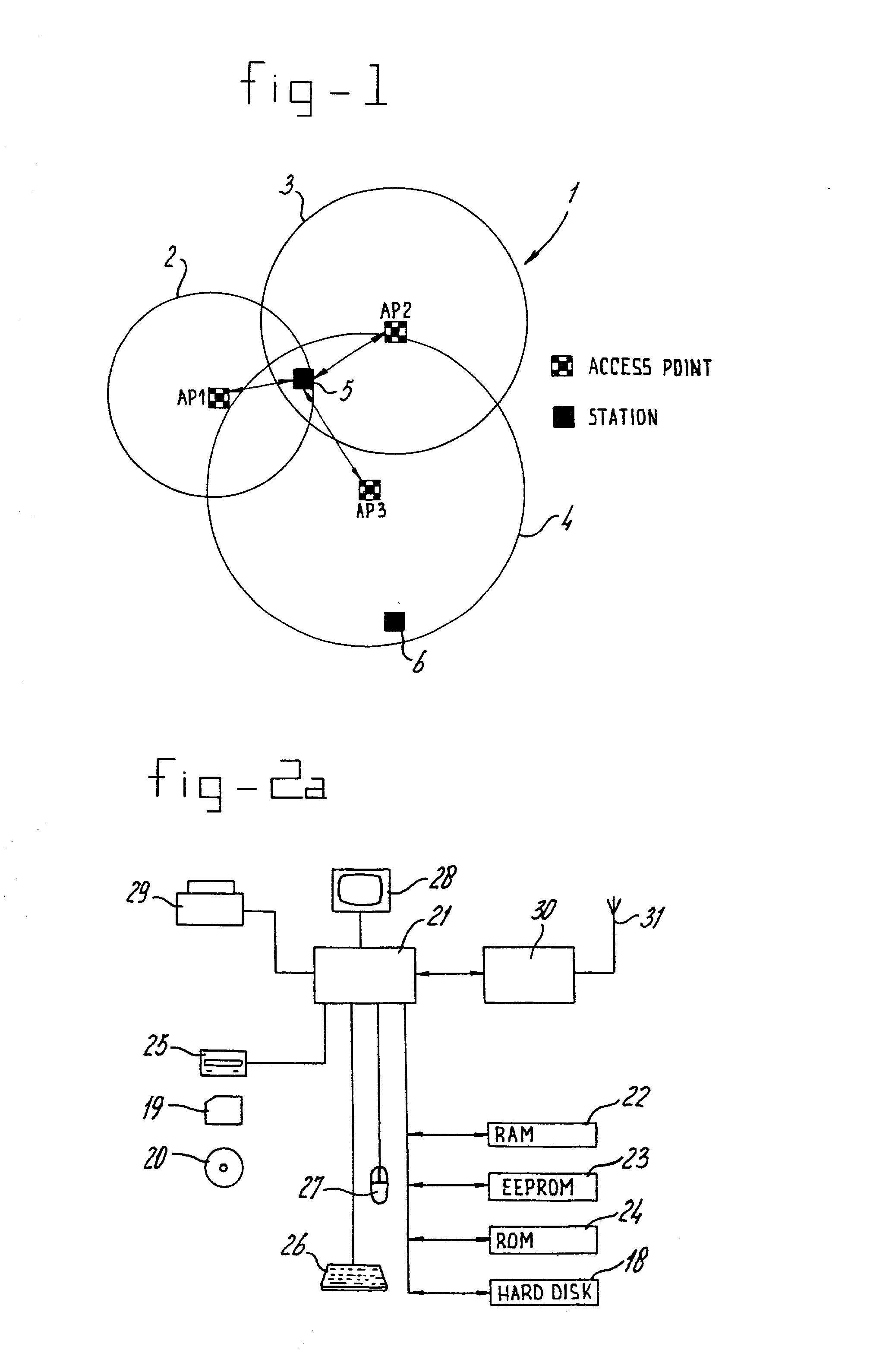
[0066] FIG. 1 shows a schematic overview of a wireless LAN 1 in which the invention is implemented. The wireless LAN 1 includes a number of access points of which three access points are shown AP1, AP2, AP3. These access points serve as access point for their respective cells 2, 3, 4 which are each schematically depicted by a circle around their respective access point. In the LAN 1 a plurality of network stations 5, 6 is present of which two are shown. Each access point AP1, AP2, AP3 is connected (not shown) via suitable I / O means to a wired distribution network for communication with other access points. In LAN 1 the actual number of network stations 5 may be 0 (zero) or more. The network stations 5, 6 may be mobile or at fixed positions: they all connect to the network 1 by means of wireless data-communication. In this embodiment of the invention the network stations 5, 6 are represented by personal computers, but it is to be understood that the network stations may be any type o...
PUM
 Login to View More
 Abstract
Description
Claims
Application Information
 Login to View More