
Sheet material including a surface fastener
a surface fastener and sheet material technology, applied in the direction of hose connection, snap fastener, buckle, etc., can solve the problems of cumbersome use of twist ties, wires and strings, difficult to remove and reattach,
- Summary
- Abstract
- Description
- Claims
- Application Information
AI Technical Summary
Benefits of technology
Problems solved by technology
Method used
Image

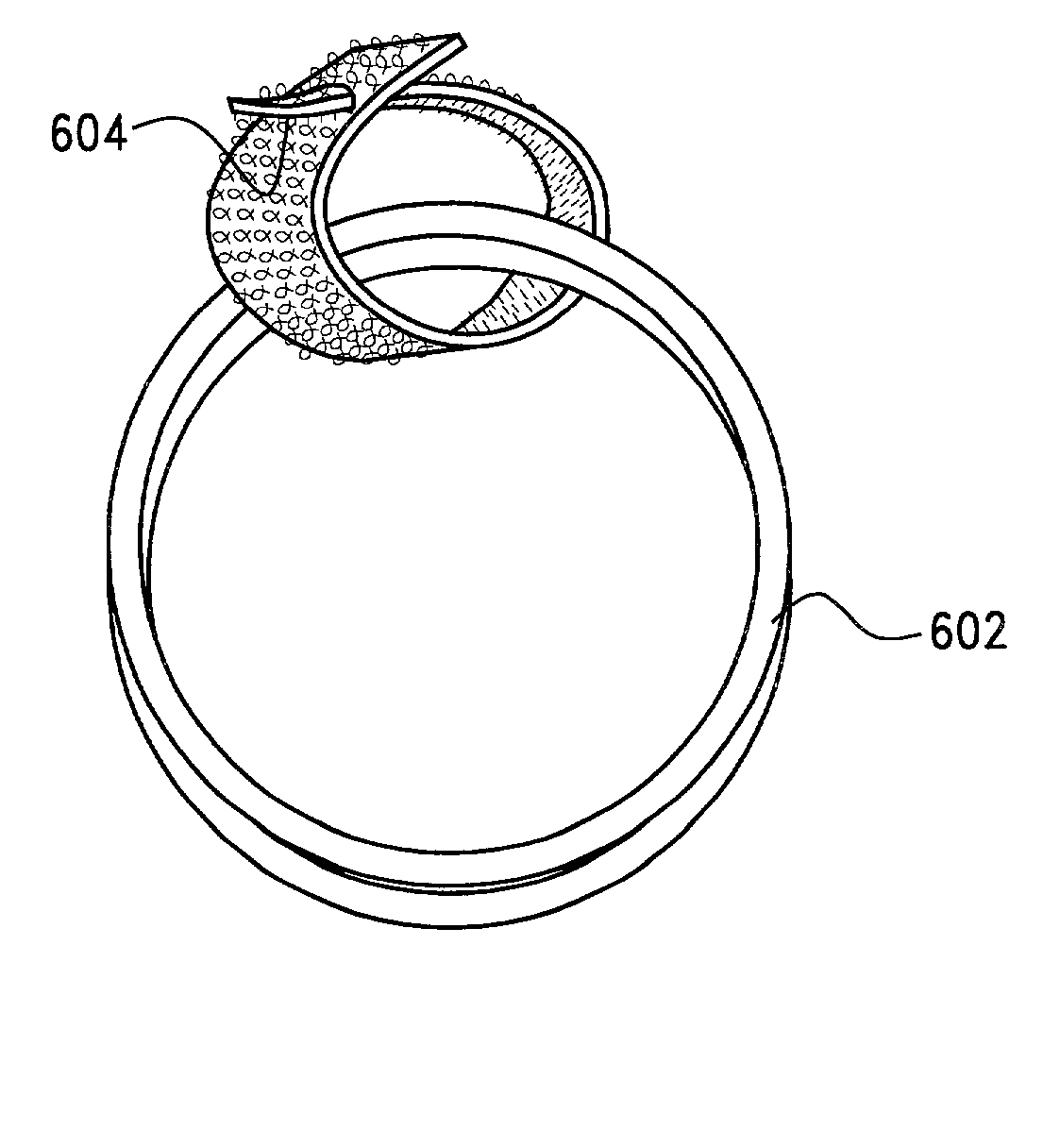
Examples
first embodiment
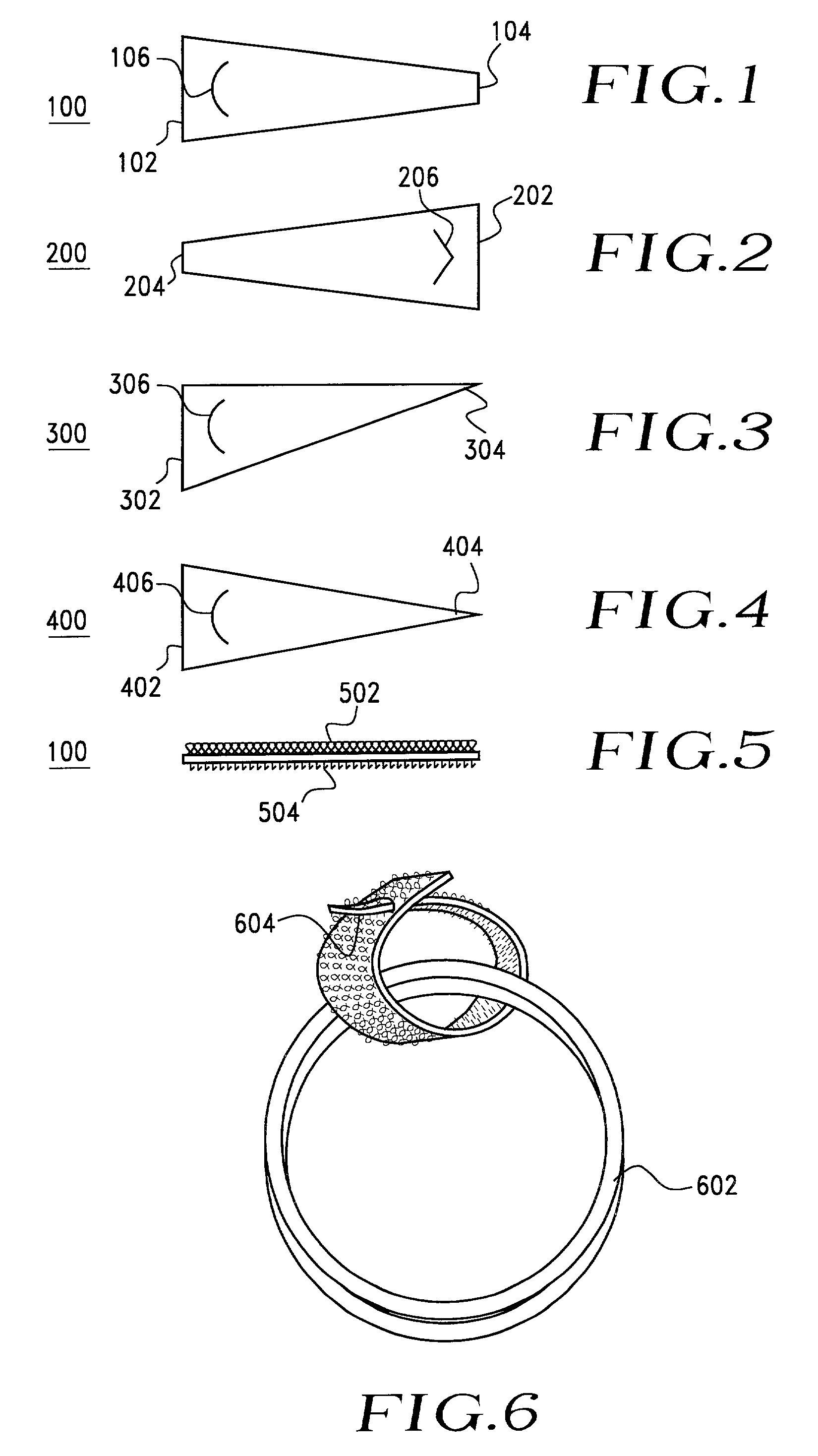
[0040] FIG. 1 shows the bundling strap 100. The strap 100 includes a narrow end 104 and a wide end 102 having an arch shaped slit 106. The slit 106 allows for a substantial portion of the strap 100 beyond the narrow end 104 to be pulled through. Slit 106 also reduces waste and increases production efficiency because no excess material is created during strap 100 production. The strap 100 is generally trapezoidal in shape. This shape allows for multiple straps to be cut from a single sheet of material without wasting surface area of the sheet. Compared to a strap having a rectangular shape, a strap having a generally triangular shape allows for more bundling straps 100 to be cut per surface area of a sheet.
second embodiment
[0041] FIG. 2 shows the bundling strap 200. The strap 200 includes a narrow end 204 and a wide end 202 having a V-shaped slit 206. The V-shaped slit 206 allows for a substantial portion of the strap 200 beyond the narrow end 204 to be pulled through. The slit 206 also reduces waste and production efficiency because no excess material is created during strap 200 production. The strap 200 is generally trapezoidal in shape.
third embodiment
[0042] FIG. 3 shows the bundling strap 300. The strap 300 is generally shaped as a right triangle and includes a narrow end 304 and a wide end 302 including an arch shaped slit 306. FIG. 4 shows a forth embodiment of the bundling strap 400. The strap 400 is generally shaped as an isosceles triangle and includes a narrow end 404 and a wide end 402 having an arch shaped slit 406. In all four embodiments described above, an arch shaped slit 106 or a V-shaped slit 206 are shown as a preferred aperture for pulling the narrow end 104 through the wide end 102. However, any slit shape or aperture may be used. For example, a circular aperture or other geometric shape will function to perform the intended purpose, but a slit is preferred due to the greater fastening ability created by the friction of a smaller aperture.
[0043] FIG. 5 shows a side view of any of the above embodiments of the bundling strap (100) shown in FIGS. 1-4. Loops 502 are shown on a first surface of the strap 100 while ho...
PUM
 Login to View More
 Abstract
Description
Claims
Application Information
 Login to View More