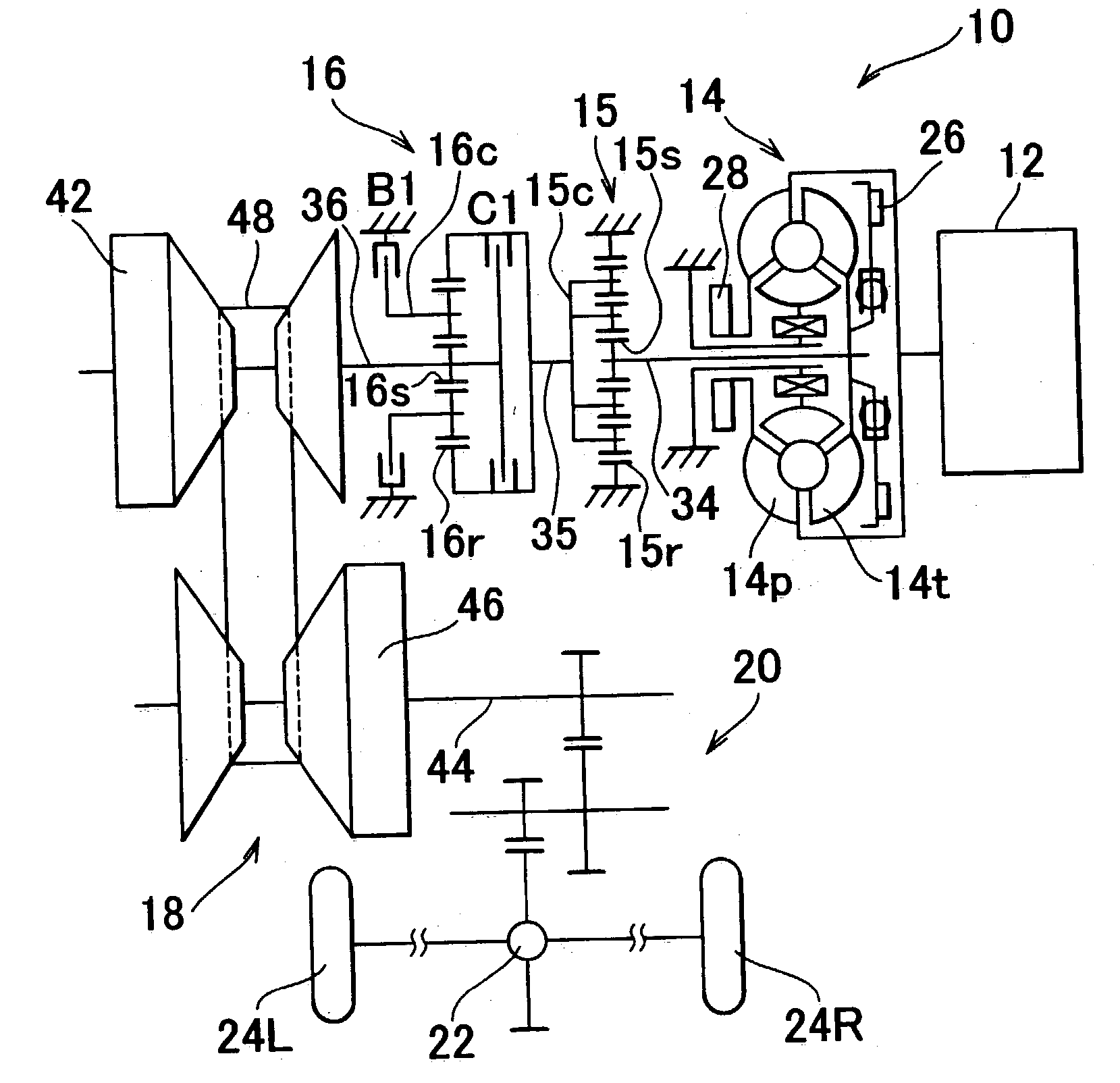
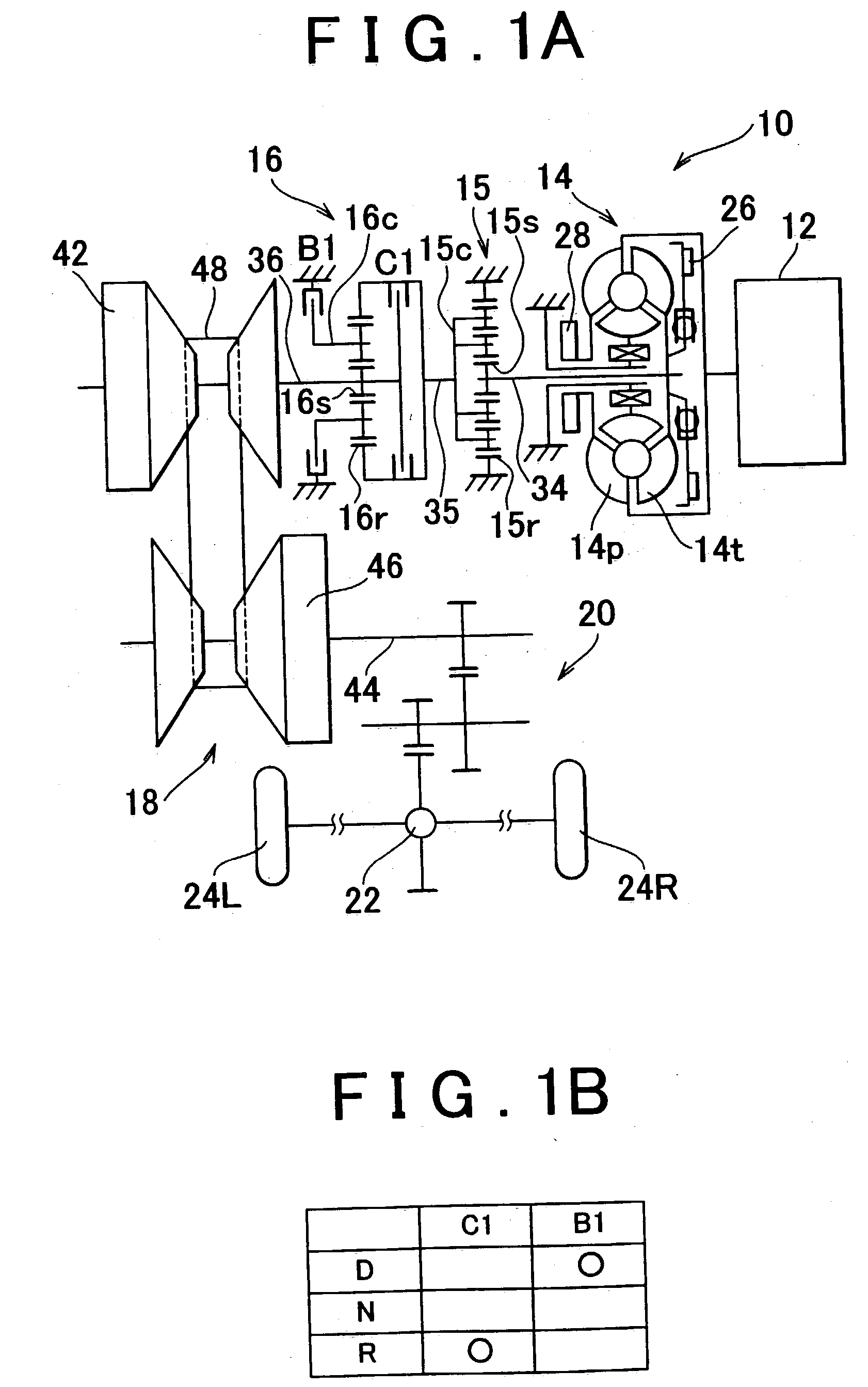
[0008] To accomplish the above object, there is provided according to the invention a driving system of a motor vehicle, comprising: (a) a driving power source that generates power, (b) a belt-and-pulley type continuously variable transmission that transmits the power received from the driving power source to a
drive wheel while changing a first speed of rotation of an input shaft thereof to a second speed of rotation of an output shaft thereof, and (c) a speed changing mechanism provided between the driving power source and the continuously variable transmission so as to increase or reduce a speed of rotation of the driving power source during forward running of the vehicle.
[0009] In the driving system of the motor vehicle as described above, the speed changing mechanism is provided between the driving power source and the belt-and-pulley type continuously variable transmission, for increasing or reducing the speed of rotation of the driving power source during forward running of the vehicle. Thus, the speed changing mechanism is able to increase or reduce the torque of the driving power source and transmit the resulting torque to the continuously variable transmission. It is therefore possible to employ a common belt-and-pulley type continuously variable transmission for use with a plurality of types of driving power sources having different output characteristics, e.g., different torque characteristics, if, for example, the
maximum torque applied to the continuously variable transmission is made substantially equal. This leads to a reduction in the overall manufacturing cost.
[0011] In the above-described driving system, the speed changing mechanism includes at least one planetary gear set and has a forward-drive / reverse-drive switching function. The driving system thus constructed is simpler in construction and is available at a reduced cost, as compared with the case where a speed changing device and a forward-drive / reverse-drive switching device are provided independently of or separately from each other.
[0013] In the driving system as described above, the driving power source is in the form of a
diesel engine that generally outputs large torque at a lower rotational speed region than a
gasoline engine. In the case where the diesel engine is used as the driving power source, the power of the diesel engine is transmitted to the belt-and-pulley type continuously variable transmission while the speed of rotation of the engine is increased by the speed changing mechanism, whereby the torque applied to the continuously variable transmission is reduced. Thus, the
maximum torque transmitted from the diesel engine to the continuously variable transmission can be made equivalent to the
maximum torque transmitted from the
gasoline engine provided that the maximum power is substantially at the same level. Furthermore, the degree of variations in the torque is reduced as the torque is reduced with the increase in the rotational speed as described above. Thus, the belt-and-pulley type continuously variable transmission used in a diesel-engine vehicle can be made substantially as compact as that used in a gasoline-engine vehicle, and power loss due to large belt clamping force that would be otherwise required for the diesel-engine vehicle is reduced, thus assuring improved fuel economy.
[0018] For example, the belt-and-pulley type continuously variable transmission may include a pair of variable pulleys whose groove widths are variable, and a
transmission belt that is wound around the variable pulleys. In operation, the continuously variable transmission transmits the power by utilizing friction generated between the
transmission belt and the variable pulleys. Also, the continuously variable transmission is arranged to control the belt clamping force produced by one of the variable pulleys by means of, for example, a
hydraulic cylinder, so as to avoid belt slippage, and control the
groove width of the other variable pulley by means of, for example, a
hydraulic cylinder, so as to establish a desired speed ratio.



 Login to View More
  Login to View More