
Modified 2' and 3'-nucleoside prodrugs for treating Flaviviridae infections
a technology of nucleosides and antibiotics, applied in the field of pharmaceutical chemistry, can solve the problems of significant economic losses worldwide, severe flu-like symptoms, and significant pestivirus exposure, and achieve the effect of determining the activity spectrum and inhibiting the activity of flaviviridae polymeras
- Summary
- Abstract
- Description
- Claims
- Application Information
AI Technical Summary
Benefits of technology
Problems solved by technology
Method used
Image

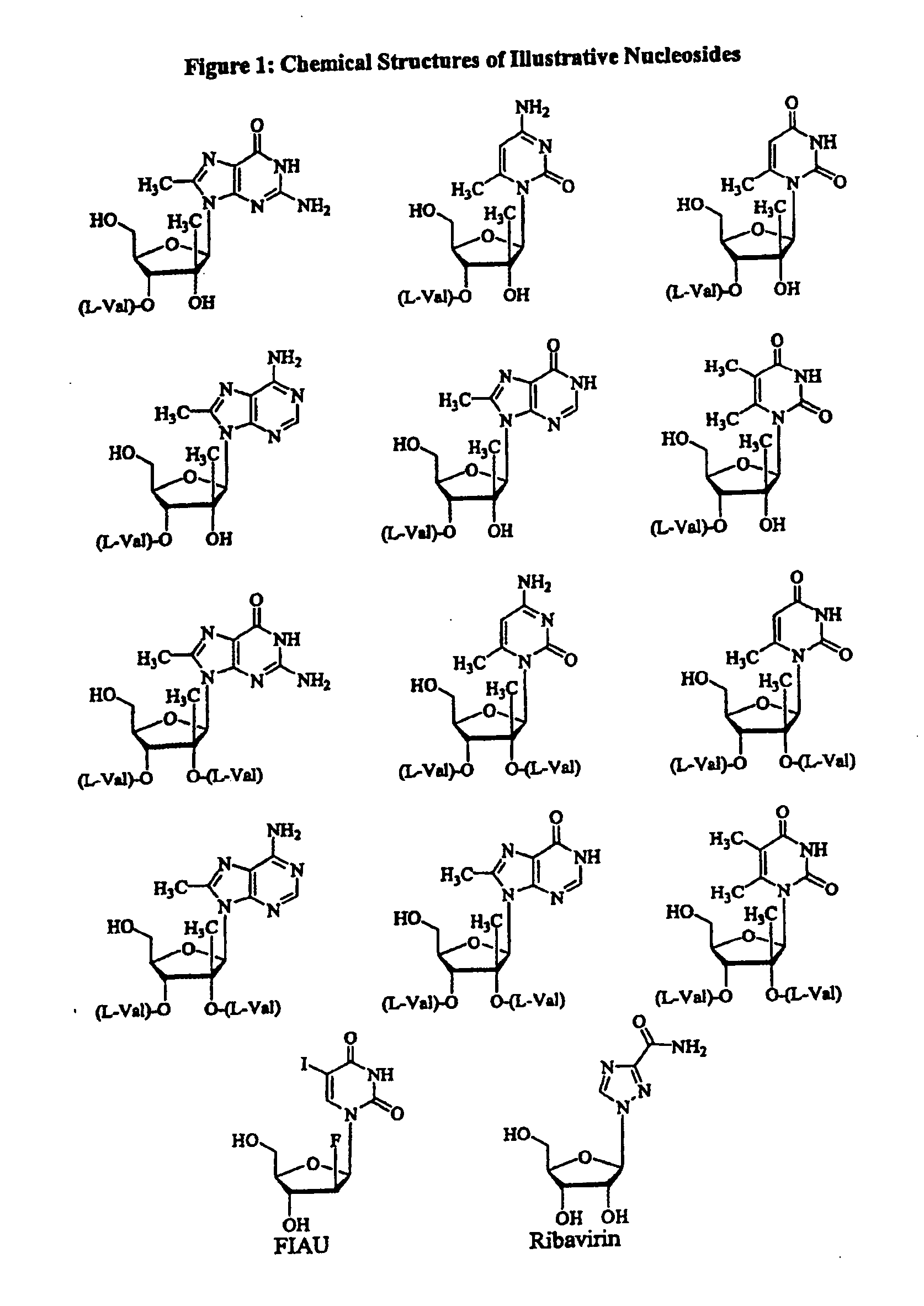
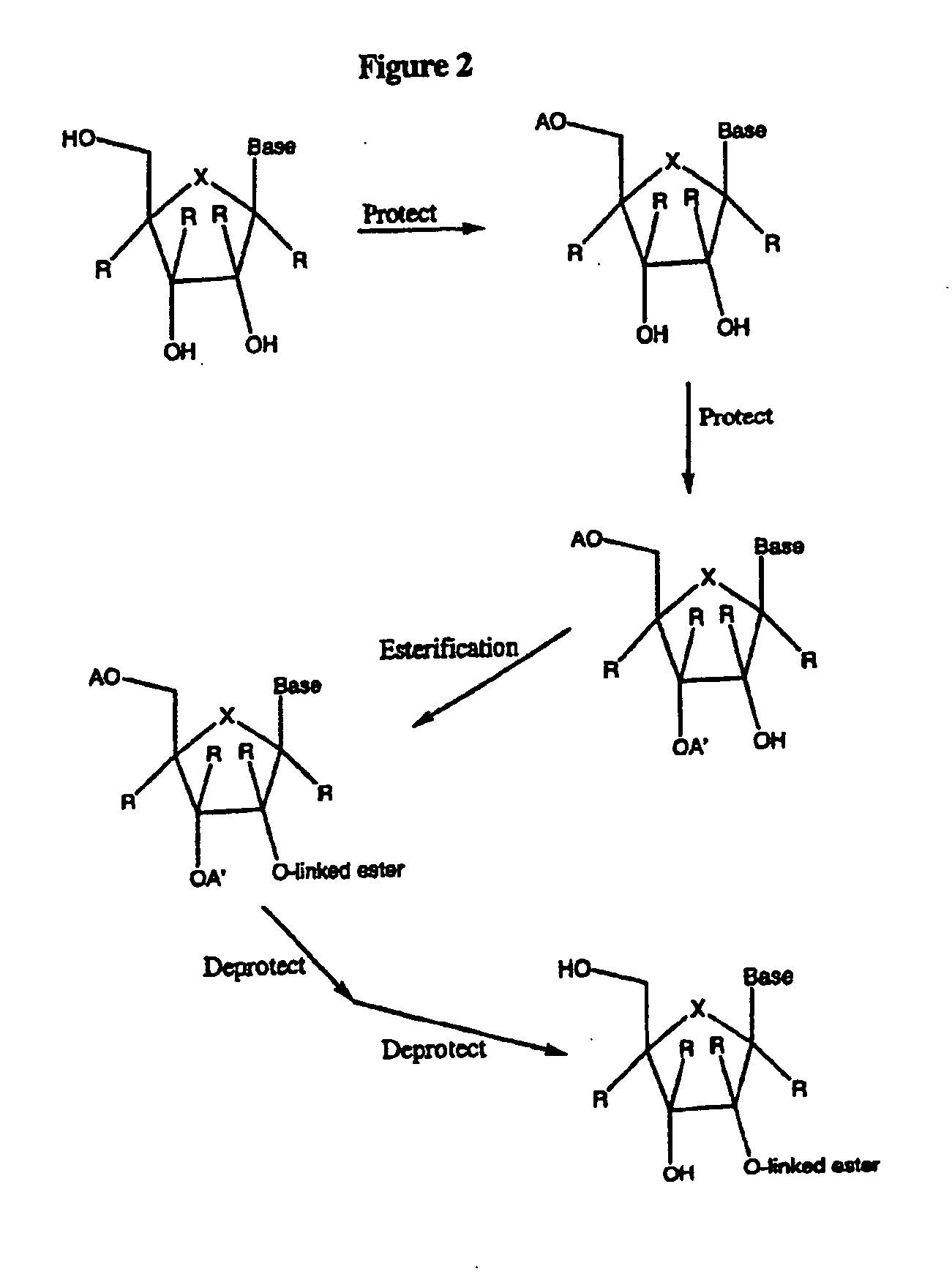
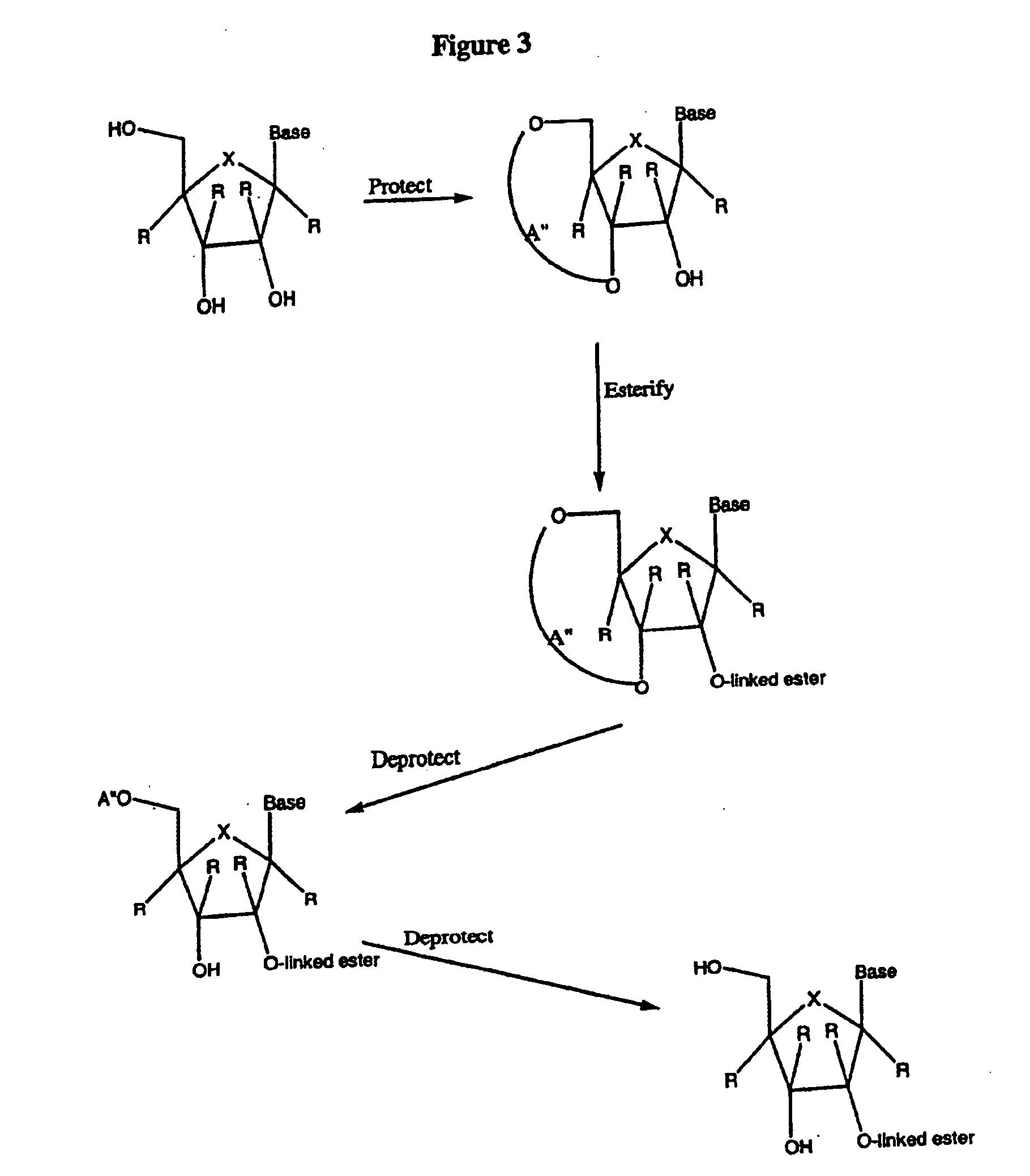
Examples
example 1
Preparation of 1′-C-methylriboadenine via 6-amino-9-(1-deoxy-β-D-psicofuranosyl)purine
[0566] Melting points were determined on a Mel-temp II apparatus and are uncorrected. NMR spectra were recorded on a Bruker 400 AMX spectrometer at 400 MHz for 1H NMR and 100 MHz for 13C NMR with TMS as internal standard. Chemical shifts (δ) are reported in parts per million (ppm), and signals are reported as s (singlet), d (doublet), t (triplet), q (quartet), m (multiplet), or bs (broad singlet). IR spectra were measured on a Nicolet 510P FT-IR spectrometer. Mass spectra were recorded on a Micromass Autospec high-resolution mass spectrometer. TLC were performed on Uniplates (silica gel) purchased from Analtech Co. Column chromatography was performed using either silica gel-60 (220-440 mesh) for flash chromatography or silica gel G (TLC grade, >440 mesh) for vacuum flash column chromatography. UV spectra were obtained on a Beckman DU 650 spectrophotometer. Elemental analysis was performed by Atlan...
example 2
Preparation of 2′-C-Methylribo-8-Methyladenine
[0570] The title compound was prepared according to a published procedure (R. E. Harry-O'kuru, J. M. Smith, and M. S. Wolfe, “A short, flexible route toward 2′-C-branched ribonucleosides”, J. Org. Chem. 1997, 62, 1754-1759) (Scheme 9).
[0571] The 3′-prodrug of the 2′-branched nucleoside was prepared according to published procedure (Synthetic Communications, 1978, 8(5), 327-333; J. Am. Chem. Soc., 1999, 121(24), 5661-5664). Alternatively, the 2′-branched nucleoside can be esterified without protection (Scheme 9b). Carbonyldiimidazole (377 mg, 2.33 mmol) was added to a solution of N-(tert-butoxycarbonyl)-L-valine (507 mg, 2.33 mmol) in 15 mL of anhydrous tetrahydrofuran. The mixture was stirred at 20° C. for one hour and at 50° C. for 10 minutes and then added to a solution of 4-Amino-1-(3,4-dihydroxy-5-hydroxymethyl-3-methyl-tetrahydro-furan-2-yl)-1H-pyrimidine-2-one (500 mg, 1.95 mmol), 4-(dimethylamino)pyridine (25 mg, 0.195 mmol), t...
example 3
Preparation of 3′-C-Methylribo-8-Methyladenine
[0573] The title compound can be prepared according to a published procedure (R. F. Nutt, M. J. Dickinson, F. W. Holly, and E. Walton, “Branched-chain sugar nucleosides. III. 3′-C-methyladenine”, J. Org. Chem. 1968, 33, 1789-1795) (Scheme 10).
[0574] In a similar manner, but using the appropriate sugar and purine bases, the following nucleosides of Formula XXXVI are prepared.
wherein R1, R2, R3, X1, X2, and Y are defined in Table 13.
Alternatively, the following nucleosides of Formula XXXVII are prepared, using the appropriate sugar and pyrimidine bases.
wherein R1, R2, R3, X1, X2, and Y are defined in Table 14.
Alternatively, the following nucleosides of Formula XXXVIII are prepared, using the appropriate sugar and pyrimidine or purine bases.
wherein R1, R2, R3, R6, X, and Base are defined in Table 15.
Alternatively, the following nucleosides of Formula XXXIX are prepared, using the appropriate sugar and pyrimidine or purine ...
PUM
| Property | Measurement | Unit |
|---|---|---|
| weight | aaaaa | aaaaa |
| temperature | aaaaa | aaaaa |
| volume | aaaaa | aaaaa |
Abstract
Description
Claims
Application Information
 Login to View More