
Non-aqueous electrolyte secondary battery
a non-aqueous electrolyte, secondary battery technology, applied in secondary cell servicing/maintenance, cell components, nickel compounds, etc., can solve the problems of increasing power consumption, nickel instability in the trivalent state, and need for developing non-aqueous electrolyte secondary batteries with higher energy densities, etc., to achieve more stable, improve heat stability, and improve stability
- Summary
- Abstract
- Description
- Claims
- Application Information
AI Technical Summary
Benefits of technology
Problems solved by technology
Method used
Image

Examples
example 1
(a) Inventive Example 1
[0071] Lithium carbonate (Li2CO3), nickel hydroxide (Ni(OH)2), manganese carbonate (MnCO3) and tungsten trioxide (WO3) were used as starting materials of the positive electrode active material.
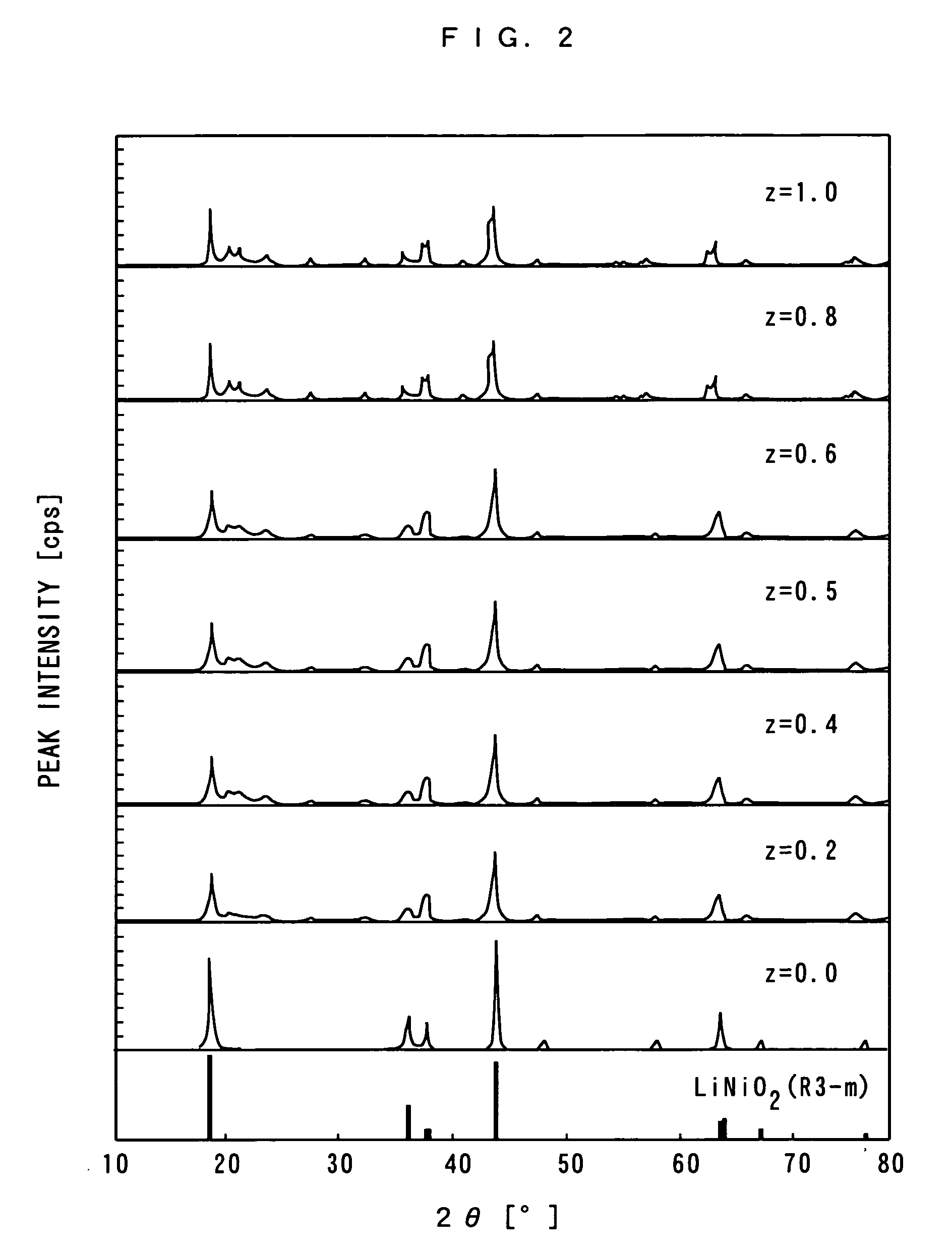
[0072] In this example, the above-mentioned lithium carbonate, nickel hydroxide, manganese carbonate and tungsten trioxide were mixed in a mole ratio of 3:4:0.5:z in this order. The above-mentioned z was set to a total of nine types of 0.0, 0.1, 0.2, 0.4, 0.5, 0.6, 0.8, 1.0 and 1.5 mol.
[0073] In addition, nine types of powders of positive electrode active materials obtained by mixing the above-mentioned materials were formed in the shape of pellets, respectively. After that, preliminary burning was carried out on each of these positive electrode active materials in the air atmosphere of 700° C. for ten hours and main burning was carried out in the air atmosphere of 800° C. for twenty hours.
[0074] Next, the respective positive electrode active materials obtained by car...
##ventive example 2
(b) Inventive Example 2
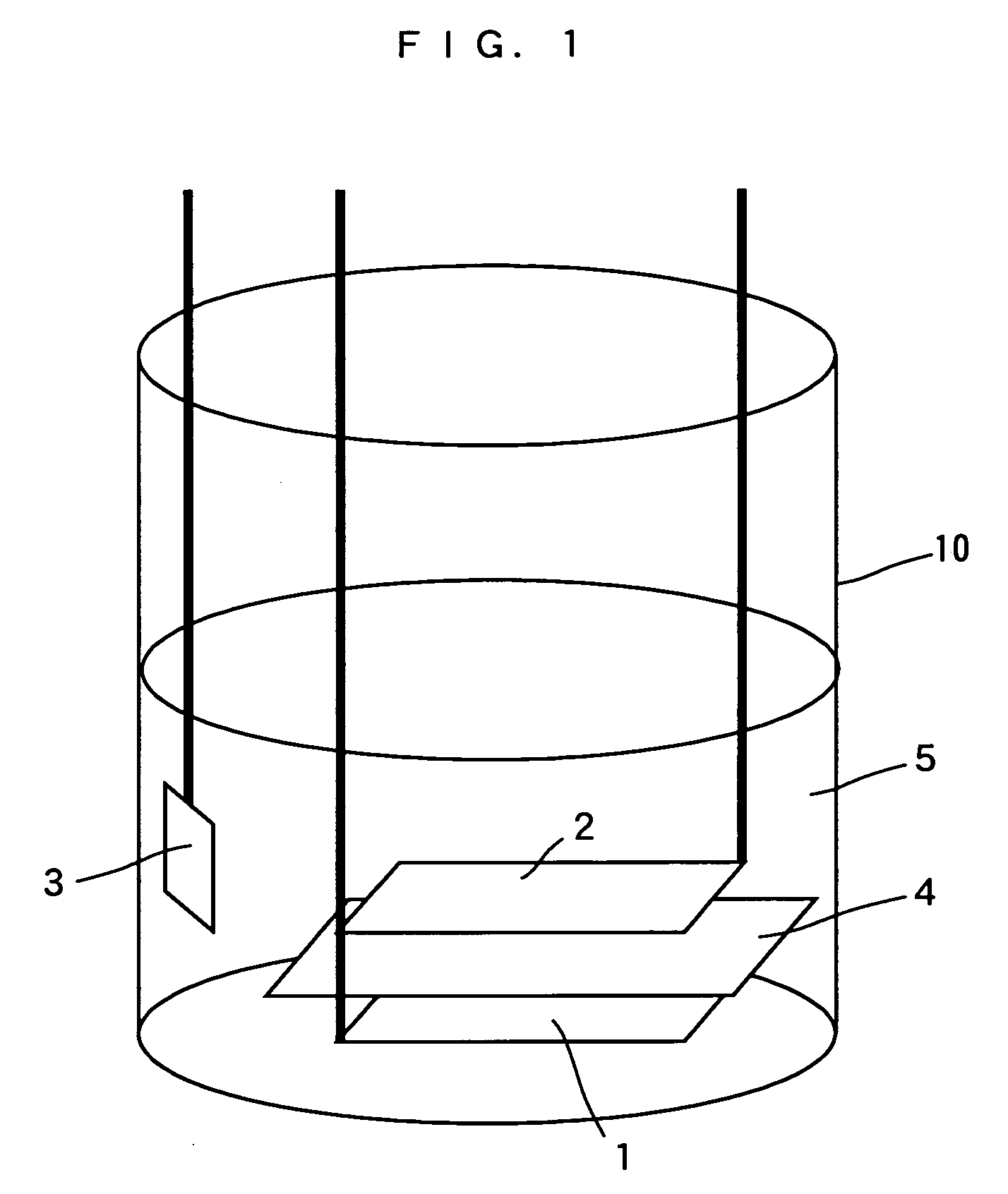
[0078] The non-aqueous electrolyte secondary batteries were fabricated using the respective positive electrode active materials obtained in the above-described Inventive Example 1 and charge and discharge tests were carried out respectively.
[0079] In addition, in Inventive Example 2, the positive electrode active material mentioned below was fabricated as a comparative example compared to Inventive Example 1 and a non-aqueous electrolyte secondary battery was fabricated using the fabricated positive electrode active material. First of all, the positive electrode active material of the comparative example is described.
[0080] In the comparative example, lithium carbonate (Li2CO3) and nickel hydroxide (Ni(OH)2) were used as starting materials of the positive electrode active material and mixed in a mole ratio of 1:2.
[0081] Furthermore, powders of the positive electrode active material obtained by mixing were formed in the shape of a pellet. After that, prelimi...
example 3
(c) Inventive Example 3
[0094] Lithium carbonate (Li2CO3), nickel hydroxide (Ni(OH)2), manganese carbonate (MnCO3) and tungsten trioxide (WO3) were used as starting materials of the positive electrode active materials.
[0095] In this example, the above-mentioned lithium carbonate, nickel hydroxide, manganese carbonate and tungsten trioxide were mixed in a mole ratio of 3:4:y:0.5 in this order. The above-mentioned y was set to a total of eight types of 0.0, 0.1, 0.2, 0.4, 0.6, 0.8, 1.0 and 1.5 mol.
[0096] Furthermore, eight types of powders of the positive electrode active materials obtained by mixing were formed in the shape of pellets, respectively. After that, burning was carried out on each of these positive electrode active materials in the air atmosphere of 800° C. for twenty hours.
[0097] Similarly to Inventive Example 2, the test cells of the non-aqueous electrolyte secondary batteries were fabricated using the resultant positive electrode active materials and charge and disch...
PUM
 Login to View More
 Abstract
Description
Claims
Application Information
 Login to View More