
Respiratory mask
- Summary
- Abstract
- Description
- Claims
- Application Information
AI Technical Summary
Benefits of technology
Problems solved by technology
Method used
Image

Examples
Embodiment Construction
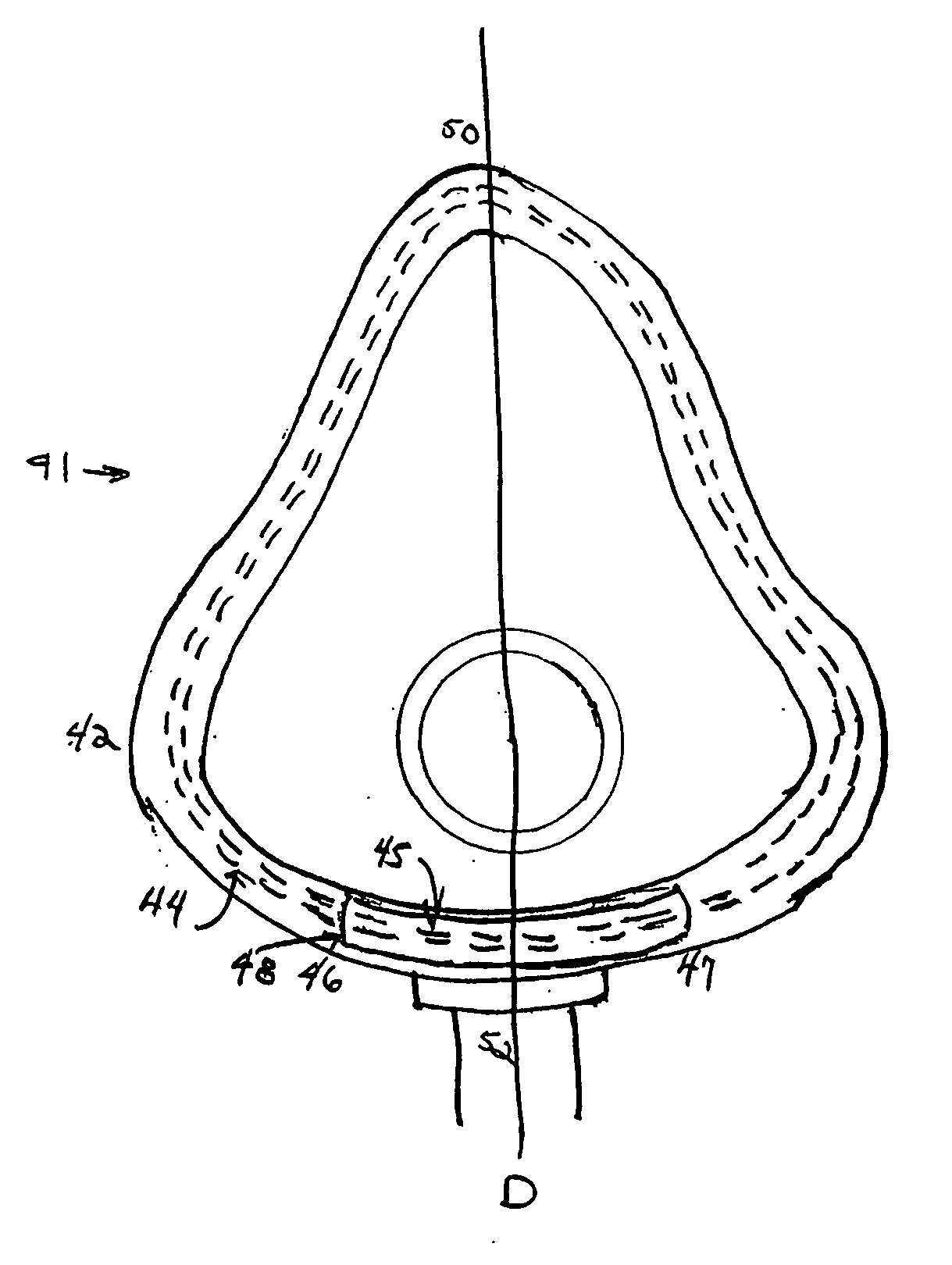
[0014] The present invention provides a system for stiffening, as described in more detail herein, a portion of the perimeter of a mask that has a formable element disposed about its perimeter. Referring to FIG. 4, one preferred embodiment of a full face mask 41 has a shell 42 constructed of a compliant and resilient material. A formable element 44 is disposed along the perimeter, and only the perimeter, of the shell 42. The formable element 44 can be affixed to the surface of the shell 42 but is molded within the shell 42 here. A portion 45 of the formable element 44 running along the wearer's chin from 46 to 47 is stiffened. It is stiffened in this preferred embodiment by molding a polycarbonate sleeve 48 over the portion 45 of the formable element 44 before the formable element 44, and polycarbonate sleeve 48, are molded in the shell 42. This causes the portion 45 of the formable element 44 to become more difficult to bend but not to be rigid, i.e., to be stiffened, compared to t...
PUM
 Login to View More
 Abstract
Description
Claims
Application Information
 Login to View More