
Method of aminoacylating tRNA
a technology of aminoacylated trna and aminoacylated trna, which is applied in the field of aminoacylated trna, can solve the problems of difficult to understand the functions of a number of proteins, and limited methods and other problems, to achieve the effect of efficient and highly practical
- Summary
- Abstract
- Description
- Claims
- Application Information
AI Technical Summary
Benefits of technology
Problems solved by technology
Method used
Image

Examples
example 1
Aminoacylation of tRNA Using Non-Ionic Micelle
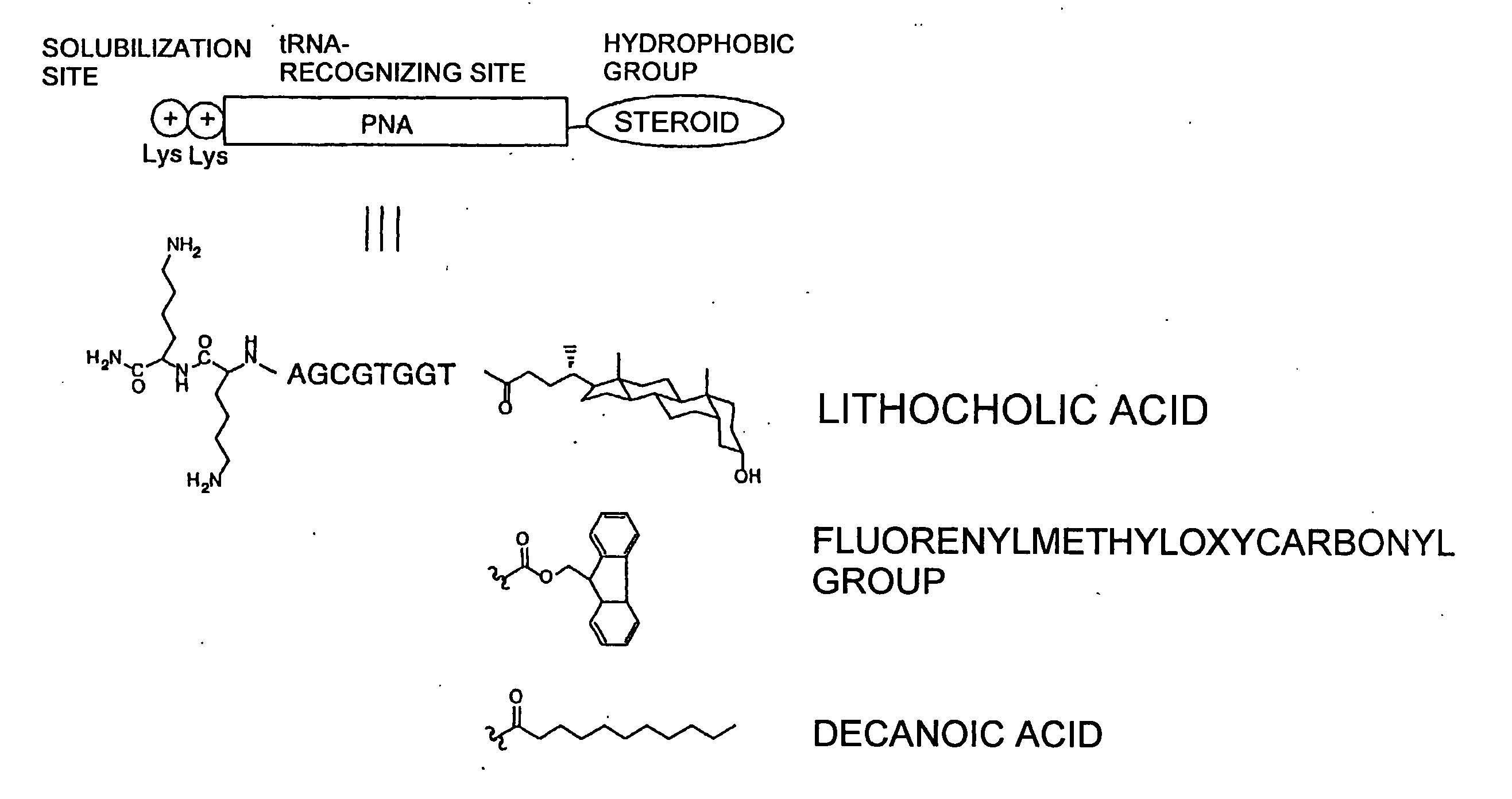
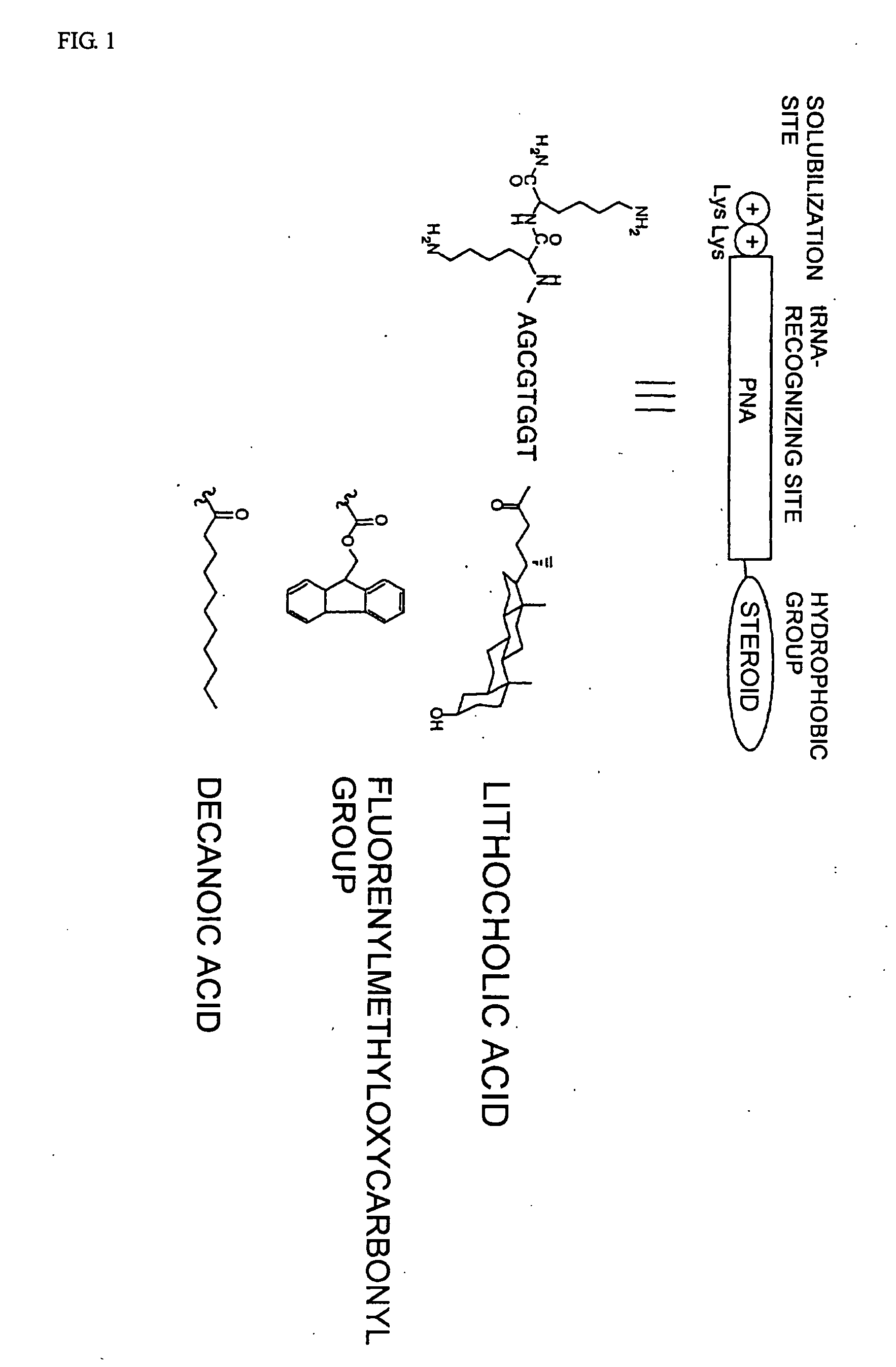
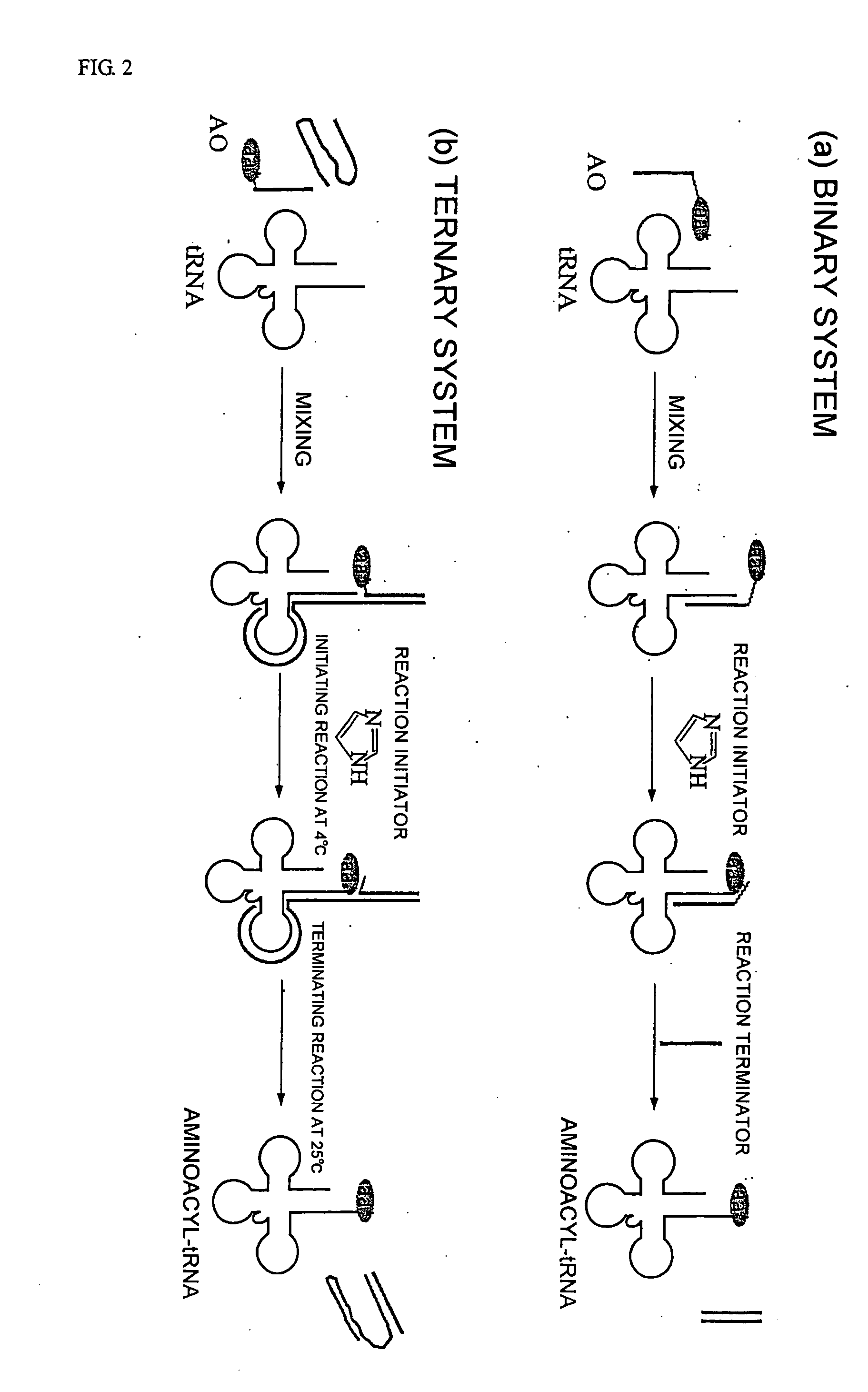
[0123] Using 2-naphthyl alanine having a naphthyl group at the side chain which has been subjected to an active esterification as a nonnatural amino acid, aminoacylation was carried out by reacting this 2-naphthyl alanine with a tRNA in the presence of a peptide nucleic acid (PNA). Incidentally, as the PNA, CGTGGT with a chain length n of 6, in which an Fmoc group and a LysLys group had been introduced as a hydrophobic group and a solubilization site, respectively, was used.
0.5 M Tween #205 μL(final concentration = 250 mM)Nvoc-napAla-OCM (11 μL(final concentration = 100 mM)M / toluene)4 M imidazole-AcOH,1 μL(final concentration = 400 mM)pH 6.50.4 mM tRNA2 μL(final concentration = 80 μM)0.8 mM Fmoc-PNA1 μL(final concentration = 80 μM)10 μL
[Operation procedure]
[0124] The imidazole buffer, then Tween #20 were added, and the mixture was micellized by ultrasonic wave. Then, the activated amino acid Nvoc-napAla-OCM was added and mixed by pip...
example 2
Aminoacylation of tRNA Using Non-Ionic Micelle
[0129] A reaction and a post-treatment were carried out in exactly the same manner as in Example 1 except for changing the composition of the reaction solution for aminoacylation as described below. The obtained product was analyzed in the same manner as in Example 1, whereby a similar result to that of Example 1 was obtained. The yield was 13%.
0.5 M Tween #405 μL(final concentration = 250 mM)Nvoc-napAla-OCM (11 μL(final concentration = 100 mM)M / toluene)4 M imidazole-AcOH,1 μL(final concentration = 400 mM)pH 6.50.4 mM tRNA2 μL(final concentration = 80 μM)0.8 mM Fmoc-PNA1 μL(final concentration = 80 μM)10 μL
example 3
Aminoacylation of tRNA Using Cationic Micelle
[0130]
20 mM CTAC1 / 100 mM imidazole (pH 7.5)18μL100 mM Pentenoyl-napAla-OCM / DMF1μL200 μM tRNA1μL20μL
[0131] The foregoing reaction solution was mixed for 10 minutes using a vortex mixer. In addition, the solution on the sidewall was brought down by centrifugation with a bench centrifuge every time when mixing is carried out for 20 to 40 seconds. To the reaction solution, 60 μL of 1.5 M AcOK was added, and 80 μL of phenol / chloroform (1:1) was further added and the mixture was mixed with a vortex mixer for several seconds (it turned out to be a white suspension). Then, the mixture was centrifuged at 15,000 rpm for several seconds at 4° C. and the supernatant was recovered. To the recovered supernatant, 80 μL of CHCl3 / i-PrOH (24:1) was added and the mixture was mixed with a vortex mixer for several seconds (it turned out to be a white suspension). In the same manner as above, the mixture was centrifuged at 15,000 rpm for several seconds at 4°...
PUM
| Property | Measurement | Unit |
|---|---|---|
| reaction temperature | aaaaa | aaaaa |
| temperature | aaaaa | aaaaa |
| temperature | aaaaa | aaaaa |
Abstract
Description
Claims
Application Information
 Login to View More