Check patentability & draft patents in minutes with Patsnap Eureka AI!

Staggering forward and reverse wireless channel allocation timing

a wireless channel and timing technology, applied in the field of wireless telecommunication systems, can solve the problems of scarce wireless channels, and achieve the effect of sending more quickly

Inactive Publication Date: 2009-01-29
IPR LICENSING INC
View PDF19 Cites 5 Cited by
  • Summary
  • Abstract
  • Description
  • Claims
  • Application Information

AI Technical Summary

Benefits of technology

"The patent describes a way to send and receive messages in a wireless communication network. By staggering the timing of when channels are allocated for sending and receiving, the network can send and receive messages faster. This is because the timing intervals for when channels are allocated are not concurrent, so a return message can be sent more quickly. This allows for quicker communication between devices in the network."

Problems solved by technology

The wireless channels, however, are a scarce resource, and are therefore allocated by a scheduler among the subscriber access units served by the base station processor.

Method used

the structure of the environmentally friendly knitted fabric provided by the present invention; figure 2 Flow chart of the yarn wrapping machine for environmentally friendly knitted fabrics and storage devices; image 3 Is the parameter map of the yarn covering machine
View more

Image

Smart Image Click on the blue labels to locate them in the text.
Viewing Examples
Smart Image
  • Staggering forward and reverse wireless channel allocation timing
  • Staggering forward and reverse wireless channel allocation timing
  • Staggering forward and reverse wireless channel allocation timing

Examples

Experimental program
Comparison scheme
Effect test

Embodiment Construction

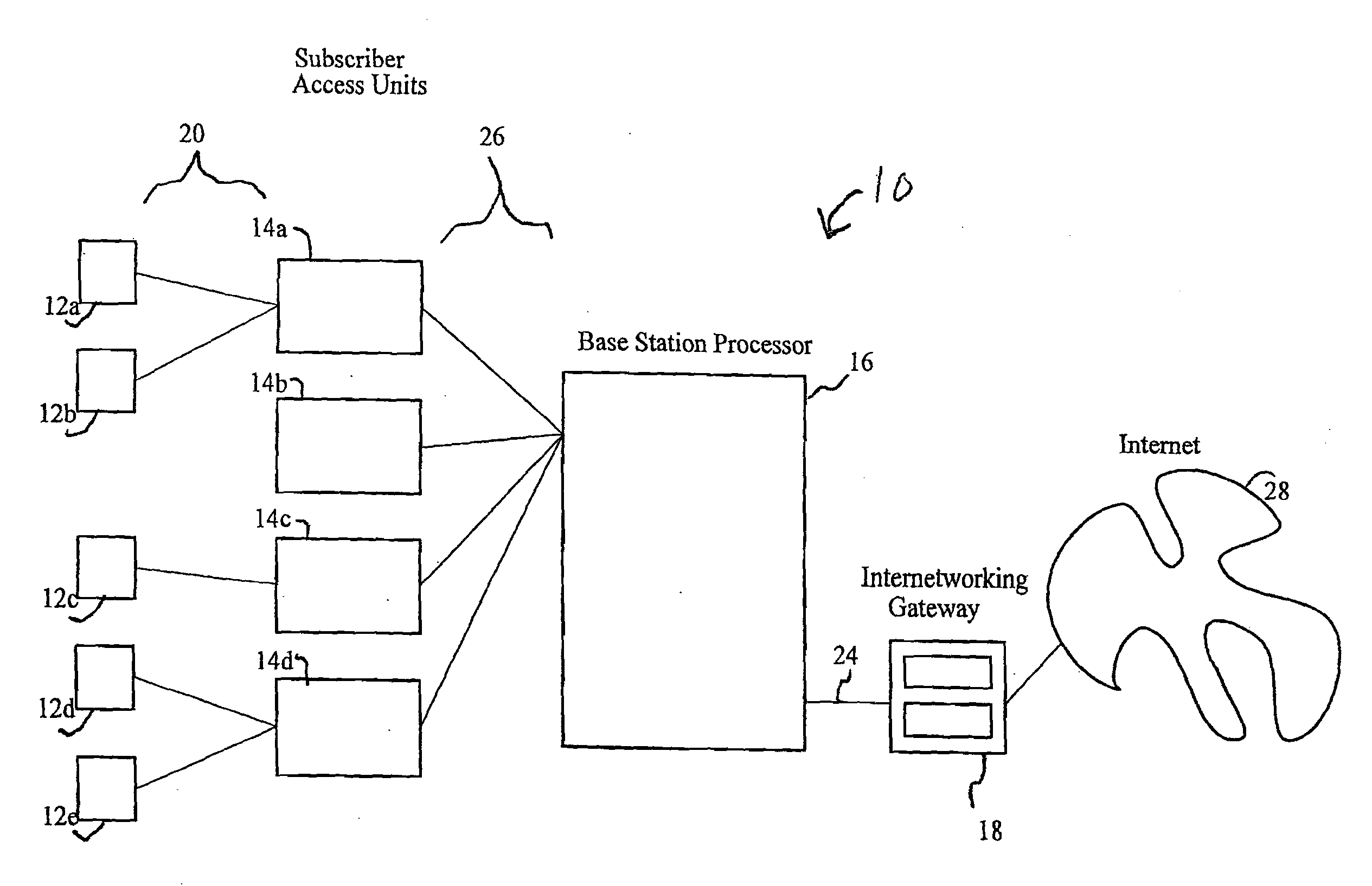
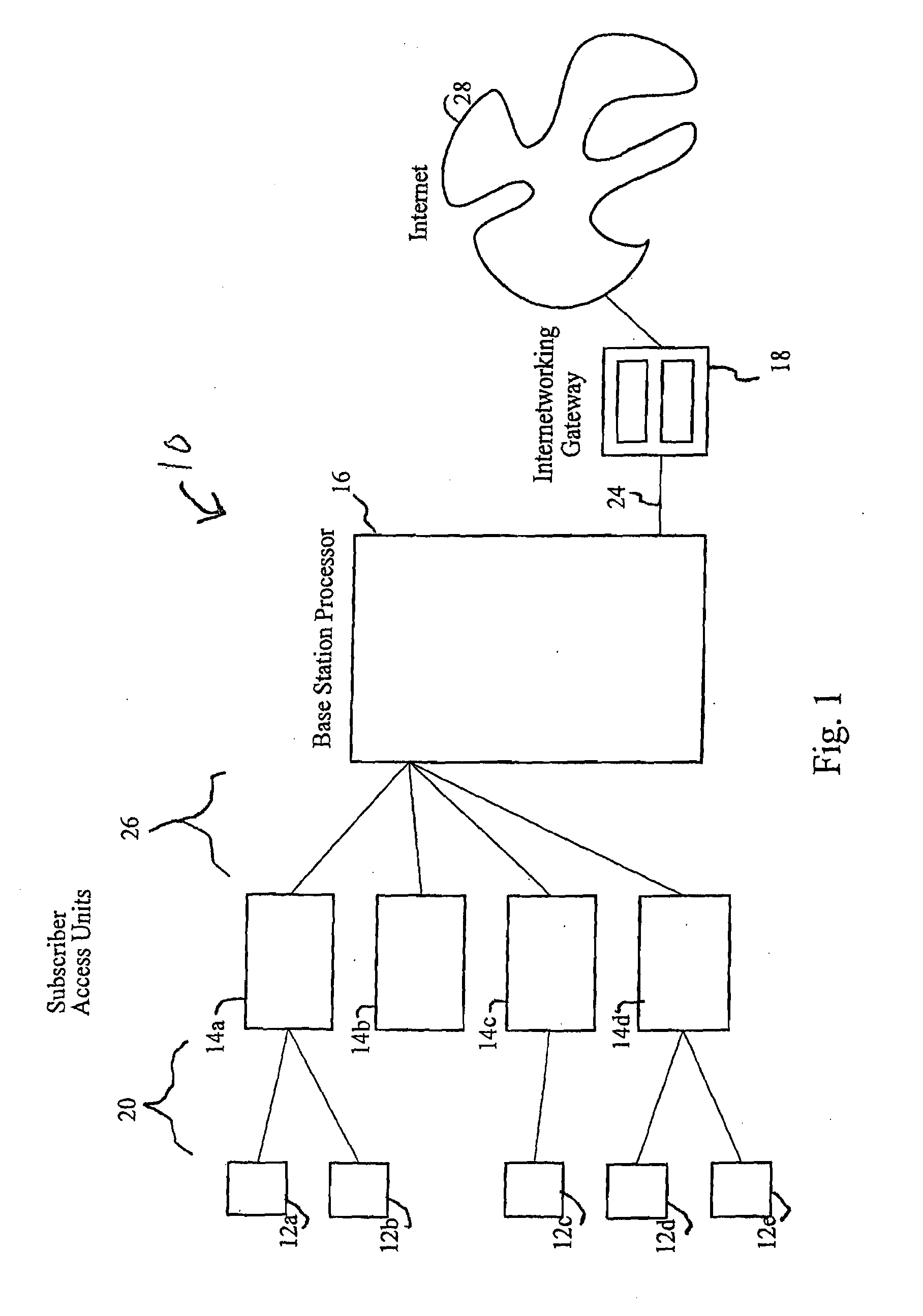
[0016]FIG. 1 shows a wireless telecommunications system suitable for performing staggered forward and reverse channel allocation. A plurality of user PCs 12a-12e are each in communication with a subscriber access unit (SAU) 14a-d via a wired connection 20. The wired connection typically conforms to a wired protocol such as TCP / IP or UDP / IP.

[0017]The subscriber access units 14a-14d are in wireless communication with a base station processor (13SP) 16 via a wireless link 26. The wireless link 26 conforms to a wireless protocol such as IS 95 or another wireless protocol which supports communication via an RF medium. The base station processor 16 is also connected to a public access network 18 such as the Internet, via an internetworking gateway 24. The internetworking gateway is typically a bridge, router, or other connection to a network backbone, and may be provided by a remote provider such as an Internet Services Provider (ISP). In this manner, an end user at the user PC 12 is prov...

the structure of the environmentally friendly knitted fabric provided by the present invention; figure 2 Flow chart of the yarn wrapping machine for environmentally friendly knitted fabrics and storage devices; image 3 Is the parameter map of the yarn covering machine
Login to View More

PUM

No PUM Login to View More

Abstract

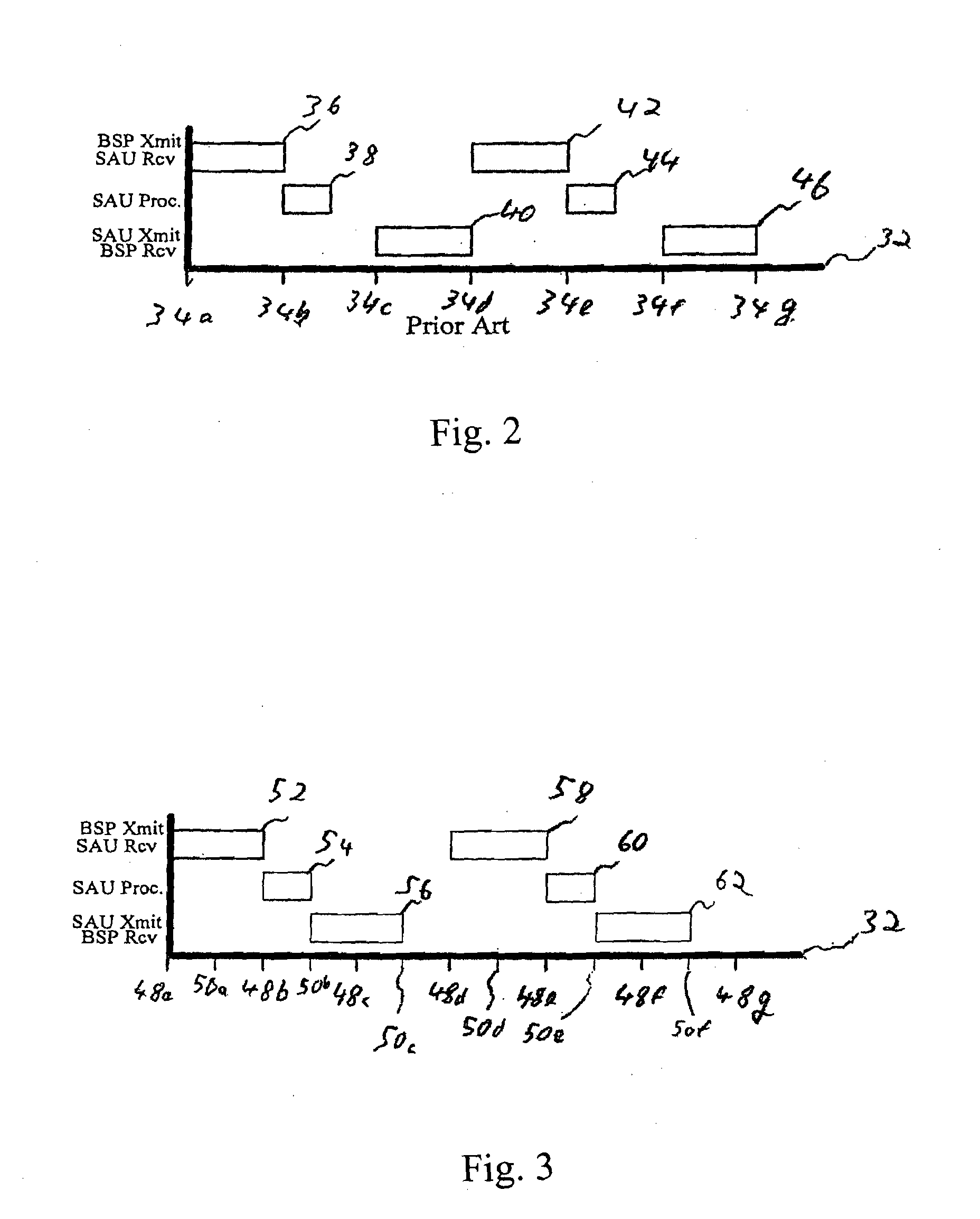
An apparatus and method for staggering forward and reverse channel time slot allocation in a wireless communication allows a wireless communication unit, such as a base station processor or a subscriber access unit, to transmit a return message in less than a full time slot interval. Forward and reverse channel allocation occurs as a cycle of time slots occurring at periodic timing intervals. Transmission of a wireless frame carrying a message payload occurs at the beginning of the time slot. Since the forward and reverse channel allocation cycles need not be concurrent, or in phase, these cycles may be staggered with respect to each other. By staggering the forward and reverse channel allocation timing interval, the return message is sent after only a portion of a full timing interval, rather than being delayed up to one complete timing interval.

Description

CROSS REFERENCE TO RELATED APPLICATIONS[0001]This application is a continuation of U.S. patent application Ser. No. 09 / 691,874 filed Oct. 19, 2000, which is incorporated by reference as if fully set forth.BACKGROUND[0002]In a wireless telecommunication system, radio channels provide a physical link between communication units. The wireless communication units in such a system typically include a base station processor in communication with a network such as the Public Switchboard Telephone Network (PSTN), in the case of voice communication, or a data network, in the case of data communication, and one or more subscriber access units in communication with a plurality of end user computing devices, such as user PCs. The wireless channels include forward channels, for message transmission from the base station processor to the subscriber access units, and reverse channels, for message transmission to the base station processor from the subscriber access units.[0003]In the case of a wir...

Claims

the structure of the environmentally friendly knitted fabric provided by the present invention; figure 2 Flow chart of the yarn wrapping machine for environmentally friendly knitted fabrics and storage devices; image 3 Is the parameter map of the yarn covering machine
Login to View More

Application Information

Patent Timeline
no application Login to View More
Patent Type & Authority Applications(United States)
IPC IPC(8): H04J3/00H04W24/00H04W72/00H04W72/04H04W72/12H04W76/02H04W92/02
CPCH04W72/1263H04W80/06
Inventor PROCTOR, JR., JAMES A.
Owner IPR LICENSING INC
Features
  • R&D
  • Intellectual Property
  • Life Sciences
  • Materials
  • Tech Scout
Why Patsnap Eureka
  • Unparalleled Data Quality
  • Higher Quality Content
  • 60% Fewer Hallucinations
Social media
Patsnap Eureka Blog
Learn More