Unlock instant, AI-driven research and patent intelligence for your innovation.

Mail sorter for simultaneous sorting using multiple algorithms

a sorter and algorithm technology, applied in the field of sorting of mail, can solve the problems of inefficiency of the mail delivery process (the last mile), no product has yet been manufactured and delivered to satisfy the need, and the equipment required to automate the process is simply too large to fit in the branches, so as to improve the efficiency of the operation, improve the degree of efficiency and sophistication, and improve the effect of efficiency

Active Publication Date: 2010-02-25
LOCKHEED MARTIN CORP
View PDF90 Cites 26 Cited by
  • Summary
  • Abstract
  • Description
  • Claims
  • Application Information

AI Technical Summary

Problems solved by technology

This requires carriers to spend substantial time merging and sorting the mail before they can start to deliver it, or else they must complete the merging while they are delivering the mail, thus making the mail delivery process (the last mile) quite inefficient.
To date, 16 years later, no product has yet been manufactured and delivered to satisfy that need.
The sorting is done there because the equipment required to automate this process is simply too large to fit in the branches.
The cost would be prohibitive for the USPS to install such equipment in each branch.
The sorters available on the market today have significant limitations: they are either huge, expensive pieces of equipment with a very large number of bins, and require significant space to operate; or they have a smaller number of bins, but require multiple passes to operate.
This multi-pass operation is a very labor-intensive process.
That means the operator must load the mail, operate the sorter, then unload the mail from each bin and re-load it into the feeder three times. While this results in some time savings compared to manual sorting, the value proposition is limited because of the high labor content.
Likewise, the manual method is still the most common method that enterprises use to sort their incoming mail; this is also very labor intensive, but the investment required and the size of available mail sortation equipment is generally prohibitive.
However, much of the tray storage and transporting is still done manually by postal employees pushing trolleys full of mail trays by hand.
Impressive as the Wallingford sorting operation is, there are several weaknesses in the current system, such as the following:1. Dozens of employees are required to simply move mail onto and off of trolleys, and move the trolleys from one point to another point in the facility multiple times.2. Each mail piece must be loaded onto a feeder belt so it can be fed into a sorter, and then unloaded from the sorter multiple times during the sorting process.3. Each trip through the sorter involves risks that the mail will jam, or be damaged by the automated processing equipment.
It is not uncommon for any single mail piece to go through one or more mail sorters 4 to 6 times. Each of these trips through the sorter increases the risk of jams or damage.4. Despite the large investments in automation, a relatively high proportion of the mail is still considered “non-machinable.” Currently, about 20% of the letter mail cannot be sorted automatically.
These manually sorting steps are a time consuming and costly process.
This step alone costs the USPS about $3 Billion each year in labor costs.5. There are a number of operations that are still done manually at Wallingford because the mail cannot be handled by the automated equipment.
Again, the manual operations are the most costly in the sorting operations.6. The sorting equipment has limited capacity and a finite number of pockets—which is the reason mail must be run through the sorters multiple times. Typically, the sorters are operated in different modes at different times of the day.
This not only requires a lot of labor, it also requires a lot of floor space for storing the mail.7. The 25 pieces of sorting equipment and the space around them to store trays of mail for processing multiple times all requires a huge footprint.
So, the managers have limited flexibility in how they use the equipment.

Method used

the structure of the environmentally friendly knitted fabric provided by the present invention; figure 2 Flow chart of the yarn wrapping machine for environmentally friendly knitted fabrics and storage devices; image 3 Is the parameter map of the yarn covering machine
View more

Image

Smart Image Click on the blue labels to locate them in the text.
Viewing Examples
Smart Image
  • Mail sorter for simultaneous sorting using multiple algorithms
  • Mail sorter for simultaneous sorting using multiple algorithms
  • Mail sorter for simultaneous sorting using multiple algorithms

Examples

Experimental program
Comparison scheme
Effect test

Embodiment Construction

[0057]An embodiment of the present invention will now be described, and it is to be understood that this description is for purposes of illustration only, and is not meant to limit the scope of the claimed invention. According to an embodiment of a mail sorting system, each mail piece is singulated, then captured by a clamp. From that point on, all mechanical operations act on the clamp, and the mail piece is not touched by either the operator or the sorter equipment. Because all the clamps are substantially identical in shape and composition, they can be manipulated by the machinery with a high degree of reliability. The present system is capable of handling the entire diversity of the shapes, sizes and weights of mail stream with a consistent reliability, and thus can also handle a wide variety of products that are needed to fulfill and order.

[0058]The present system automatically handles letters, flats, postcards, periodicals, odd shaped mail pieces, and even parcels up to a spec...

the structure of the environmentally friendly knitted fabric provided by the present invention; figure 2 Flow chart of the yarn wrapping machine for environmentally friendly knitted fabrics and storage devices; image 3 Is the parameter map of the yarn covering machine
Login to View More

PUM

No PUM Login to View More

Abstract

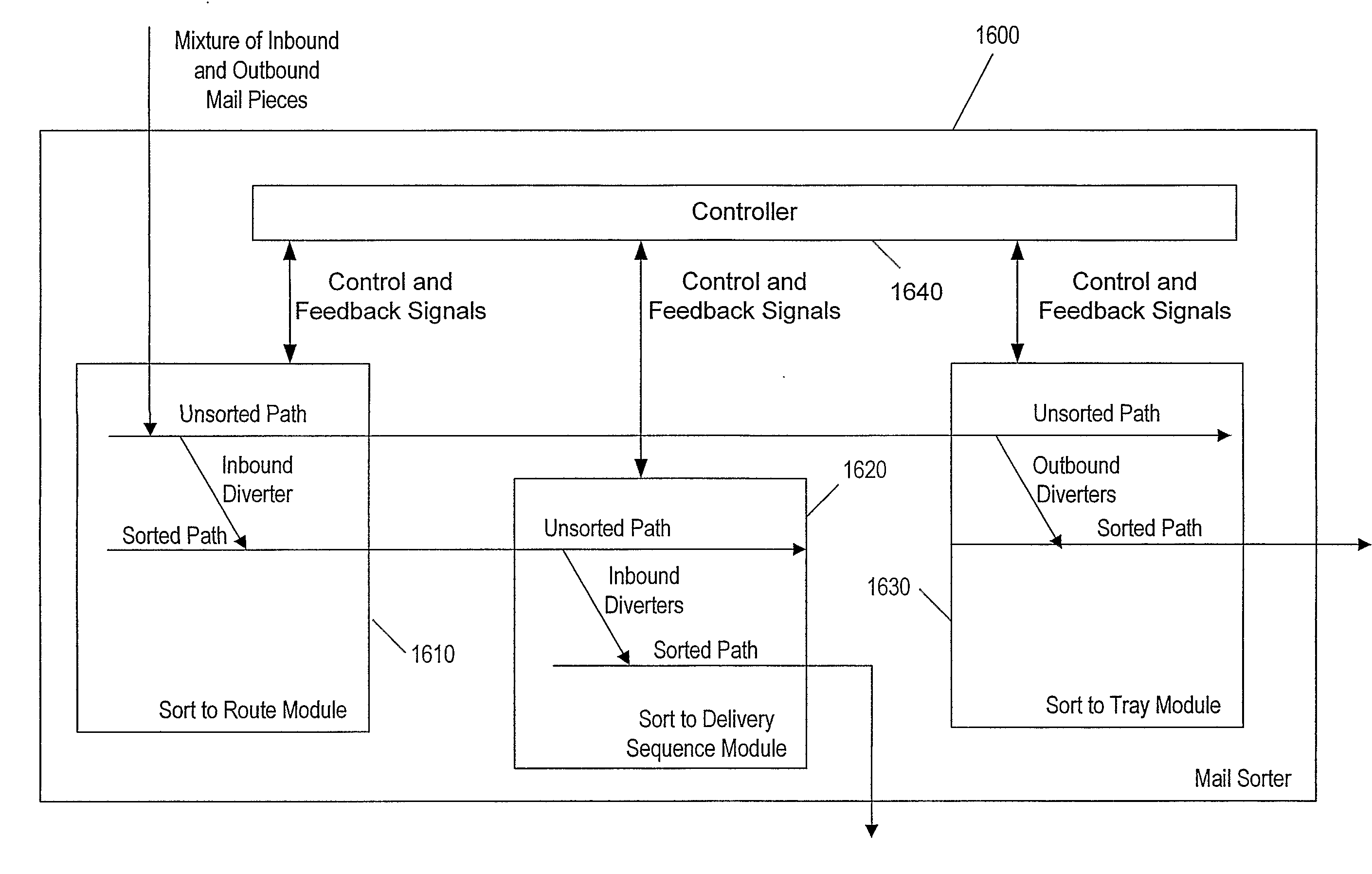
A mail sorter, method, and software product are used for sorting inbound mail pieces and outbound mail pieces. The mail sorter includes sorter modules cooperatively engaged with each other, so as to receive mail pieces that are a mixture of both inbound mail pieces and outbound mail pieces, and so as to sort both the inbound mail pieces and the outbound mail pieces. The mail sorter also includes an unsorted mail piece path that is utilized by both the inbound mail pieces and the outbound mail pieces. The outbound mail pieces are mail pieces destined for sorting at a remote postal facility prior to delivery to destination addresses, whereas the inbound mail pieces are mail pieces that are not destined for sorting at a remote postal facility prior to delivery to destination addresses.

Description

CROSS-REFERENCE TO RELATED APPLICATION[0001]The present application claims priority to U.S. Provisional Application No. 60 / 669,340 filed 7 Apr. 2005.TECHNICAL FIELD[0002]The present invention relates generally to sorting of mail, and more particularly to improved mail sorting efficiencies.BACKGROUND OF THE INVENTION[0003]Many posts around the world are seeking to develop a more effective mail merging system that automatically merges all mail streams and sorts them to as fine a degree as time permits, preferably to delivery sequence. The system should accomplish this merging at the step of carrier sequence sorting by merging all elements of the mail stream (letters, flats, periodicals, post cards etc.) at some point during the sorting process.[0004]At present, some of the mail streams arrive at the postal branch offices sorted in delivery sequence and some do not. Generally, even when the mail arrives at the branch already sorted to delivery sequence, postal carriers need to merge mu...

Claims

the structure of the environmentally friendly knitted fabric provided by the present invention; figure 2 Flow chart of the yarn wrapping machine for environmentally friendly knitted fabrics and storage devices; image 3 Is the parameter map of the yarn covering machine
Login to View More

Application Information

Patent Timeline
no application Login to View More
Patent Type & Authority Applications(United States)
IPC IPC(8): B07C5/00G06F7/00
CPCB07C3/082B65G1/0457B65G1/1373Y10S209/90B07C5/3412
Inventor STEMMLE, DENIS J.
Owner LOCKHEED MARTIN CORP