Supercharge Your Innovation With Domain-Expert AI Agents!

Cyanine dyes and their applications as luminescence quenching compounds

a technology of cyanine dyes and luminescence quenching compounds, applied in the field of cyanine dyes, can solve problems such as quenching of luminescen

Active Publication Date: 2010-12-30
ANASPEC
View PDF20 Cites 2 Cited by
  • Summary
  • Abstract
  • Description
  • Claims
  • Application Information

AI Technical Summary

Problems solved by technology

The complementary member is typically labeled with a luminescent label, and association of the two members of the specific binding pair results in luminescence quenching.

Method used

the structure of the environmentally friendly knitted fabric provided by the present invention; figure 2 Flow chart of the yarn wrapping machine for environmentally friendly knitted fabrics and storage devices; image 3 Is the parameter map of the yarn covering machine
View more

Image

Smart Image Click on the blue labels to locate them in the text.
Viewing Examples
Smart Image
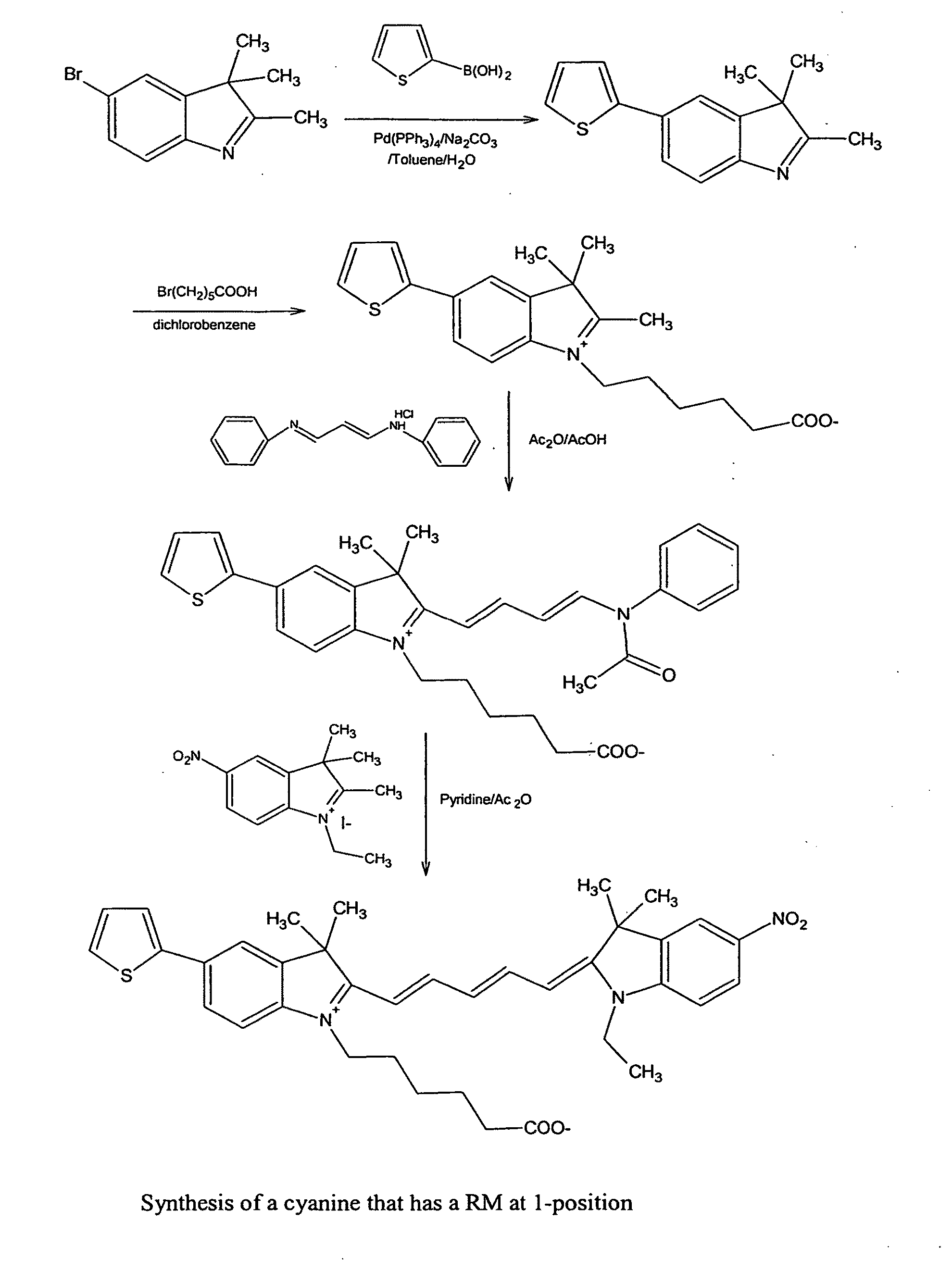
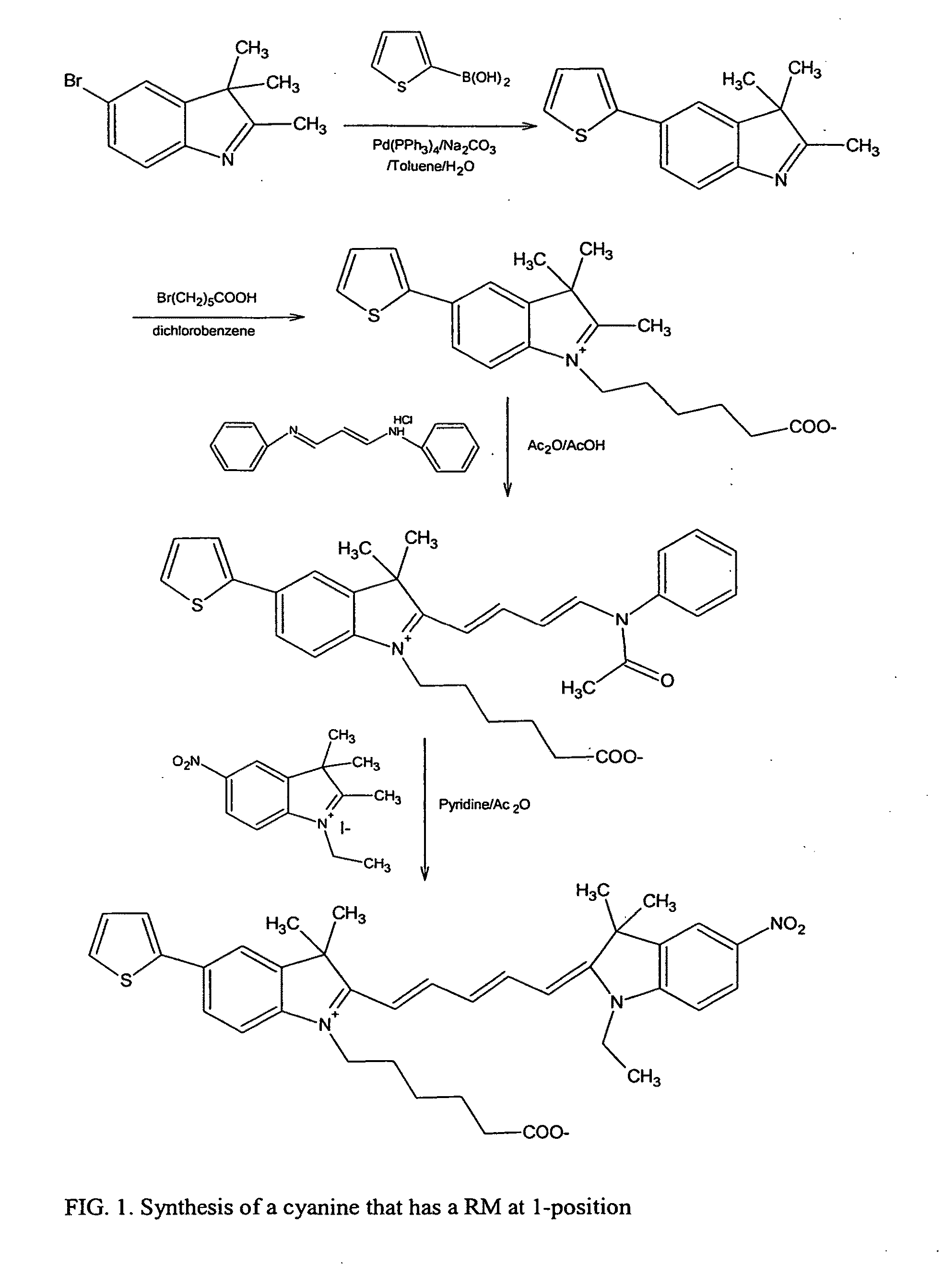
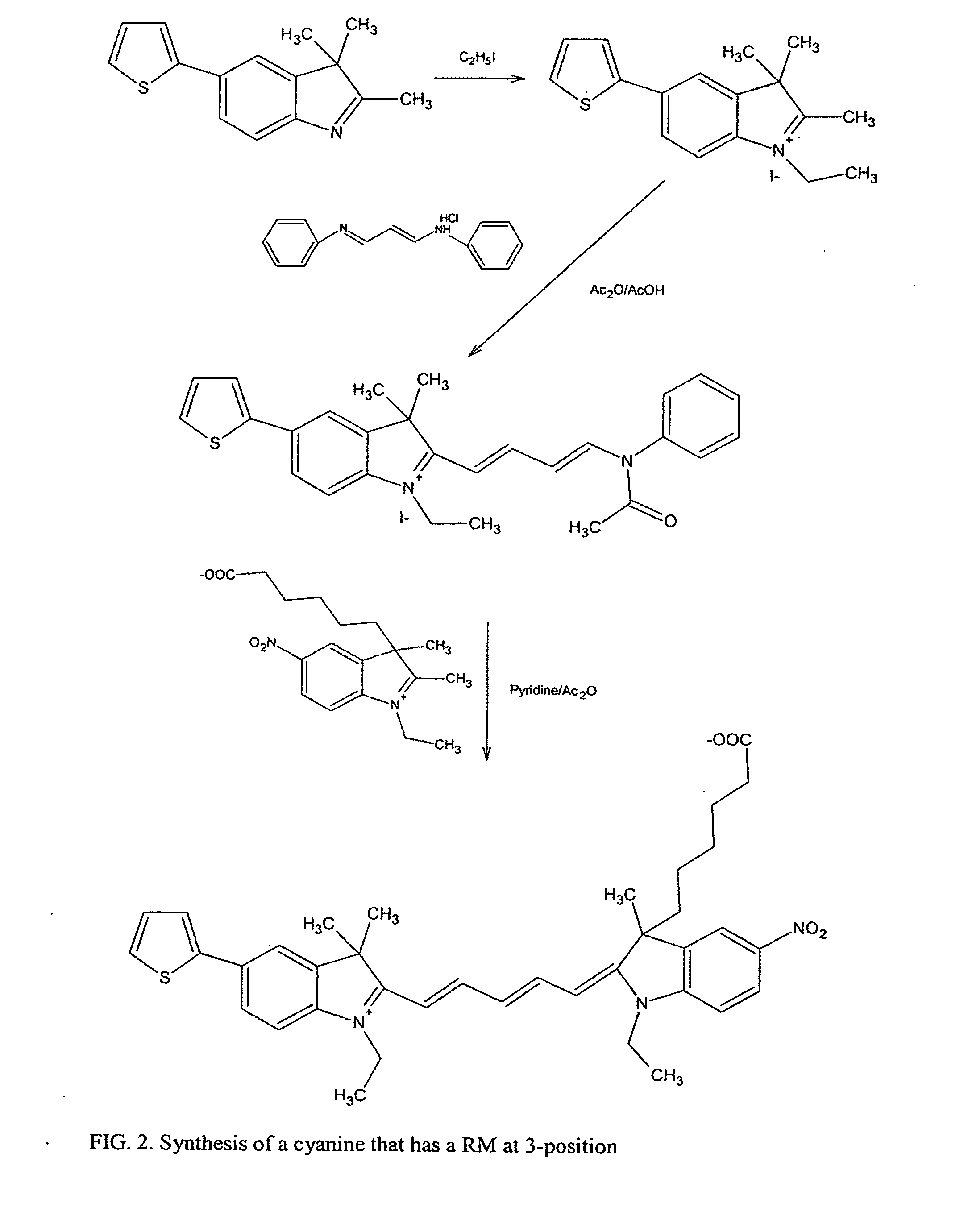
  • Cyanine dyes and their applications as luminescence quenching compounds
  • Cyanine dyes and their applications as luminescence quenching compounds
  • Cyanine dyes and their applications as luminescence quenching compounds

Examples

Experimental program
Comparison scheme
Effect test

example 1

Preparation of Compound 1

[0190]

[0191]To a solution of thiophene (50 g, 594 mmol) in anhydrous THF (200 mL) is added slowly a 1.6M solution of n-butyllithium in hexane (408 mL, 653 mmol) under nitrogen atomospere at −30° C. The reaction mixture is stirred for a further 2 hours, during which period it is allowed to warm to room temperature. The solution is recooled to 0° C. and a solution of 1,4-dibromobutane (141 g, 653 mmol) in anhydrous THF (100 mL) is added. The stirring is continued overnight. The mixture is diluted with ethyl acetate (1000 mL) and shaken with water (800 mL). The organic layer is washed with brine twice and dried over anhydrous Na2SO4. After removal of the solvent, the residue is distilled in vacuo to afford 2-(4-bromobutyl)-thiophene 1 as colorless oil (66 g).

example 2

Preparation of Compound 2

[0192]

[0193]The potassium salt of 2,3,3-trimetylindolenium-5-sulfonate 2 is synthesized by Fisher indole synthesis through the reaction of 4-hydrazinobenzenesulfonic acid and 3-methyl-2-butanone, followed by treatment the sulfonic acid with a saturated solution of potassium hydroxide in 2-propanol.

example 3

Preparation of Compound 3

[0194]

[0195]The mixture of the potassium salt of 2,3,3-trimetylindolenium-5-sulfonate 2 (7.5 g, 54.1 mmol) and 2-(4-bromobutyl)-thiophene 1 (11.9 g, 54 1 mmol) in dichlorobenzene (6 mL) is heated at 120° C. for 10 hours under nitrogen. The crude product is triturated with 2-propanol. The solid is filtered and washed with 2-propanol and ether and dried under vacuum to give Compound 3 (10.0 g, 98%).

the structure of the environmentally friendly knitted fabric provided by the present invention; figure 2 Flow chart of the yarn wrapping machine for environmentally friendly knitted fabrics and storage devices; image 3 Is the parameter map of the yarn covering machine
Login to View More

PUM

PropertyMeasurementUnit
structureaaaaaaaaaa
luminescenceaaaaaaaaaa
Fluorescence Resonance Energy Transferaaaaaaaaaa
Login to View More

Abstract

The quenching compounds of the invention are weakly luminescent cyanines that are substituted by one or more heteroaromatic quenching moieties. The quenching compounds of the invention exhibit little or no observable luminescence and efficiently quench a broad spectrum of luminescent compounds. The chemically reactive quenching compounds possess utility for labeling a wide variety of substances, including biomolecules. These labeled substances are highly useful for a variety of energy-transfer assays and applications.

Description

[0001]This application is a continuation of, and accordingly claims priority from, U.S. patent application Ser. No. 11 / 222,049, filed Sep. 7, 2005, which claims priority from U.S. Provisional Patent Appl. No. 60 / 608,817, filed Sep. 10, 2004, the subject matter of each being incorporated herein by reference in their entirety.FIELD OF THE INVENTION [0002]The invention relates to cyanine compounds that are efficient quenchers of luminescence. Chemically reactive versions of the cyanine compounds are described, as are conjugates prepared using the reactive compounds. Applications using the cyanine quenching compounds are also described.BACKGROUND [0003]Fluorescence Resonance Energy Transfer (FRET) is a process whereby a first fluorescent dye (the “donor” dye) is excited, typically by illumination, and transfers its absorbed energy to a second dye (the “acceptor” dye) that has a longer wavelength and therefore lower energy emission. Where the second dye is fluorescent, energy transfer re...

Claims

the structure of the environmentally friendly knitted fabric provided by the present invention; figure 2 Flow chart of the yarn wrapping machine for environmentally friendly knitted fabrics and storage devices; image 3 Is the parameter map of the yarn covering machine
Login to View More

Application Information

Patent Timeline
no application Login to View More
Patent Type & Authority Applications(United States)
IPC IPC(8): C07D471/04C07D403/14C07D417/14C07F9/28
CPCC07D209/60C07D403/14C07D409/04C07D409/06C07D409/14G01N33/582C07D471/04C07H21/04C07J43/00G01N33/542C07D417/14C09B23/083
Inventor DIWU, ZHENJUNZHANG, JIANHENGTANG, YI
Owner ANASPEC
Features
  • R&D
  • Intellectual Property
  • Life Sciences
  • Materials
  • Tech Scout
Why Patsnap Eureka
  • Unparalleled Data Quality
  • Higher Quality Content
  • 60% Fewer Hallucinations
Social media
Patsnap Eureka Blog
Learn More