Unlock instant, AI-driven research and patent intelligence for your innovation.

Protection/restoration of mpls networks

a technology of mpls network and recovery time, applied in data switching networks, frequency-division multiplexes, instruments, etc., can solve problems such as serious service disruption, requiring recovery times of tens of milliseconds, and damage to one or both unidirectional links

Inactive Publication Date: 2011-03-10
TELLABS OPERATIONS
View PDF29 Cites 24 Cited by
  • Summary
  • Abstract
  • Description
  • Claims
  • Application Information

AI Technical Summary

Benefits of technology

"The patent text discusses the need for protection and restoration of traffic in the network routing system of the Internet. The current routing algorithms are focused on connectivity and do not provide efficient recovery times in the event of failures. The technical effect of this patent is to provide a framework for MPLS to protect traffic and allow for faster recovery in the event of failures, which is important for organizations that require reliable service. The patent also introduces new terms such as failure indication signal, failure recovery signal, liveness message, link failure, and loss of signal."

Problems solved by technology

Although the current routing algorithms are very robust and survivable, the amount of time they take to recover from a failure can be significant, on the order of several seconds or minutes, causing serious disruption of service in the interim.
This is unacceptable to many organizations that aim to provide a highly reliable service, and thus require recovery times on the order of tens of milliseconds.
A link failure is defined as the failure of the link probing mechanism, and is indicative of the failure of either the underlying physical link between adjacent LSRs or a neighbor LSR itself (In case of a bidirectional link implemented as two unidirectional links, it could mean that either one or both unidirectional links are damaged.)
An MPLS layer impairment that is local to the LSR and consists of excessive discarding of packets at an interface, either due to label mismatch or due to TTL errors.
Thus, while they may provide link protection for example, they cannot easily provide MPLS path protection.(iv) Establishing interoperability of protection mechanisms between multi-vendor LSRs in core MPLS networks is urgently required to enable the adoption of MPLS as a viable core transport technology.

Method used

the structure of the environmentally friendly knitted fabric provided by the present invention; figure 2 Flow chart of the yarn wrapping machine for environmentally friendly knitted fabrics and storage devices; image 3 Is the parameter map of the yarn covering machine
View more

Image

Smart Image Click on the blue labels to locate them in the text.
Viewing Examples
Smart Image
  • Protection/restoration of mpls networks
  • Protection/restoration of mpls networks
  • Protection/restoration of mpls networks

Examples

Experimental program
Comparison scheme
Effect test

Embodiment Construction

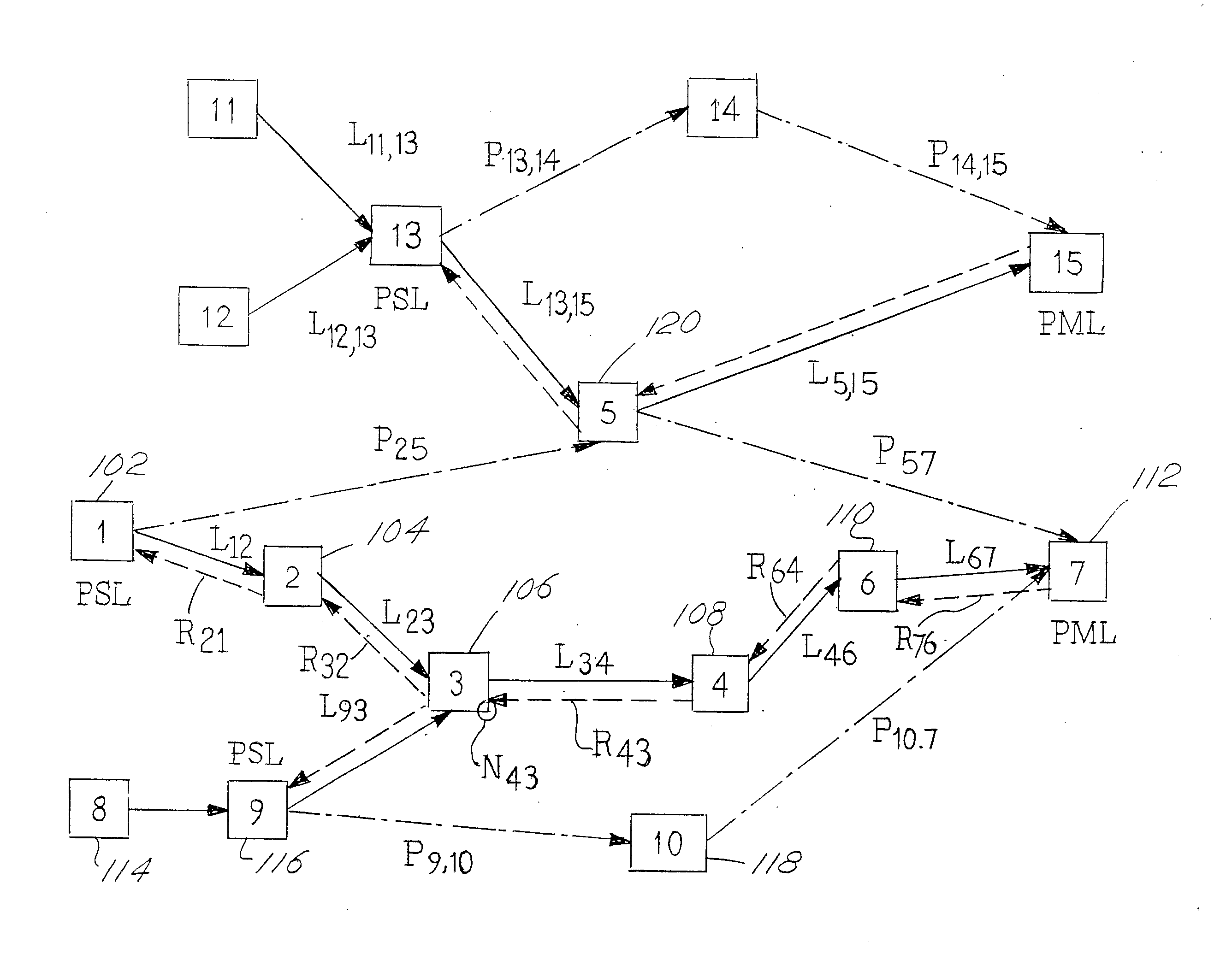
[0050]MPLS protection switching refers to the MPLS layer's ability to effect quick and complete restoration of traffic during any changes in the status of the MPLS layer. Fast MPLS layer protection may be viewed as the MPLS LSR switch completion time that is comparable to, or equivalent to, the 60 ms switch completion time of the SONET layer. This section provides a discussion of the concepts and principles of protection switching for MPLS protection. We do not make any assumptions about the underlying layer 1 or layer 2 transport mechanisms or their protection mechanism.

Objectives

[0051]We lay down the following objectives for MPLS protection switching.[0052](i) MPLS protection mechanisms should facilitate fast recovery of the working traffic, to maximize network reliability and availability.[0053](ii) MPLS protection techniques should be specified for an LSP, PMTP, or PMTG.[0054](iii) MPLS protection techniques can be specified for traffic on an end-to-end LSP or for a segment of a...

the structure of the environmentally friendly knitted fabric provided by the present invention; figure 2 Flow chart of the yarn wrapping machine for environmentally friendly knitted fabrics and storage devices; image 3 Is the parameter map of the yarn covering machine
Login to View More

PUM

No PUM Login to View More

Abstract

In a multi-protocol label system (MPLS) carrying data, a working path carries data from a starting point or node to a destination point or node via a working path. The working path includes the switches and physical media linking starting point and the destination point. MPLS system reliability is enhanced by way of a protection path, over which data can be carried from the starting point to the destination point upon a detected failure along the working path. Upstream messages inform one or more MPLS switching systems to make a switchover from a working path to a protection path.

Description

RELATED APPLICATIONS[0001]This application is a continuation of U.S. application Ser. No. 09 / 696,051, filed Oct. 25, 2000, which claims the benefit of U.S. Provisional Application Nos. 60 / 161,277, filed Oct. 25, 1999, and 60 / 187,798, filed Mar. 8, 2000. The entire teachings of the above applications are incorporated herein by reference.BACKGROUND OF THE INVENTION[0002]Network routing deployed in the Internet today is focused primarily on connectivity, and typically supports only one class of service, the best effort class. Multi-protocol label switching, on the other hand, by integrating a label-swapping framework with network layer routing allows flexibility in the delivery of new routing services, since it allows new services to be added without changing the basic forwarding mechanism. This enables more sophisticated features such as quality-of-service (QoS) and traffic engineering to be implemented. An important component of providing QoS, however, is the ability to do so reliabl...

Claims

the structure of the environmentally friendly knitted fabric provided by the present invention; figure 2 Flow chart of the yarn wrapping machine for environmentally friendly knitted fabrics and storage devices; image 3 Is the parameter map of the yarn covering machine
Login to View More

Application Information

Patent Timeline
no application Login to View More
Patent Type & Authority Applications(United States)
IPC IPC(8): G06F11/00H04L45/24H04L45/28H04L45/50
CPCH04L45/00H04L45/50H04L45/28H04L45/22H04L45/247
Inventor OWENS, KENNETH R.MAKAM, SRINIVAS V.HUANG, CHANGCHENGSHARMA, VISHAL
Owner TELLABS OPERATIONS