
Liquid ejecting apparatus
a liquid ejecting and apparatus technology, applied in printing, other printing apparatus, etc., can solve problems such as image quality degradation
- Summary
- Abstract
- Description
- Claims
- Application Information
AI Technical Summary
Benefits of technology
Problems solved by technology
Method used
Image

Examples
first embodiment
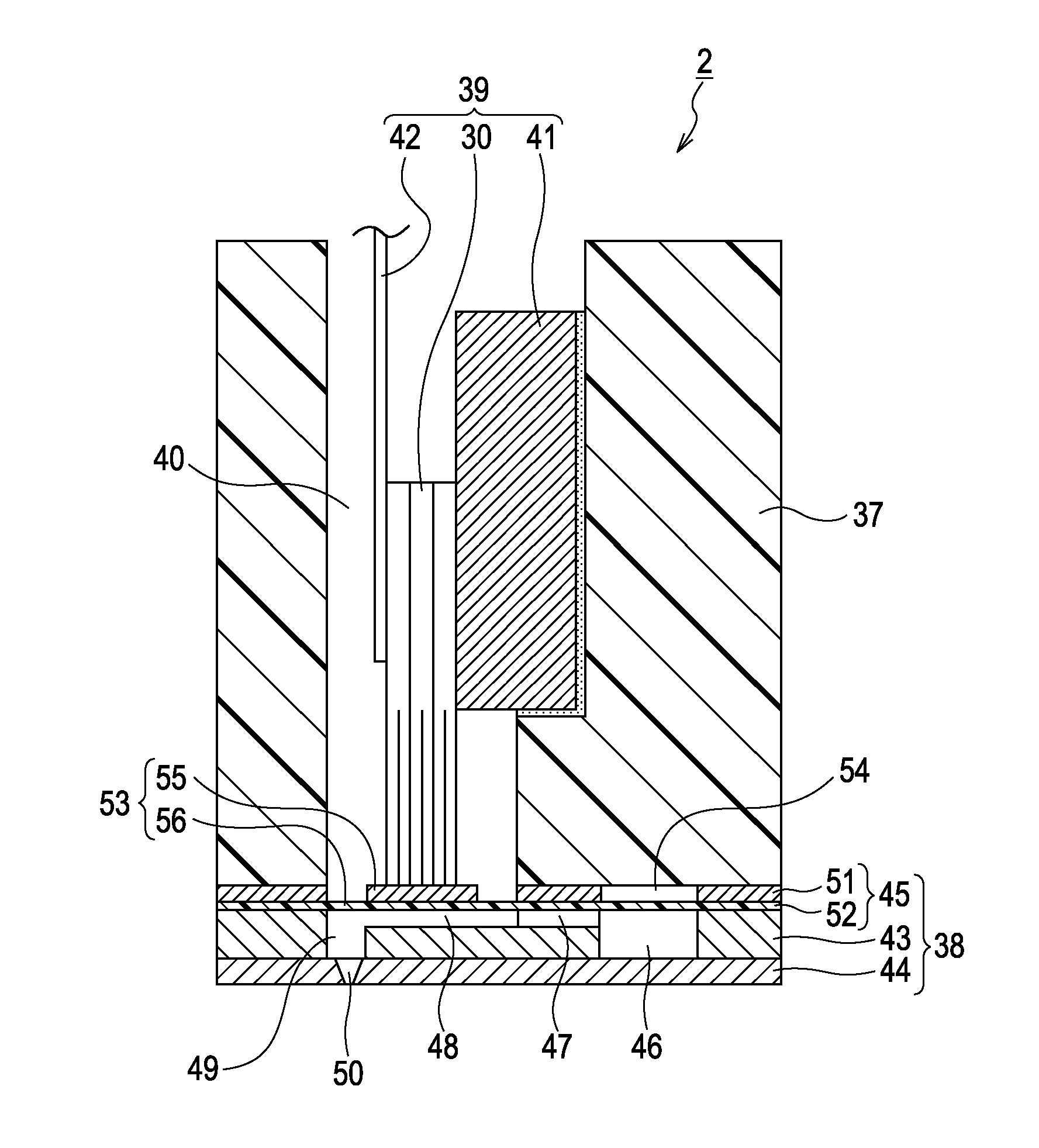
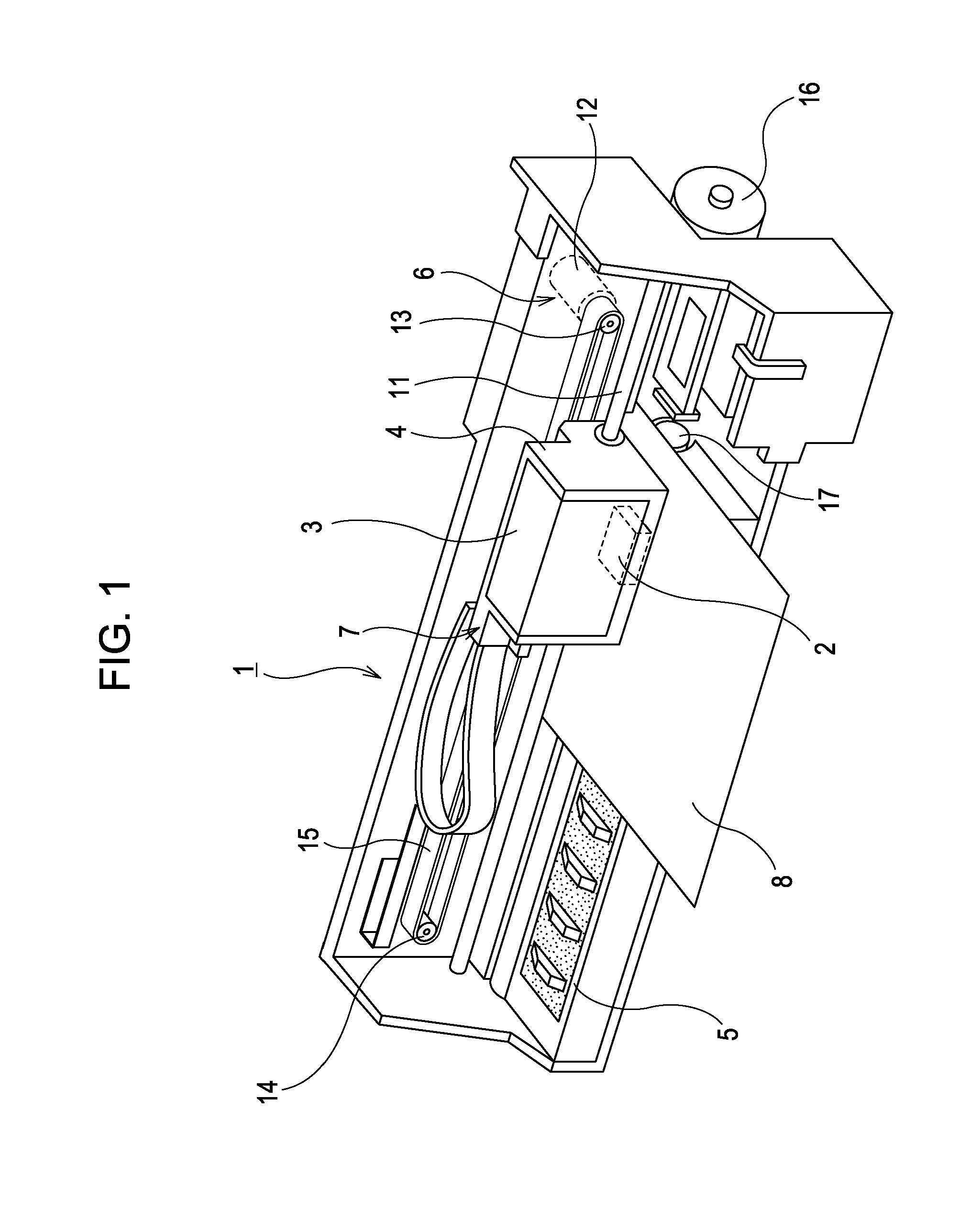
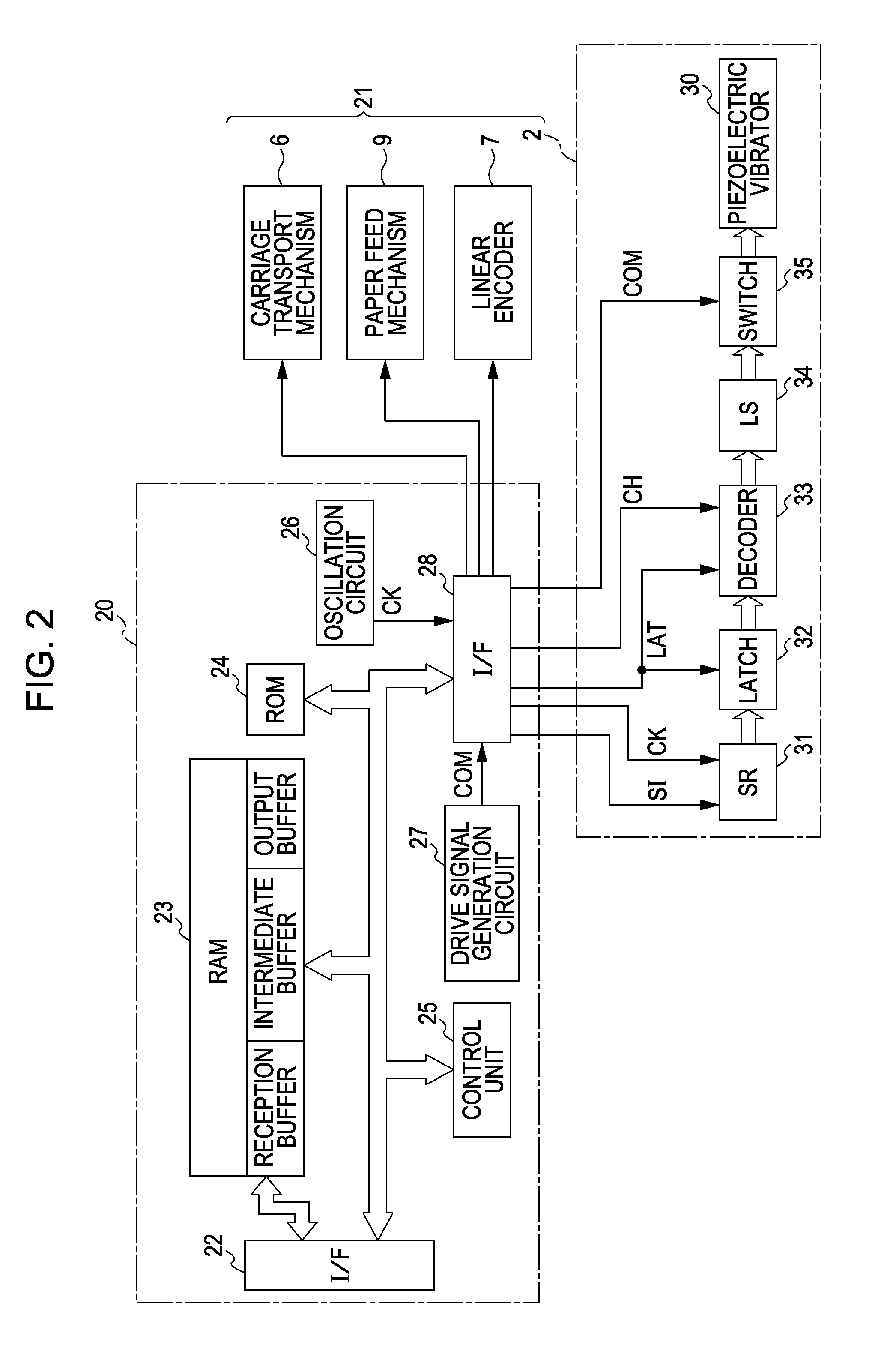
[0018]The printer 1 shown in FIG. 1 ejects an ink, an example of a liquid which may be used in association with the invention, onto a recording medium such as a recording paper sheet, a cloth, or a film. The recording medium is an example of the landing target on which the ejected liquid is to land. The printer 1 includes a carriage 4 on which a recording head 2 exemplifying the liquid ejection head is mounted, and an ink cartridge 3, an example of the liquid supply source, is removably mounted, a platen 5 disposed below the recording head 2, a carriage transport mechanism 6 that moves the carriage 4 in a direction of the width of a recording paper sheet 8 exemplifying the landing target, a linear encoder 7 that outputs an encoder pulse according to the movement of the carriage 4, and a paper feed mechanism 9 that transports the recording paper sheet 8 in a paper-feed direction.
[0019]The carriage transport mechanism 6 includes a guide shaft 11 disposed so as to extend in a main scan...
second embodiment
[0050]A second embodiment is similar to the first embodiment, unless otherwise stated specifically.
[0051]FIG. 7 is a wave diagram showing a configuration of an ejection pulse DP′ according to the second embodiment. The ejection pulse DP′ according to the second embodiment includes the expansion phase p1 where the potential is increased from the reference potential VB corresponding to the contracted volume of the pressure chamber 48 to the expansion potential VH, so that the pressure chamber 48 expands from the contracted volume to the expanded volume, the expansion hold phase p2 where the expansion potential VH is maintained for holding the expanded state of the pressure chamber 48 for a predetermined period, and the contraction phase p3 where the potential is decreased from the expansion potential VH to the reference potential VB, so that the pressure chamber 48 contracts to the contracted volume. The ejection pulse DP′ is different from the ejection pulse DP according to the first...
PUM
 Login to View More
 Abstract
Description
Claims
Application Information
 Login to View More