Disinfection of a file system

a file system and virus technology, applied in the field of file system virus infection, can solve the problems of virus triggering, many millions of pounds worth of damage in terms of data loss and working time, and virus infection of computers and computer systems

US20120124007A1Inactive Publication Date: 2012-05-17F SECURE CORP
11 Cites 55 Cited by

Patent Information

Authority / Receiving Office
US · United States
Current Assignee / Owner
Publication Date
2012-05-17
Estimated Expiration
Not applicable · inactive patent

Smart Images

  • Figure 1
    Figure 1
  • Figure 2
    Figure 2
  • Figure 3
    Figure 3
Patent Text Reader

Abstract

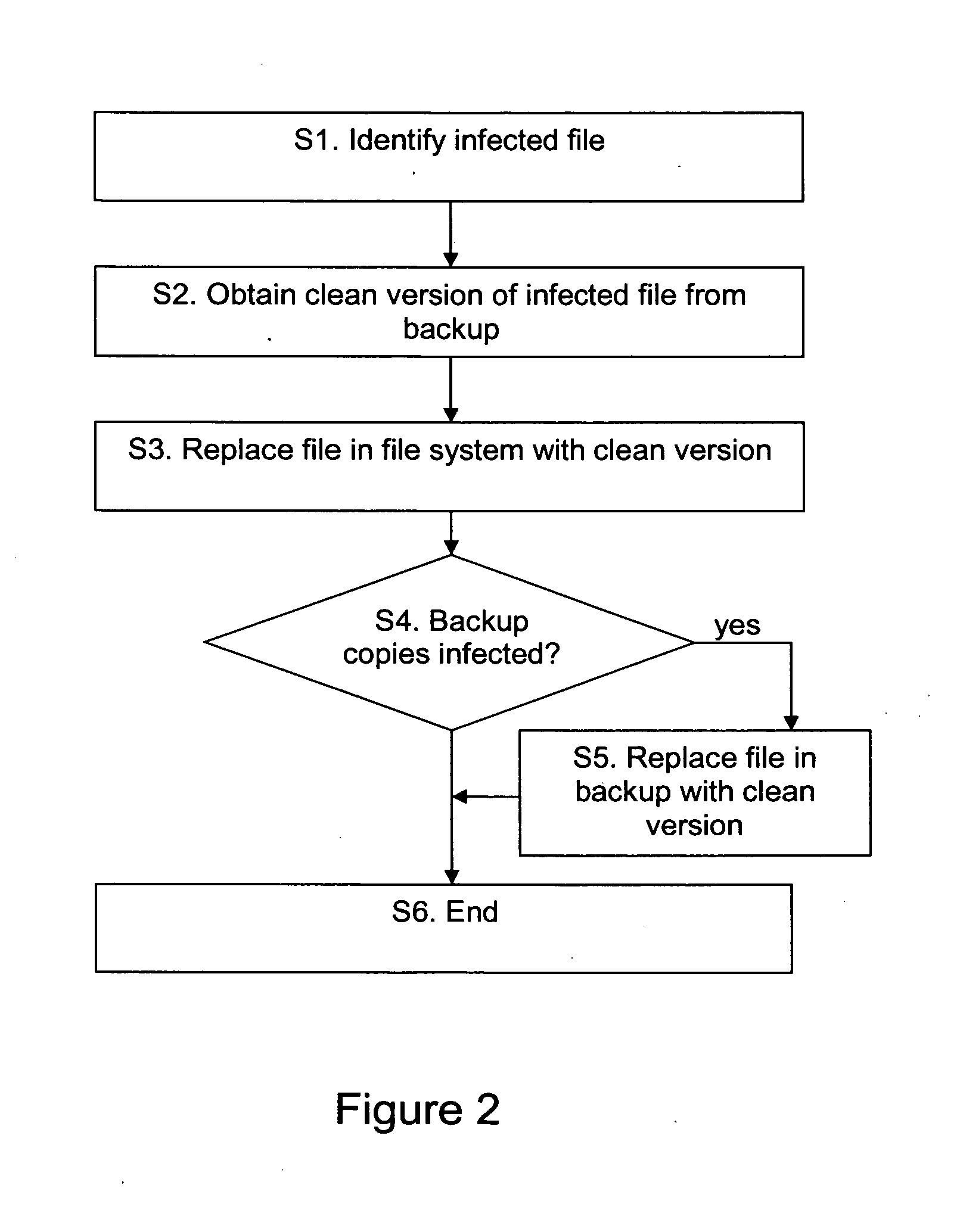
A method of disinfecting an infected electronic file in a file system. At a computer device, a file system is scanned using an anti-virus application to identify the infected electronic file. All or part of an uninfected version of the electronic file is obtained from a backup database of the file system. The backup system includes data from which a plurality of backup copies of at least part of the file system may be obtained. All or part of the infected electronic file is replaced with all or part of the uninfected electronic file. A determination is made as to whether any of the plurality of backup copies include an infected version of the file. If any of the plurality of backup copies include an infected version of the electronic file, the electronic file in the backup database is replaced with all or part of the uninfected version of the electronic file.
Need to check novelty before this filing date? Find Prior Art

Description

FIELD OF THE INVENTION

[0001] The present invention relates to the field of disinfection of a file system.BACKGROUND TO THE INVENTION

[0002] Virus infection of computers and computer systems is a growing problem. Recently there have been examples where computer viruses have spread rapidly around the world causing many millions of pounds worth of damage in terms of lost data and lost working time.

[0003] Computer viruses are spread in many different ways. Early viruses were spread by the copying of infected files onto floppy disks, and the transfer of the file from the disk onto a previously uninfected computer. When the user tries to open the infected file, the virus is triggered and the computer infected. More recently, viruses have in addition been spread via the Internet, for example using e-mail. In the future it can be expected that viruses will be spread by the wireless transmission of data, for example by communications between mobile communication devices using a cellular telephon...

Examples

Embodiment Construction

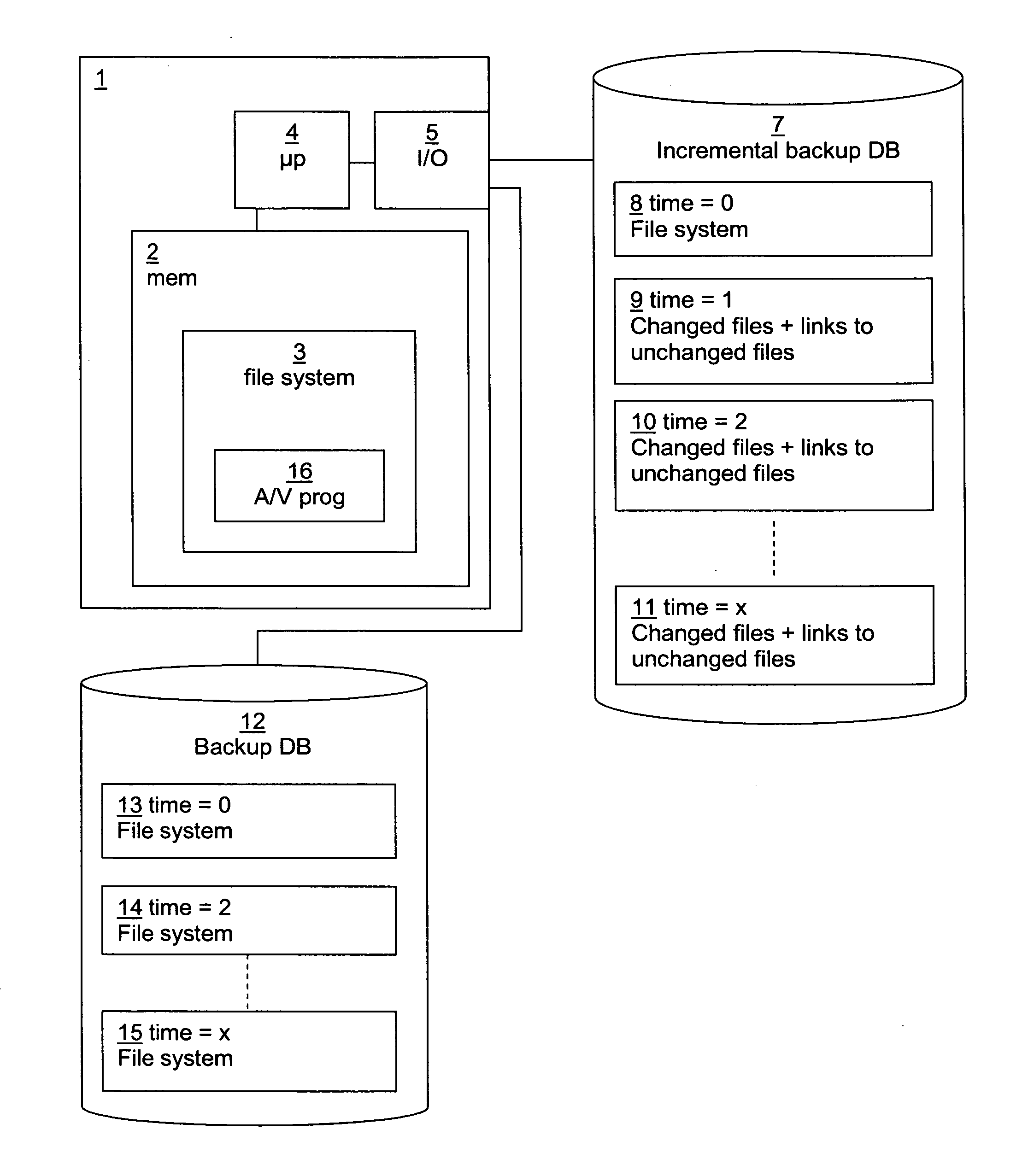
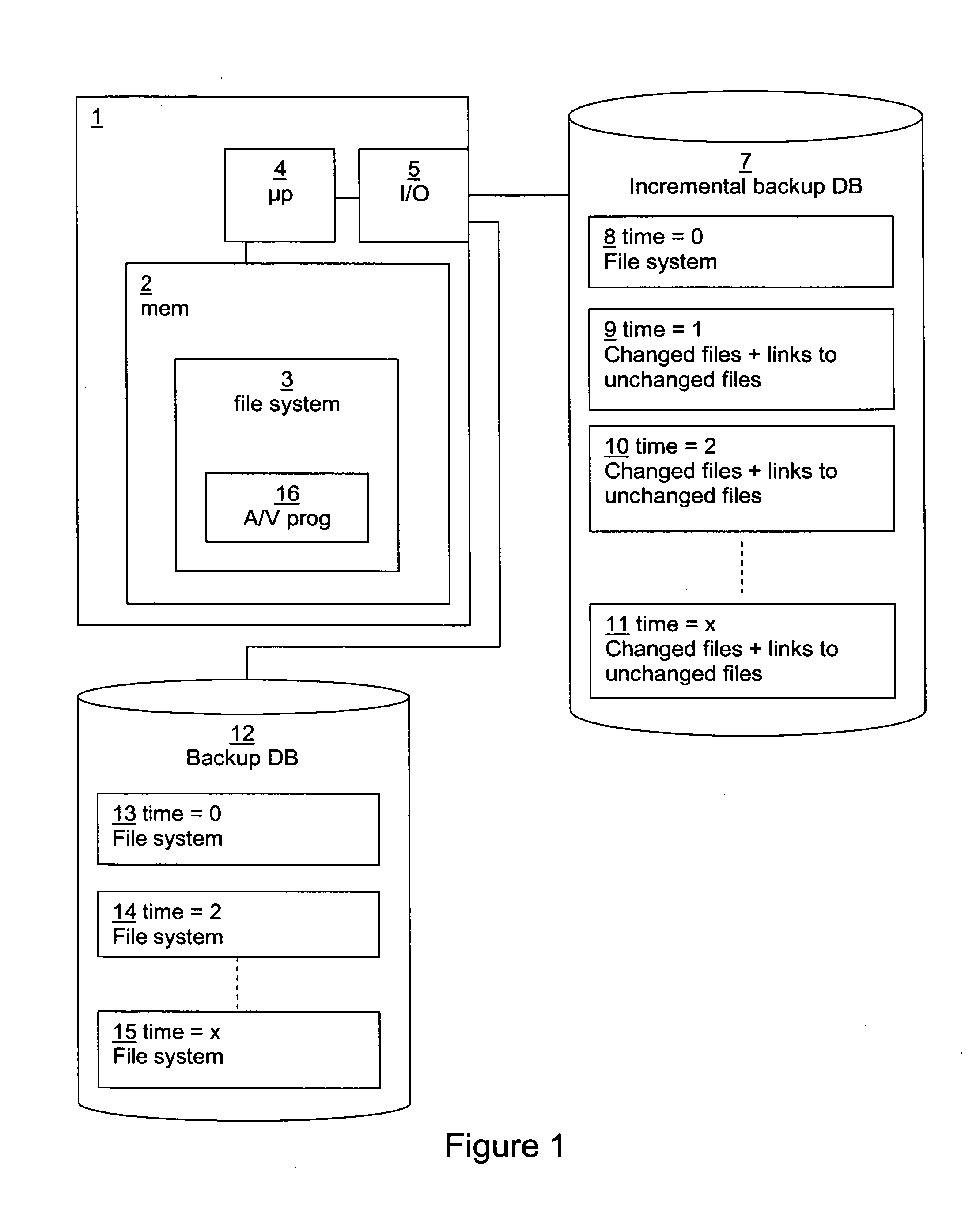
[0030]Referring to FIG. 1, there is illustrated a computer device 1. The computer device 1 may be any type of computer device, such as a desktop personal computer, a laptop computer, a mobile telephone, a Personal Digital Assistant (PDA) and so on. The computer device has a computer readable medium in the form of a memory 2 in which files are stored in a file system 3 A program 4 required to run an anti-virus scan may be stored as part of the file system 3. The memory 2 may be any writable medium in which files can be stored, such as a hard disk, a Random Access Memory, a flash disk and so on. Furthermore, whilst the memory 2 may be integral with the client device 1 it may also simply be connected to the client device 1. An example of a memory 2 connected to a computer device is a hard disk connected via a USB connection to a desktop personal computer. A processor 4 is provided for running an anti-virus application and scanning the file system 3 stored in the memory 2. In addition, ...