The constraints of the head / media technology limit the read / write capabilities to using only one active head at a time.
All data requests that are sent to the drive are handled in a serial manner, with long delays between operations, as the actuator moves the read / write head to the required position and the media rotates to place the data under the read / write head.
As a result, multiple data bits that share the same cell and their electronic states, (hence their threshold voltage Vt's), are interdependent to a point that an unexpected power interruption can generate unpredictable consequences.
In spite of the advantages of MLC over SLC, MLC flash memory devices have not traditionally been used because of certain technical constraints, among which data corruption presents one of the most severe challenges.
MLC flash memory devices are more vulnerable to data corruption than SLC flash memory devices.
The lower cycle limit in the MLC flash memory devices poses particular problems for data centers that operate with unpredictable data streams.
The unpredictable data streams may cause “hot spots”, resulting in certain highly-used areas of memory being subject to a large number of erase cycles.
In addition, various factors in normal operation can also affect flash memory integrity, including read disturbs or program disturbs.
These disturbs lead to unpredictable loss of data bits in a memory cell, as a result of the reading or writing of memory cells adjacent to the disturbed cell.
Sudden data losses in MLC flash memory devices due to unexpected power interruptions require frequent data recoveries.
Because some data levels require more than one write operations to achieve and because more than one bit of data share the same memory cell, a power change or a program error during a write data operation leaves the data in a wrong state.
When the power returns, the memory cell can be in an erratic state.
Therefore a power interruption is a major risk to the integrity of data stored in MLC flash memory devices.
If the power failure occurs while the MLC is in the middle of an operation that changes the contents of the flash media (e.g., in the middle of writing a page of data or in the middle of erasing a block of data), the electrical states of the interrupted page or block are unpredictable after the device is powered up again.
However, other bits may be lagging behind and have not yet reached their target values yet.
Furthermore, some bits might be caught in intermediate states and thus be in an unreliable mode, so that reading these bits returns different results under different read operations.
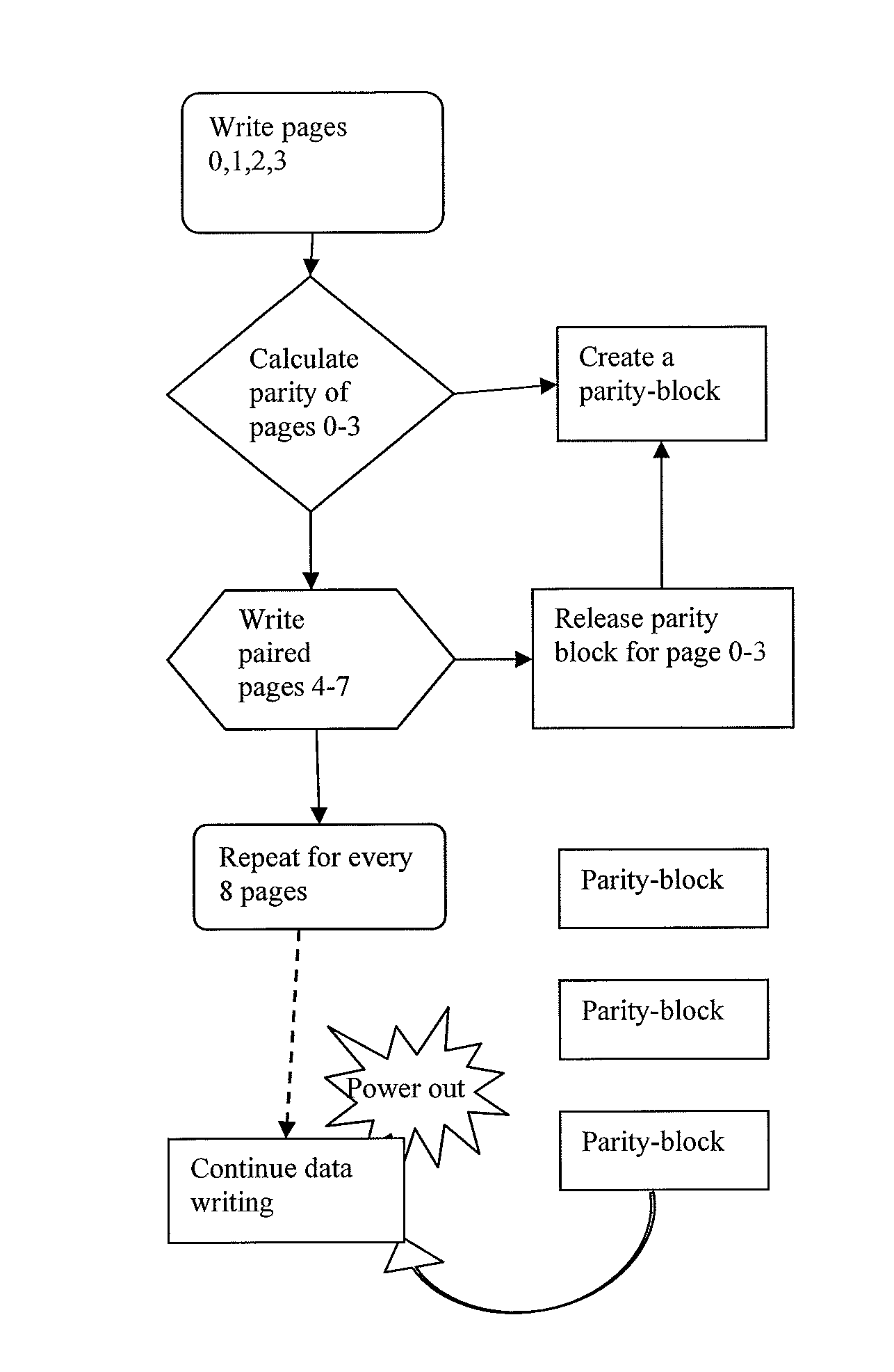
Therefore power losses while programming a certain page can corrupt a paired page.
Those techniques require either additional memory or complicated error-searching and data rebuilding procedures after power returns.
Such requirements or solutions make the process costly to implement and place significant strain on the processing power of a conventional flash memory controller, which generally includes only a single processor.
Furthermore, if a power failure occurs during the writing of a page, the paired page data can become corrupt in a MLC flash memory device.
Therefore even the conventional paired page technique is susceptible to a sudden power interruption.
As a matter of fact, the severity of the possible corruption is high; in some cases, every 10th data bit can be lost.
Relying on conventional ECC techniques to make a MLC flash memory system reliable would be impractical to implement.
NAND flash memory data corruption can also result from program erase cycle wear outs.
Repeated program / erase cycles damage the oxide and reduce its effectiveness.
As device dimensions (e.g., oxide film thickness) shrink, data integrity problems from device wearing out can become more severe.
One factor that influences this wearing out process is the speed at which the program and erase cycles are performed.
However, if the speed of programming and erasing is slowed to avoid wearing out, overall performance can be impacted significantly.
However, as the device wears out, its ability to store a charge is compromised.
However, a lower sense voltage also returns a lower detected voltage, thus resulting in an incorrect charge tracking.


 Login to View More
  Login to View More