
Capsule phototherapy
a phototherapy and capsule technology, applied in the field of capsule phototherapy, can solve the problems of not describing a method for treating lesions or promoting tissue healing in the gastrointestinal tract, and unable to disclose any means for focusing the light beam produced by the light source, so as to promote, encourage and accelerate the healing of the intestinal mucosa and underlying tissues
- Summary
- Abstract
- Description
- Claims
- Application Information
AI Technical Summary
Benefits of technology
Problems solved by technology
Method used
Image

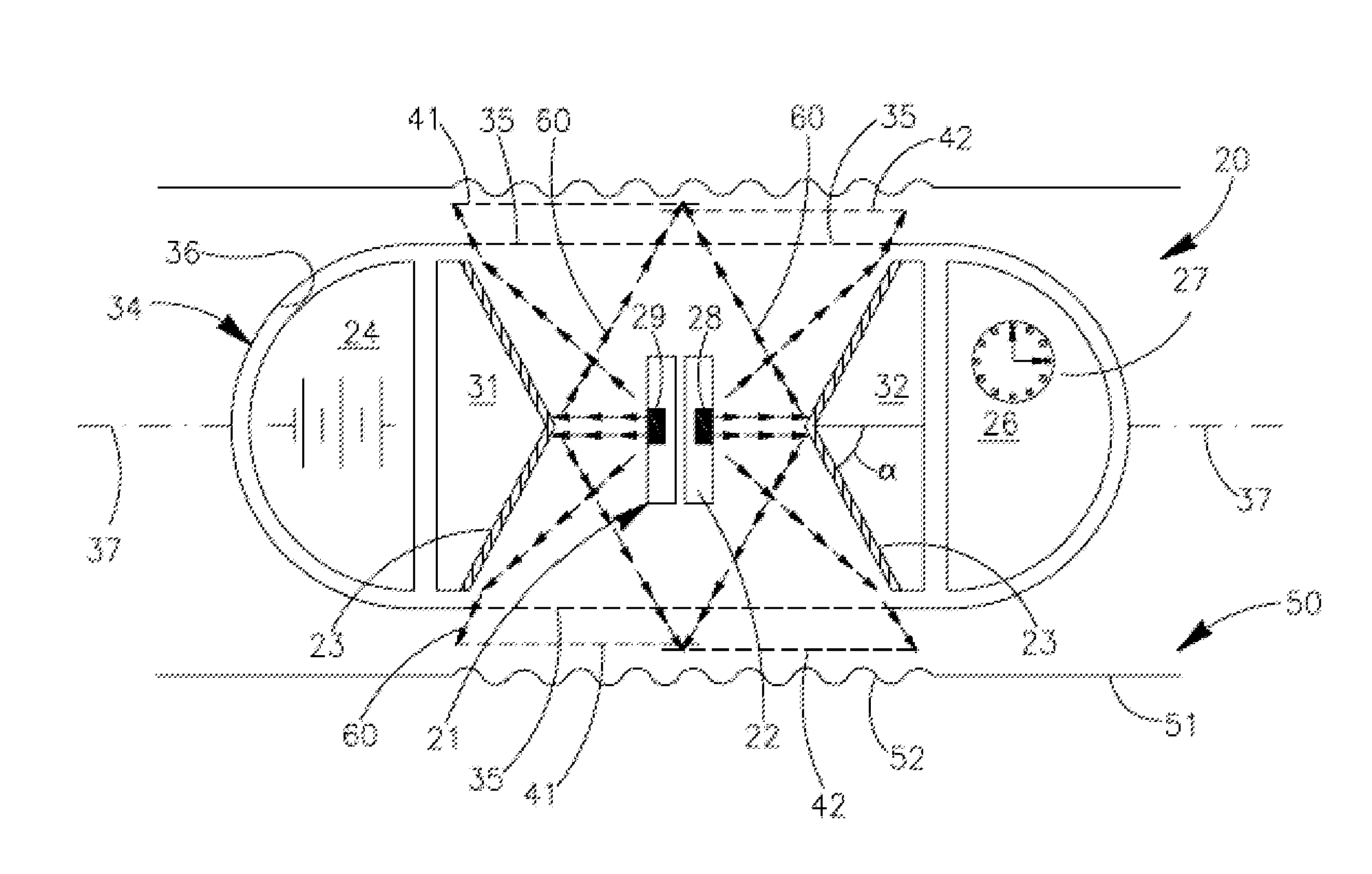
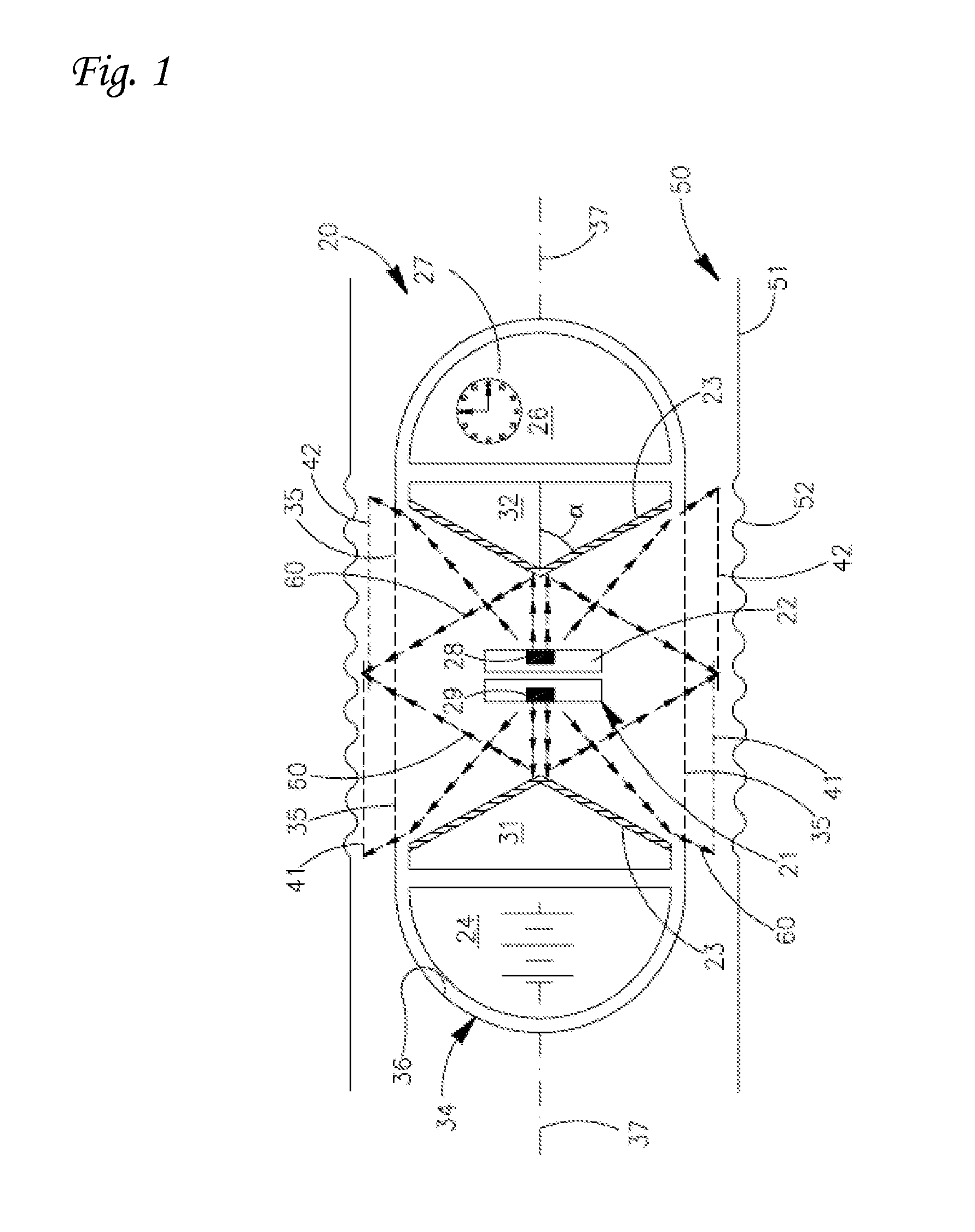
Examples
example 1
Typical Phototherapy Capsule of the Present Invention
[0165]Physical dimensions—Length 11 mm
[0166]External diameter 27 mm
[0167]The outer shell is transparent and is made of a mixture of Polycarbonate, Polystyrene and K-resin with a wall thickness of 0.4 mm, and is manufactured using a conventional molding technique as well known to the skilled artisan . . . .
[0168]The power source contained within the capsule is a small cylindrical battery—GP1015L08—having a length of 15 mm and a height of 10 mm.
[0169]The capsule includes 2 electronic printed circuit boards, the first of which is a DC to DC driver (Texas Instrument's TPS61041) used to drive the LEDs used in the capsule, and a controlling microprocessor (MicroChip's PIC12F1822-I / MF) which controls the activation and operation of the capsule.
[0170]The second circuit hosts the Photo-therapy LEDs in a circular arrangement, such that the light generated by said LEDs is transmitted radially outwards.
[0171]The LEDs are UT-692UR supplied by ...
example 2
Effect of Intraluminal Phototherapy in a Murine Colitis Model
[0173]Introduction:
[0174]A dextran sulfate sodium (DSS)-induced colitis model in mice was used to demonstrate the positive therapeutic effect obtained by using intraluminal phototherapy to treat inflammatory lesions of the GI tract. Colitis was induced in C57BL / 6 mice by adding DSS to their drinking water, in accordance with standard protocols for chronic and acute DSS-induced colitis [Wirtz et al., 2007, Nature Protocols Vol. 2 pp. 541-546]. Phototherapy treatment was carried out using a Storz mini-endoscope system fitted with intraluminal light sources emitting at 440±40 nm (blue), 660±50 nm (red) and 850±50 nm (near infra-red [NIR]).
[0175]Severity of the induced colitis was assessed endoscopically using the following set of criteria:
Murine endoscopic index of colitis severity0123TotalThickeningTransparentModerateMarkedNon-0-3of the colontrans-parentChanges ofNormalModerateMarkedBleeding0-3the vascularpatternFibrin visib...
PUM
 Login to View More
 Abstract
Description
Claims
Application Information
 Login to View More