
Opening type bone conduction earphone
a bone conduction earphone and open-type technology, applied in the direction of transducer details, earpiece/earphone attachment, electrical transducer, etc., can solve the problems of large number of components, difficult to hear warning sounds, and nerve and physical burdens, and achieve the effect of easy direct transmission of vibration
- Summary
- Abstract
- Description
- Claims
- Application Information
AI Technical Summary
Benefits of technology
Problems solved by technology
Method used
Image

Examples
embodiment 1
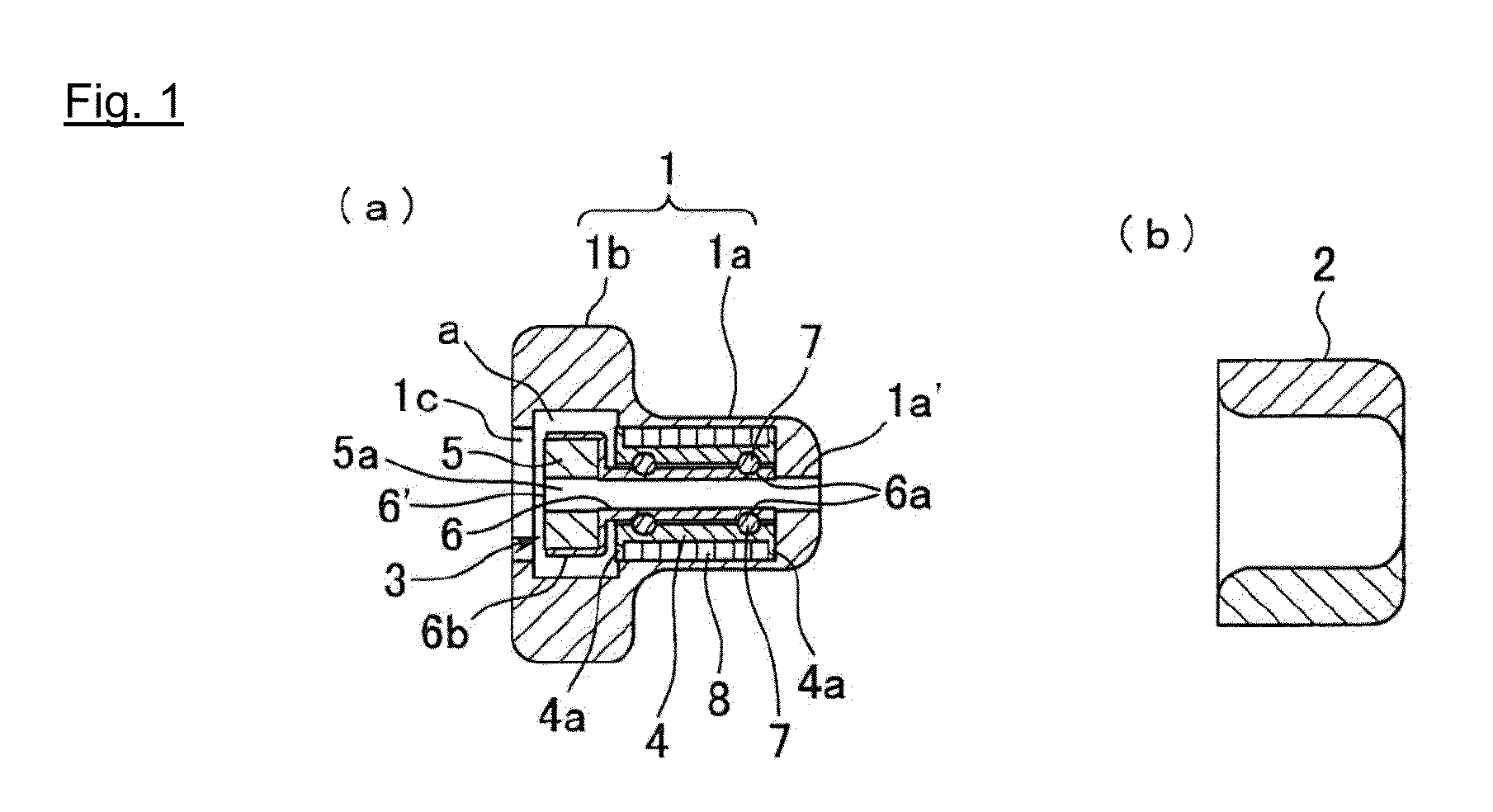
[0036]FIG. 1(a) shows a vertical cross-sectional diagram of an opening type relating to the first embodiment of the present invention.
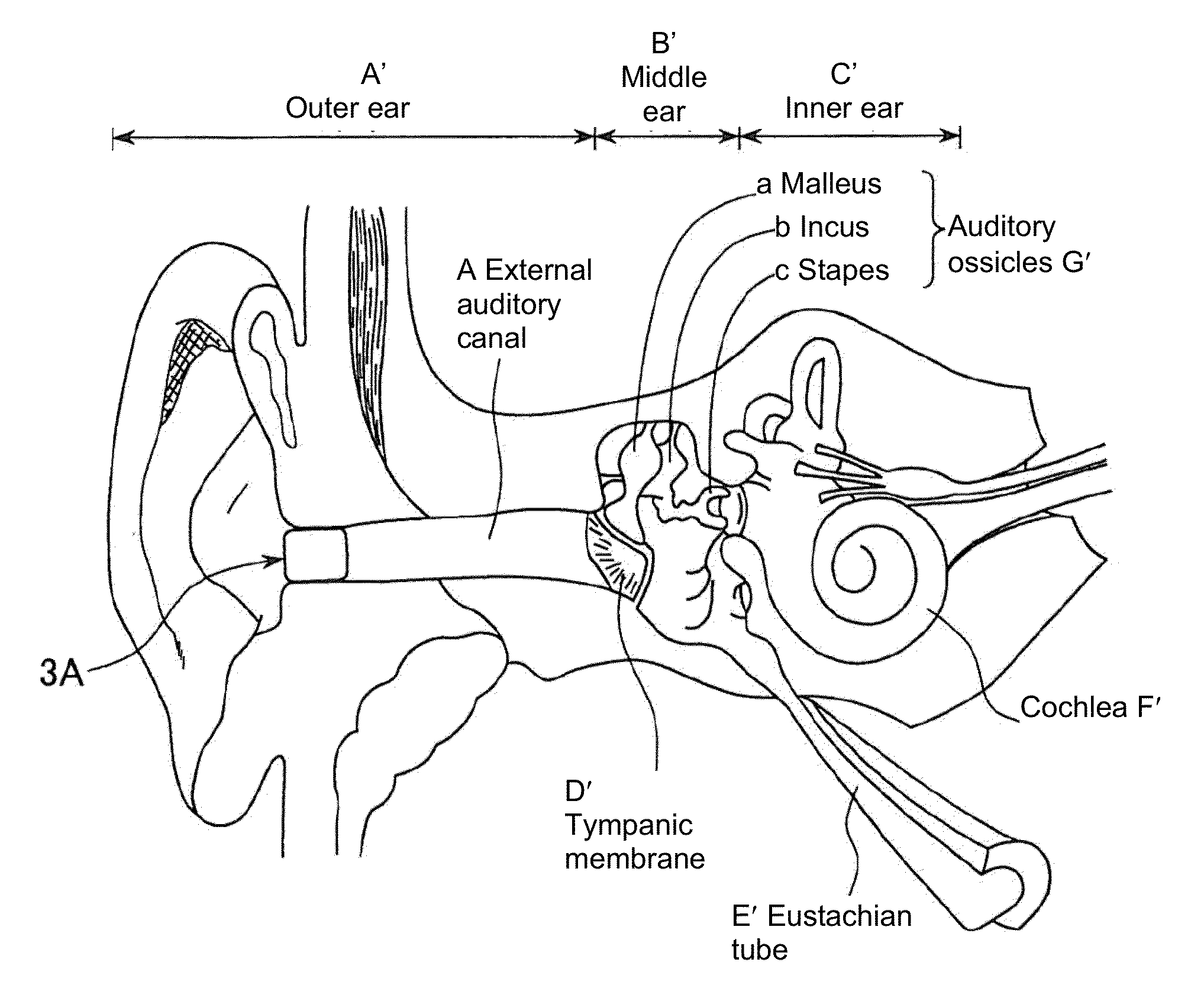
[0037]1 in the drawing is a housing comprising an elastic member such as silicone rubber or elastomer, this housing 1 comprises a cylindrical part 1a, which is inserted into the external auditory canal and forms a nearly cylindrical shape, and a flange part 1b, which is formed at the outer circumference of one of the outer end parts of this cylindrical part 1a, has a prescribed thickness, and is nearly disk shaped. In usage, the cylindrical part 1a is inserted into the external auditory canal, and the flange part 1b is also similarly inserted into the external auditory canal. In addition, a material and hardness that have good vibration conduction efficiency are selected for the material of the housing.
[0038]A pad 2 with a nearly cylindrical shape is placed on the outer circumference part of the cylindrical part 1a as shown in FIG. 1(b). This pad 2 co...
embodiment 2
[0058]FIG. 10 shows a cross-sectional view of a second embodiment of the present invention. This embodiment is characterized in that the entire outer shape has been made somewhat long and nearly cylindrical in the axial direction. FIG. 11(a) is an explanatory view that shows the external appearance, and (b) is a front view.
[0059]In this embodiment, the shape of the movement 6 is made simple. Specifically, it is characterized in that the opening type bone conduction apparatus 3 is comprised by making the movement 6 long and thin and cylindrical and installing a ring shaped magnet 5 at the outer circumference of one end part thereof (in the case in which insertion into the external auditory canal has been performed, corresponding to the outside position of the external auditory canal). In this example, one end part of the movement 6 functions as the support part of the magnet 5.
embodiment 3
[0060]FIG. 12 shows another example of a bone conduction apparatus 3. In this third embodiment, the magnet 5 is installed at the end part of the movement 6, one damper 7 and groove 6a are used, and the dimensions of the movement 6 and the coil bobbin 4 in the axial direction are made short, and otherwise it has nearly the same basic configuration as the previously discussed bone conduction apparatus 3, so repeating an explanation is not necessary.
[0061]FIG. 13 shows a cross-sectional view of the assembled status.
[0062]FIG. 14(a) is an explanatory drawing of the completed status, and (b) is a front view.
PUM
 Login to View More
 Abstract
Description
Claims
Application Information
 Login to View More