Check patentability & draft patents in minutes with Patsnap Eureka AI!

AC/DC Power Conversion Methods and Apparatus

Active Publication Date: 2013-12-19
MCCUNE JR EARL W
View PDF18 Cites 13 Cited by
  • Summary
  • Abstract
  • Description
  • Claims
  • Application Information

AI Technical Summary

Benefits of technology

[0010]In one embodiment of the invention, the controller modulates the duty cycles of the plurality of switches to regulate the DC output voltage Vout to the desired, constant output level. In another embodiment of the invention, the duty cycles of the switches are held constant but their frequency is changed in response to variations in the load. On average, the input current to the AC/DC converter is inversely proportional to the frequency of the switch drive signals. Therefore, by holding the duty cycles of the switch drive signals constant and adjusting their frequency as the load va

Problems solved by technology

However, many applications require a much lower voltage.
Although the AC/DC converter 300 in FIG. 3 addresses the inability of the AC/DC converter 100 in FIG. 1 to step down the DC voltage to a lower DC voltage, it does not address another well-known problem of conventional AC/DC converters—low power factor.
A low power factor can result due to the input voltage Vin being out of phase with the input current Iin or by action of a nonlinear load distorting the shape of the input current Iin.
The harmonics lower the power factor, resulting in reduced conversion efficiency and undesirable heating in the AC mains generator and distribution systems.
The harmonics also c

Method used

the structure of the environmentally friendly knitted fabric provided by the present invention; figure 2 Flow chart of the yarn wrapping machine for environmentally friendly knitted fabrics and storage devices; image 3 Is the parameter map of the yarn covering machine
View more

Image

Smart Image Click on the blue labels to locate them in the text.
Viewing Examples
Smart Image
  • AC/DC Power Conversion Methods and Apparatus
  • AC/DC Power Conversion Methods and Apparatus
  • AC/DC Power Conversion Methods and Apparatus

Examples

Experimental program
Comparison scheme
Effect test

Embodiment Construction

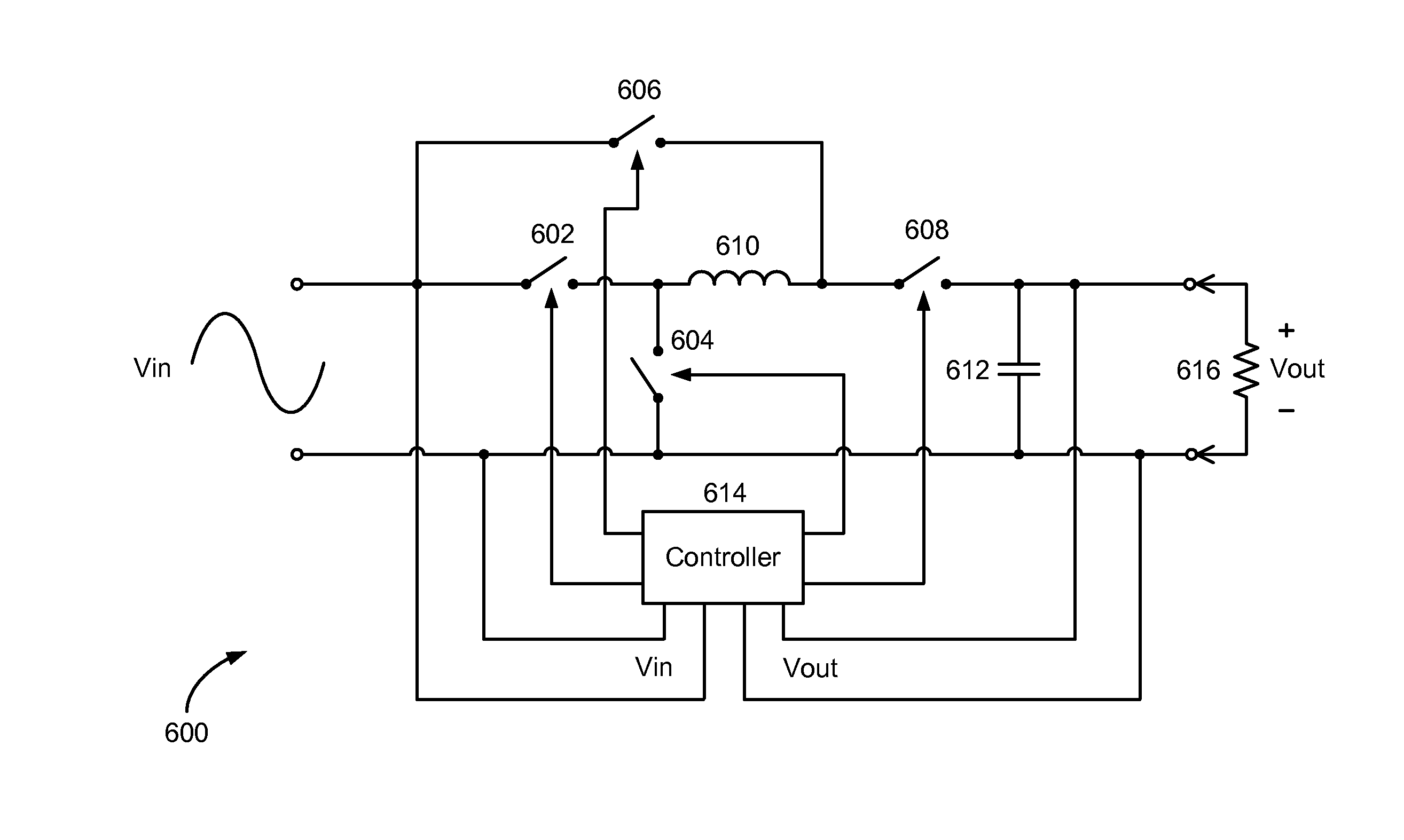
[0028]Referring to FIG. 6, there is shown an alternating current to direct current (AC / DC) converter 600, according to an embodiment of the present invention. The AC / DC converter 600 comprises first, second, third and fourth switches 602, 604, 606 and 608, an inductor 610, a smoothing capacitor 612, and a controller 614. The first switch 602 is coupled between one terminal of the AC input and a first terminal of the inductor 610; the second switch 604 is coupled between the first terminal of the inductor 610 and the opposing-polarity terminal of the AC input; the third switch 606 is coupled between the AC input and the second terminal of the inductor 610; and the fourth switch 608 is coupled between the second terminal of the inductor 610 and the positive DC output terminal. The controller 614 generates switch drive signals for controlling the switching of the first, second, third and fourth switches 602, 604, 606 and 608, depending on the instantaneous AC input voltage Vin compared...

the structure of the environmentally friendly knitted fabric provided by the present invention; figure 2 Flow chart of the yarn wrapping machine for environmentally friendly knitted fabrics and storage devices; image 3 Is the parameter map of the yarn covering machine
Login to View More

PUM

No PUM Login to View More

Abstract

An AC/DC power conversion apparatus comprises an AC/DC converter for converting AC power to DC power for a load and a controller that maintains a power factor of the load as the load varies. The AC/DC converter includes an inductor and a plurality of switches that alternately connects and disconnects the inductor to and from an AC power source, to generate the DC power for the load. The plurality of switches is controlled by a plurality of switch drive signals generated by the controller, based on comparisons of an AC voltage from the AC power source to a DC output voltage produced by the AC/DC converter. To maintain the power factor of the load, the controller is configured to adjust the frequency of the plurality of switch drive signals in response to variations in the load while holding the duty cycles of the switch drive signals constant.

Description

CROSS-REFERENCE TO RELATED APPLICATIONS[0001]The present application is a continuation-in-part of U.S. patent application Ser. No. 12 / 841,608, filed on Jul. 22, 2010, the disclosure of which is incorporated herein by reference in its entirety and for all purposes.FIELD OF THE INVENTION[0002]The present invention relates in general to power conversion and in particular to methods and apparatus for converting alternating current (AC) to direct current (DC).BACKGROUND OF THE INVENTION[0003]Many household and industrial machines and devices are powered by a direct current (DC) power source that has been rectified from alternating current (AC) power provided by the AC mains. The AC-to-DC rectification is typically accomplished using a bridge rectifier 104 (or “diode bridge”) comprised of four diodes 102-1, 102-2, 102-3102-4 configured as shown in FIG. 1. The bridge rectifier 104 converts the positive and negative half cycles of the AC input voltage Vin to a full-wave-rectified waveform o...

Claims

the structure of the environmentally friendly knitted fabric provided by the present invention; figure 2 Flow chart of the yarn wrapping machine for environmentally friendly knitted fabrics and storage devices; image 3 Is the parameter map of the yarn covering machine
Login to View More

Application Information

Patent Timeline
no application Login to View More
IPC IPC(8): H02M1/42
CPCH02M1/42H02M7/2176
Inventor MCCUNE, JR., EARL W.
Owner MCCUNE JR EARL W
Features
  • R&D
  • Intellectual Property
  • Life Sciences
  • Materials
  • Tech Scout
Why Patsnap Eureka
  • Unparalleled Data Quality
  • Higher Quality Content
  • 60% Fewer Hallucinations
Social media
Patsnap Eureka Blog
Learn More