Optimised Pulse Sequences for Evaluating Spatial Frequency Content of a Selectively Excited Internal Volume

a spatial frequency content and pulse sequence technology, applied in the field of structural analysis, can solve the problems of less noise ratio, less edge effects to total slice thickness, and unsatisfactory data artifacts

US20150153432A1Active Publication Date: 2015-06-04OSTEOTRONIX MEDICAL PTE LTD
0 Cites 6 Cited by

Patent Information

Authority / Receiving Office
US · United States
Patent Type
Applications(United States)
Current Assignee / Owner
Publication Date
2015-06-04

Smart Images

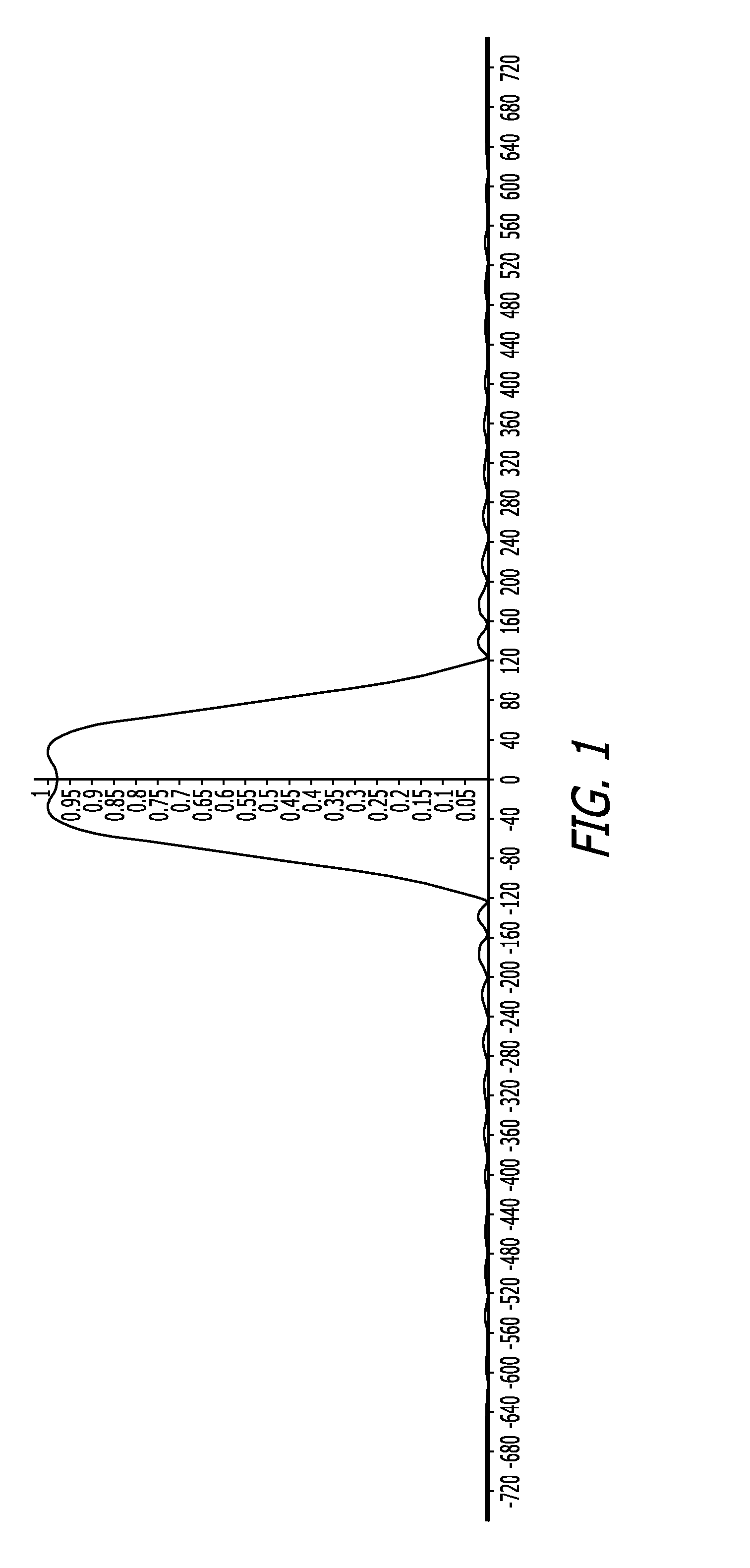
  • Figure 1
    Figure 1
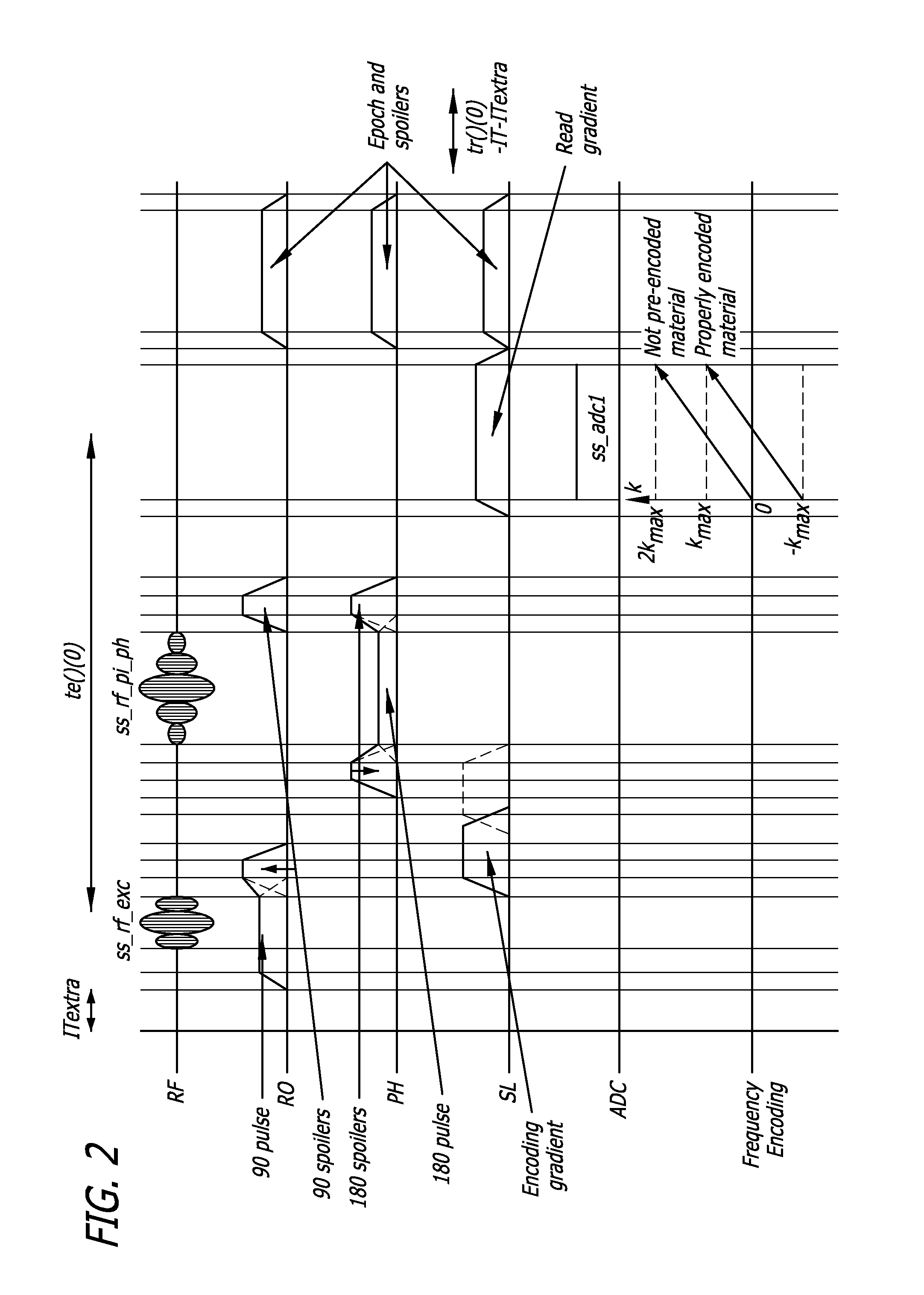
  • Figure 2
    Figure 2
  • Figure 3
    Figure 3
Patent Text Reader

Abstract

In a structural analysis using NMR techniques, a method for gathering k-value data from frequency encoded spin echoes generated from internal volumes selectively excited by intersecting 90° and 180° slice selective and refocusing RF pulses and subjected to a read gradient for the purpose of quantifying the spatial frequency content of the selected internal volume without contamination by a FID signal, comprising: acquiring spin echo data such that the FID signal generated by imperfections in the 180° slice selective refocusing RF pulse is attenuated by the read gradient such that any remaining FID signal is spatially encoded with higher k-values than the frequency encoded k-values being recorded for subsequent structural analysis while simultaneously providing for t2 t2* and t1 contrast. Other aspects of the invention are disclosed.
Need to check novelty before this filing date? Find Prior Art

Description

CROSS-REFERENCE TO RELATED APPLICATIONS

[0001] This application is a continuation of International Application No. PCT / US2013 / 049167 filed Jul. 2, 2013, which claims the benefit of U.S. Provisional Patent Application No. 61 / 668,472 filed Jul. 6, 2012.BACKGROUND OF THE INVENTION

[0002] 1. Field of the Invention

[0003] The present invention relates to the field of nuclear magnetic resonance (NMR), and more particularly to structural analysis, including but not limited to structural analysis of living tissue using modifications of NMR techniques.

[0004] 2. Prior Art

[0005] The following terms will be used throughout the text:

[0006] 1. Prism: A prism is an elongate volume of material from which a signal is measured. The signal varies as a function of position along the prism. Although the form of prism generally referred to in the text has a rectangular cross section, in general it may include shapes of any arbitrary cross-section. Additionally, although the measurement of signal generally referre...

Examples

Embodiment Construction

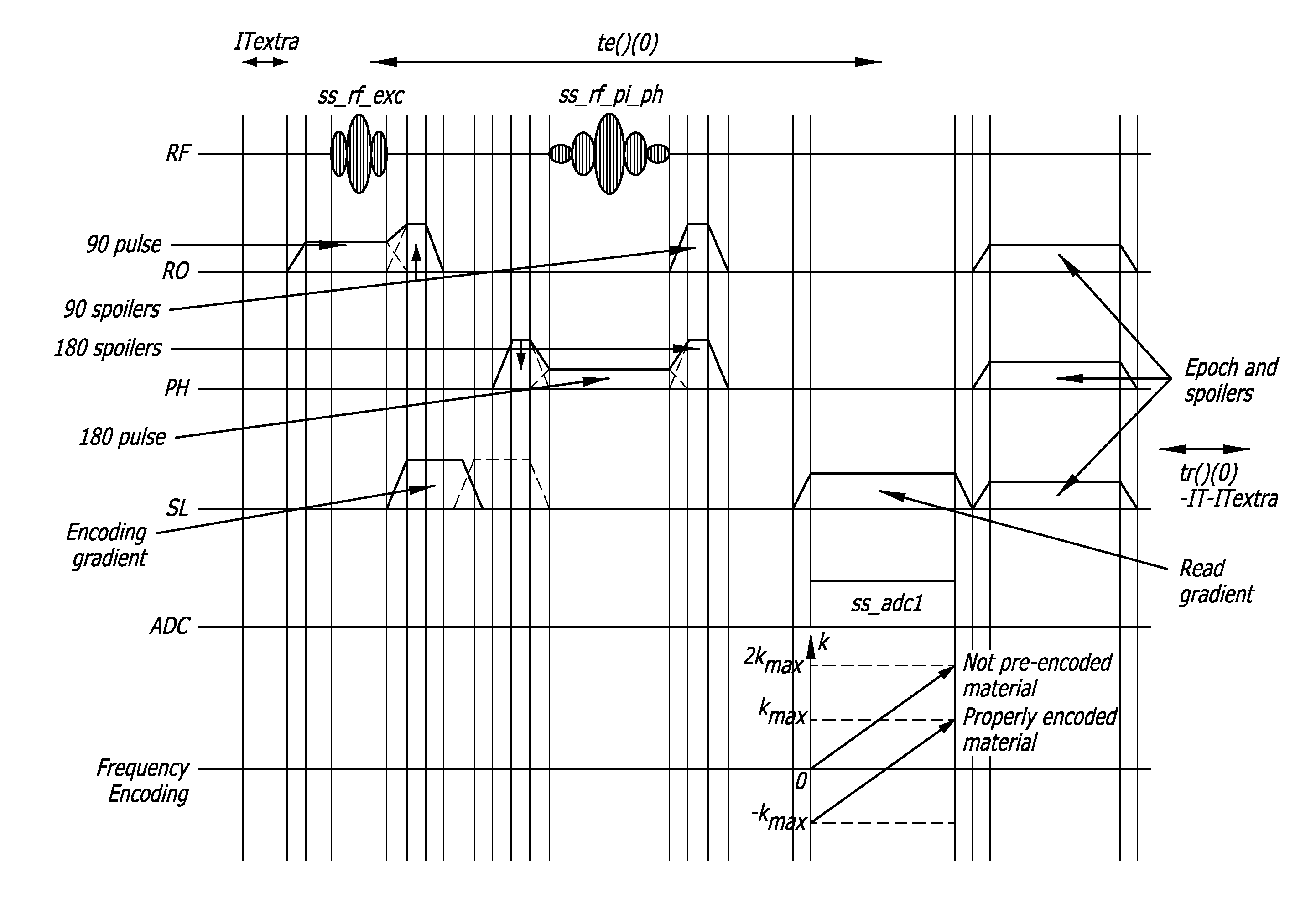
[0024]This disclosure contains details of the problem of artifacts appearing on spatial frequency spectra scans when the prism size is small. The document is organized as follows. First there is an explanation of the artifacts, why they occur (above), what has been done and what will be done to eliminate them from the data. Then there is a description of the pulse sequences that have been developed with the minimization of these artifacts in mind.

[0025]There are two key differences between conventional imaging and spatial frequency Spectroscopy. The first is that the spatial frequency analysis in structural analysis is only interested in high spatial frequencies and not at all in the k=0 signal, since conventional imaging can address low spatial frequencies directly by imaging and image analysis. The second is that because spatial frequency analysis is only interested in the high frequency encoded signal, the analysis can arrange the spatial encoding such that the high frequencies o...