Ligand-modified quantum dot materials, methods of fabricating liquid crystal display panels and liquid crystal display panels

a quantum dot material and liquid crystal technology, applied in the field of display technology, can solve the problems of poor heat resistance, dust particles, residual electrostatic, brush marks, etc., and achieve the effects of improving the display quality of the liquid crystal display panel, simplifying the alignment process of liquid crystal, and reducing the cos

US20180079960A1Active Publication Date: 2018-03-22TCL CHINA STAR OPTOELECTRONICS TECH CO LTD
0 Cites 3 Cited by

Patent Information

Authority / Receiving Office
US · United States
Patent Type
Applications(United States)
Current Assignee / Owner
Publication Date
2018-03-22

Smart Images

  • Figure 1
    Figure 1
  • Figure 2
    Figure 2
  • Figure 3
    Figure 3
Patent Text Reader

Abstract

The present application provides a ligand-modified quantum dot material, a method of fabricating a liquid crystal display panel, and a liquid crystal display panel. The ligand-modified quantum dot material of the present application can occur a polymerization with the ligand-modified quantum dot material under ultraviolet irradiation to form a polymer, while the polymer deposits on a substrate to form a polymer film, which can replace the PI alignment film, so that an alignment process of liquid crystal is simplified, and a cost is economized; simultaneously, display quality of a liquid crystal display panel can be improved by the quantum dots anchored in the polymer film. The method of fabricating the liquid crystal display panel of the present application eliminates the fabricating process of the PI alignment film, the method has simple process and low cost, and a liquid crystal display panel obtained thereby has better display quality. The liquid crystal display panel of the present application utilizes the polymer film, which is obtained by polymerizing the ligand-modified quantum dot material and a polymerizable monomer, to replace the PI alignment film, so as to greatly enhance quality of the panel, and to have a low fabricating cost.
Need to check novelty before this filing date? Find Prior Art

Description

FIELD OF THE INVENTION

[0001] The present application relates to display technology field, especially to a ligand-modified quantum dot material, a method of fabricating a liquid crystal display panel, and a liquid crystal display panel.BACKGROUND OF THE INVENTION

[0002] With the development of the display technology, due that flat display devices of liquid crystal displays (LCD) and the like have advantages of high definition, power saving, thin body, wide range application etc., the flat display devices are widely applied to various consumer electronic products of mobile phones, televisions, personal digital assistants, notebook computers, desktop computers and the like, so as to be the mainstream of the display devices.

[0003] Most of the liquid crystal devices in current market are backlight type liquid crystal display, which includes a liquid crystal display panel and a backlight module. The working principle of the liquid crystal display panel is: placing liquid crystal molecules in ...

Examples

Embodiment Construction

[0060]In order to further clarify the technical means adopted in the present application and the effects thereof, the preferable embodiments of the present application and the accompanying drawings thereof will be more specifically described as follows.

[0061]Please refer to FIG. 1, the present application provides a ligand-modified quantum dot material, including quantum dots (QDs) and a ligand modifier adsorbing surfaces of the quantum dots; a structural formula of the ligand modifier being A-B-R, the ligand modifier adsorbing the surface of the quantum dots through group A;

[0062]wherein A refers —SH, —NH2, —NH—, or —COOH;

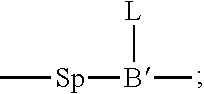
[0063]B refers

[0064]Sp refers group —(CH2)n—, or a group obtained by a —CH2— in the group —(CH2)n— substituted with —O—, —S—, —CO—, —CO—O—, —O—CO—, —O—CO—O—, —OCH2—, —CH2O—, —CH═CH—, —CF═CF—, —C≡C—, —CH═CH—COO—, or —OCO—CH═CH—, wherein n is an integer 1˜8;

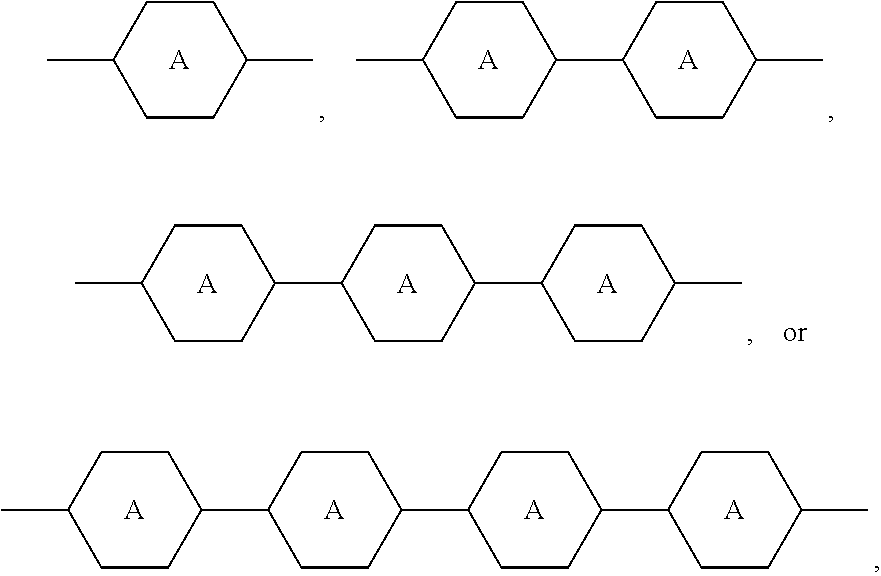
[0065]B′ refers

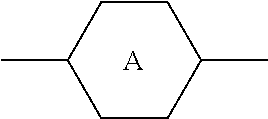
wherein

is phenyl, a group obtained by H atom of phenyl substituted with F, Cl, Br, I, —CN, —NO2...