Unlock instant, AI-driven research and patent intelligence for your innovation.

Content-Based Object Detection, 3D Reconstruction, and Data Extraction from Digital Images

Active Publication Date: 2019-03-21
KOFAX
View PDF31 Cites 29 Cited by
  • Summary
  • Abstract
  • Description
  • Claims
  • Application Information

AI Technical Summary

Benefits of technology

The patent describes a method for detecting and extracting objects from digital images using a computer system. The method involves identifying features within the object and creating a model to extract the content based on those features. This allows for accurate detection and extraction of objects from digital images, which can be useful in various applications such as object recognition and image analysis. The patent also includes corresponding systems and computer programs for this purpose.

Problems solved by technology

A major challenge in transitioning conventional document capture and processing techniques is the limited processing power and image resolution achievable using hardware currently available in mobile devices.
These limitations present a significant challenge because it is impossible or impractical to process images captured at resolutions typically much lower than achievable by a conventional scanner.
As a result, conventional scanner-based processing algorithms typically perform poorly on digital images captured using a mobile device.
In addition, the limited processing and memory available on mobile devices makes conventional image processing algorithms employed for scanners prohibitively expensive in terms of computational cost.
Attempting to process a conventional scanner-based image processing algorithm takes far too much time to be a practical application on modern mobile platforms.
A still further challenge is presented by the nature of mobile capture components (e.g. cameras on mobile phones, tablets, etc.).
Where conventional scanners are capable of faithfully representing the physical document in a digital image, critically maintaining aspect ratio, dimensions, and shape of the physical document in the digital image, mobile capture components are frequently incapable of producing such results.
Specifically, images of documents captured by a camera present a new line of processing issues not encountered when dealing with images captured by a scanner.
Additionally, with camera capture, nonlinear distortions may be introduced because of the camera optics.
Distortions and blur are particularly challenging when attempting to detect objects represented in video data, as the camera typically moves with respect to the object during the capture operation, and video data are typically characterized by a relatively low resolution compared to still images captured using a mobile device.
Moreover, the motion of the camera may be erratic and occur within three dimensions, meaning the horizontal and / or vertical consistency associated with linear motion in a conventional scanner is not present in video data captured using mobile devices.
Accordingly, reconstructing an object to correct for distortions, e.g. due to changing camera angle and / or position, within a three-dimensional space is a significant challenge.
However, often the detection of objects within the mobile image data is a challenging task, particularly where the object's edges may be missing, obscured, etc. within the captured image / video data.
Since conventional detection techniques rely on detecting objects by locating edges of the object (i.e. boundaries between the object, typically referred to as the image “foreground” and the background of the image or video), missing or obscured object edges present an additional obstacle to consistent and accurate object detection.

Method used

the structure of the environmentally friendly knitted fabric provided by the present invention; figure 2 Flow chart of the yarn wrapping machine for environmentally friendly knitted fabrics and storage devices; image 3 Is the parameter map of the yarn covering machine
View more

Image

Smart Image Click on the blue labels to locate them in the text.
Viewing Examples
Smart Image
  • Content-Based Object Detection, 3D Reconstruction, and Data Extraction from Digital Images
  • Content-Based Object Detection, 3D Reconstruction, and Data Extraction from Digital Images
  • Content-Based Object Detection, 3D Reconstruction, and Data Extraction from Digital Images

Examples

Experimental program
Comparison scheme
Effect test

Embodiment Construction

[0036]The following description is intended to illustrate the general principles of the present invention and is not meant to limit the inventive concepts claimed herein. Further, particular features described herein can be used in combination with other described features in each of the various possible combinations and permutations.

[0037]Unless otherwise specifically defined herein, all terms are to be given their broadest possible interpretation including meanings implied from the specification as well as meanings understood by those skilled in the art and / or as defined in dictionaries, treatises, etc.

[0038]It must also be noted that, as used in the specification and the appended claims, the singular forms “a,”“an” and “the” include plural referents unless otherwise specified.

[0039]The present application refers to image processing. In particular, the present application discloses systems, methods, and computer program products configured to detect and reconstruct objects depicte...

the structure of the environmentally friendly knitted fabric provided by the present invention; figure 2 Flow chart of the yarn wrapping machine for environmentally friendly knitted fabrics and storage devices; image 3 Is the parameter map of the yarn covering machine
Login to View More

PUM

No PUM Login to View More

Abstract

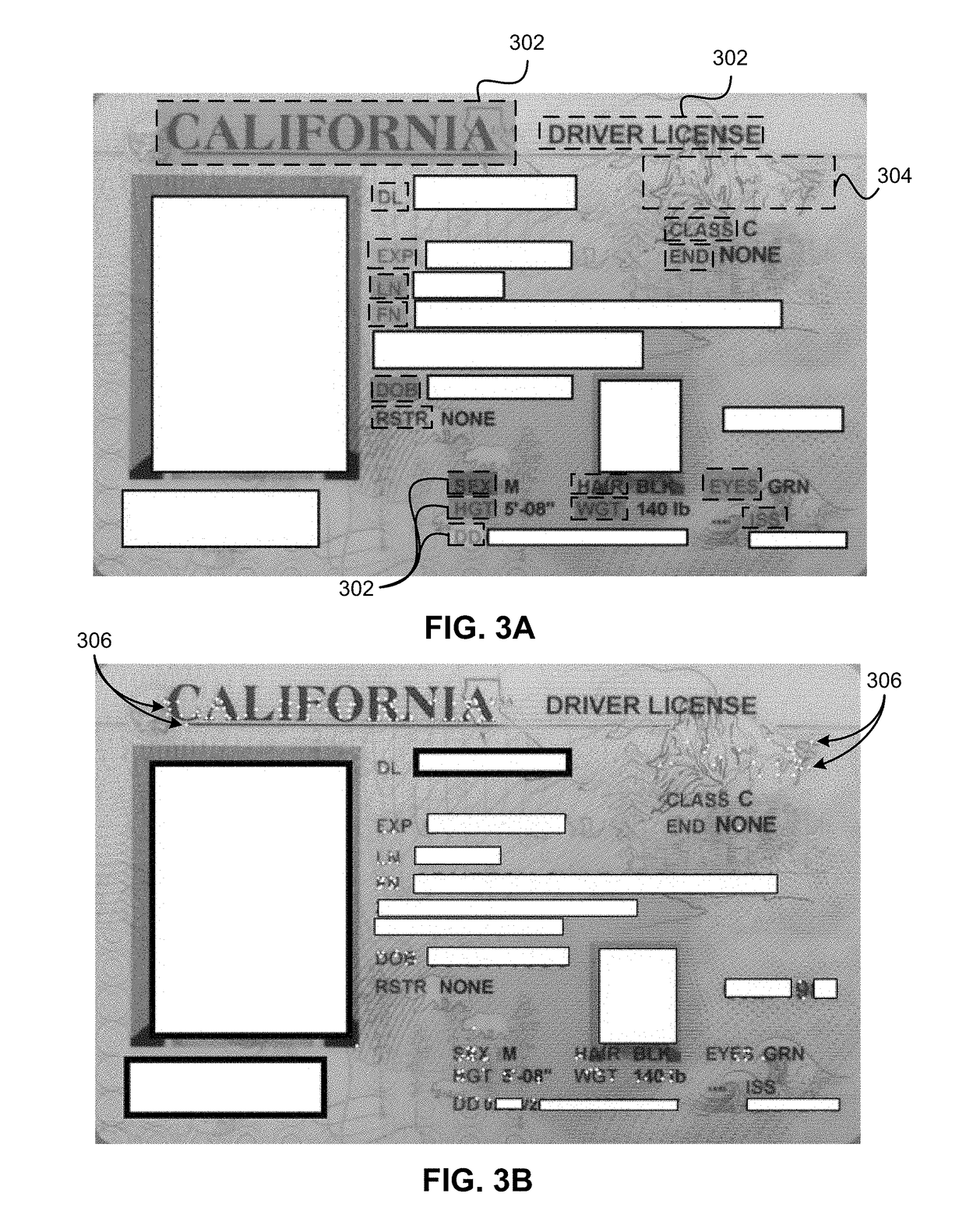
A method of detecting an object depicted in a digital image includes: detecting a plurality of identifying features of the object, wherein the plurality of identifying features are located internally with respect to the object; projecting a location of region(s) of interest of the object based on the plurality of identifying features, where each region of interest depicts content; building and / or selecting an extraction model configured to extract the content based at least in part on: the location of the region(s) of interest, the of identifying feature(s), or both; and extracting the some or all of the content from the digital image using the extraction model. Corresponding system and computer program product embodiments are disclosed. The inventive concepts enable reliable extraction of data from digital images where portions of an object are obscured / missing, and / or depicted on a complex background.

Description

RELATED APPLICATIONS[0001]This application is a continuation-in-part of U.S. patent application Ser. No. 16 / 151,090, filed Oct. 3, 2018, which is a continuation of U.S. patent application Ser. No. 15 / 234,993, filed Aug. 11, 2016, which claims the benefit of U.S. Provisional Patent Application No. 62 / 317,360, filed Apr. 1, 2016 and which is a continuation-in-part of U.S. patent application Ser. No. 14 / 932,902, filed Nov. 4, 2015 (granted Apr. 17, 2018 as U.S. Pat. No. 9,946,954), which is a continuation of U.S. patent application Ser. No. 14 / 491,901 filed Sep. 19, 2014 (granted Dec. 8, 2015 as U.S. Pat. No. 9,208,536), which claims the benefit of U.S. Provisional Patent Application No. 61 / 883,865. Priority is claimed to each of the foregoing applications, and the contents of which are herein incorporated by reference.[0002]This application is a continuation-in-part of U.S. patent application Ser. No. 15 / 396,322, filed Dec. 30, 2016, which is a continuation-in-part of U.S. patent appl...

Claims

the structure of the environmentally friendly knitted fabric provided by the present invention; figure 2 Flow chart of the yarn wrapping machine for environmentally friendly knitted fabrics and storage devices; image 3 Is the parameter map of the yarn covering machine
Login to View More

Application Information

Patent Timeline
no application Login to View More
IPC IPC(8): G06T5/00G06T7/50G06T3/00G01B11/14G06K9/62H04N1/00G06V10/20
CPCG06T7/50G06T3/00G01B11/14G06K9/6211G06T5/002H04N1/00G06T2207/30176G06K9/00483G06K9/4671G06T7/12G06V30/414G06V10/247G06V10/20G06V30/418G06T5/70
Inventor MA, JIYONGTHOMPSON, STEPHEN M.AMTRUP, JAN W.
Owner KOFAX