
System and method to percutaneously block painful sensations
a nerve fiber and percutaneous block technology, applied in the field of system and method to block nerve fiber activity, can solve the problems of uncomfortable sensations, uncomfortable motor contractions, and difficulty in the use of high-frequency electrical stimulation, and achieve the effect of facilitating complete, or near complete, blockage of nerve conduction
- Summary
- Abstract
- Description
- Claims
- Application Information
AI Technical Summary
Benefits of technology
Problems solved by technology
Method used
Image

Examples
example system # 1
EXAMPLE SYSTEM #1
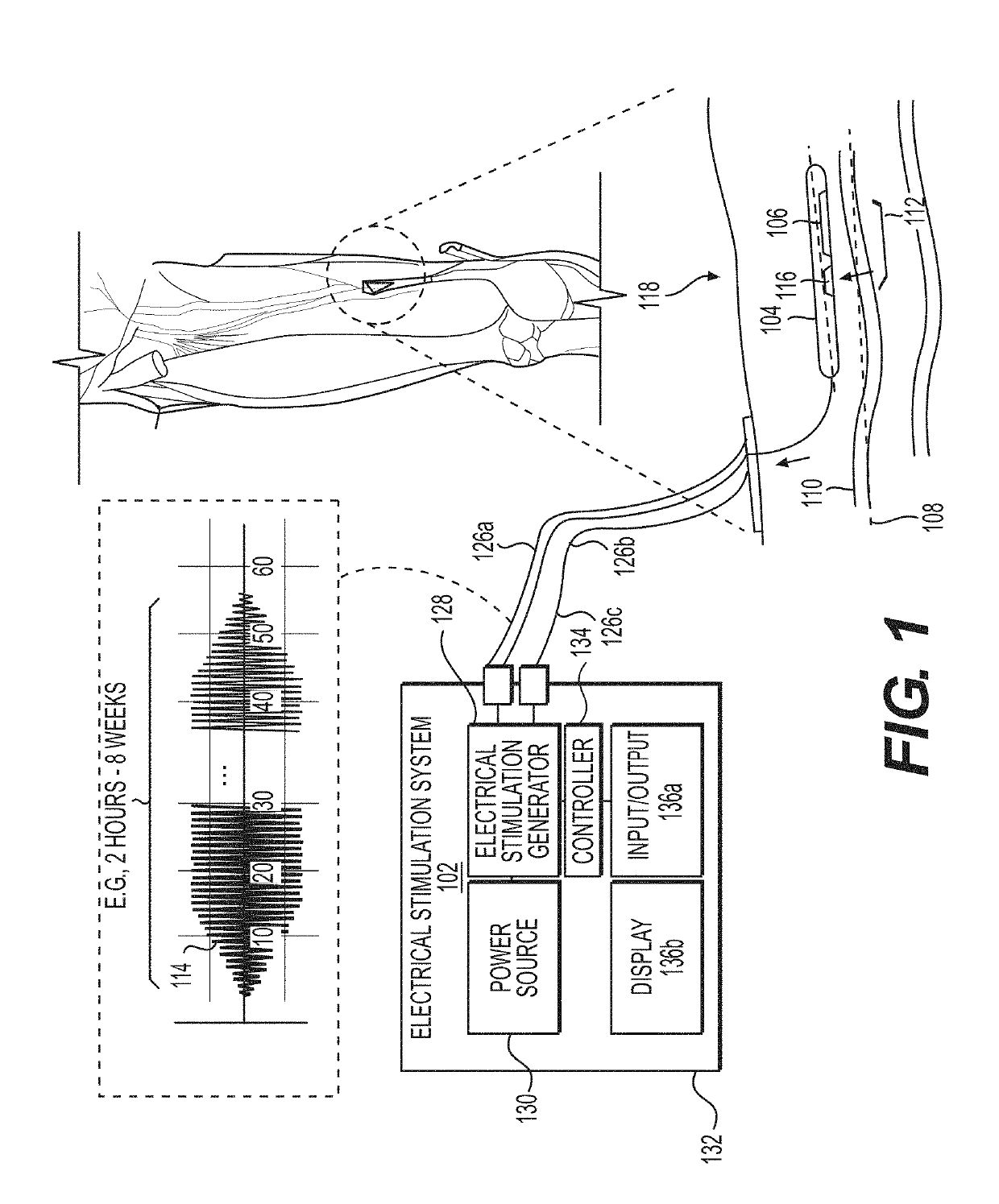
[0212]FIG. 1 is a diagram of an exemplary electrical stimulation system 102 configured to deliver electrical stimulation 114 from a percutaneous lead 104 comprising one or more percutaneous electrode(s) 106 placed in parallel, or substantially in parallel, and without direct contact, to a long axis 108 of a target nerve 110 over an overlapping nerve region 112 of greater than about 3 millimeters, to block nerve conduction through the overlapping nerve region 112, in accordance with an illustrative embodiment. This overlapping nerve region 112 is also referred to herein as a point of nerve conduction block 112. A percutaneous electrode 106 does not have to directly contact the nerve trunk, e.g., the epineurium, though it can, and the electrode and its associated assembly can be offset from the nerve trunk by up to 15 millimeters. The intensity or power of the electrical stimulation may be adjusted to compensate for individual patient perception of pain as well as for...
example system # 2
EXAMPLE SYSTEM #2
Implantable Stimulator
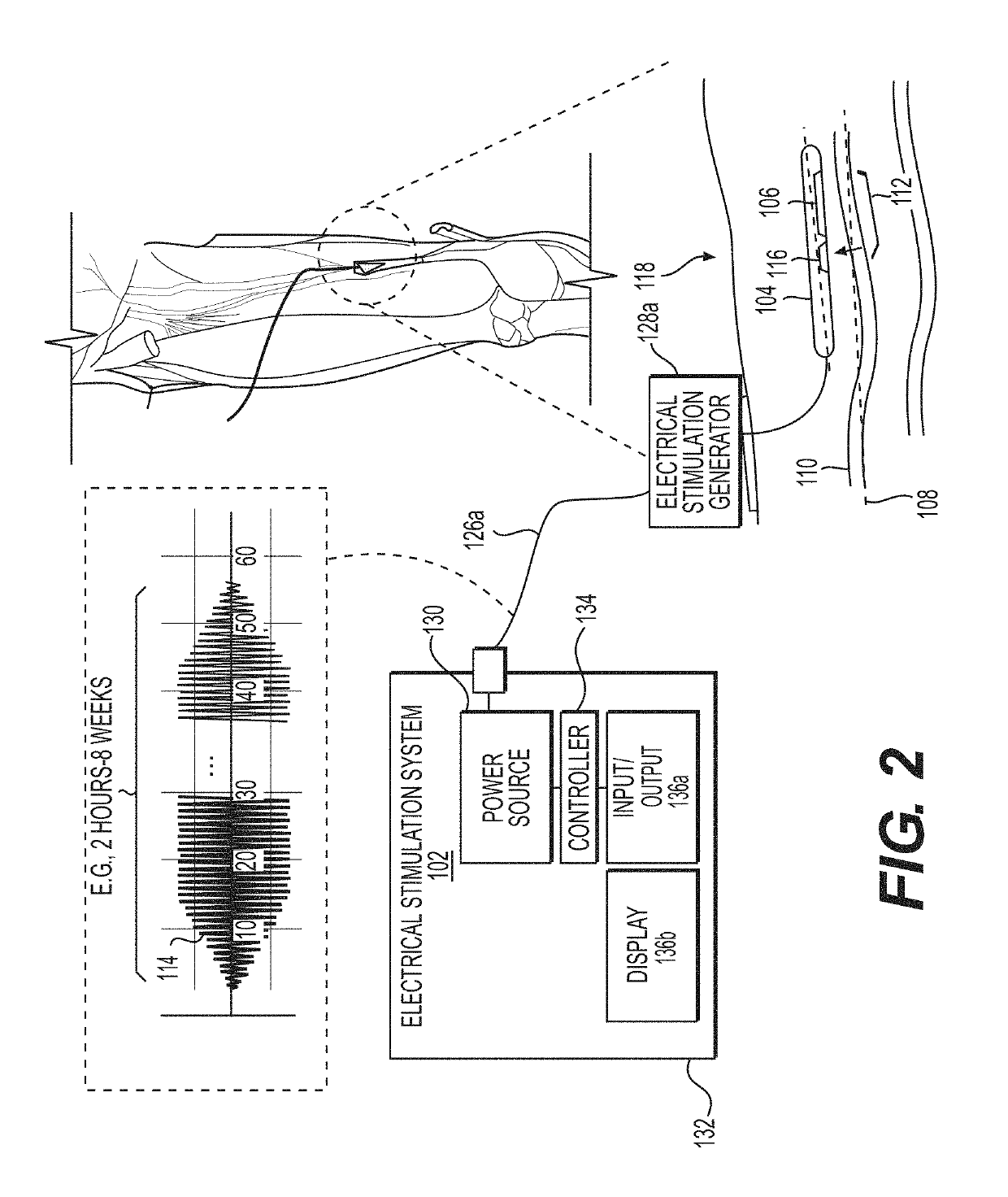
[0222]FIG. 2 is a diagram of another exemplary electrical stimulation system 102a configured to deliver electrical stimulation (114) from a percutaneous leads 104 comprising one or more percutaneous electrode(s) 106 placed in parallel, or substantially in parallel, and without direct contact, to a long axis 108 of a target nerve 110 over an overlapping nerve region 112 of greater than about 3 millimeters, to block nerve conduction through the overlapping nerve region 112, in accordance with an illustrative embodiment.
[0223]Rather than an external electrical stimulator 128, the electrical stimulation system 102a includes an implantable stimulator 128a that can be placed on, or under, the skin of the patient 118.
[0224]Method of Treatment By Placement of Percutaneous Electrode in Parallel Orientation to a Target Nerve
[0225]In another aspect, a method of treatment is provided to place a percutaneous lead at a treatment site of a subject to block ne...
example # 1
EXAMPLE #1
[0387]FIG. 27 demonstrates the sensory response in an able-bodied subject to a percutaneously delivered high-frequency electrical stimulation. The sensations are consistent with the onset response elicited by high-frequency stimulation of a sensory nerve. An S8 (Abbott) electrode was used to stimulate the saphenous nerve at a site 5-to-10 cm proximal to the ankle. The stimulation consisted of a constant-current, 10 kHz sinusoidal waveform, and it was delivered for a period of 20 seconds at various amplitudes, including 4 mA (A—see reference number 2704), 6 mA (B—see reference number 2706), 10 mA (C—see reference number 2708), and 15 mA (D—see reference number 2710). The subject verbally described the quality of the evoked sensations (e.g. light-touch or pain) and indicated the intensity of the sensation on an 11-point scale: levels 1 and 2 defined tactile sensation, level 3 defined the pain threshold, and levels 4-10 indicated a mild-to-severe painful sensation.
[0388]FIG. ...
PUM
 Login to View More
 Abstract
Description
Claims
Application Information
 Login to View More