

Dense reconstruction for narrow baseline motion observations
a baseline motion and dense reconstruction technology, applied in the field of reconstruction of dense geometry, can solve the problems of large variation, high depth uncertainty, and inability to generate accurate three-dimensional models using these bursts of two-dimensional images
- Summary
- Abstract
- Description
- Claims
- Application Information
AI Technical Summary
Benefits of technology
Problems solved by technology
Method used
Image

Examples
Embodiment Construction
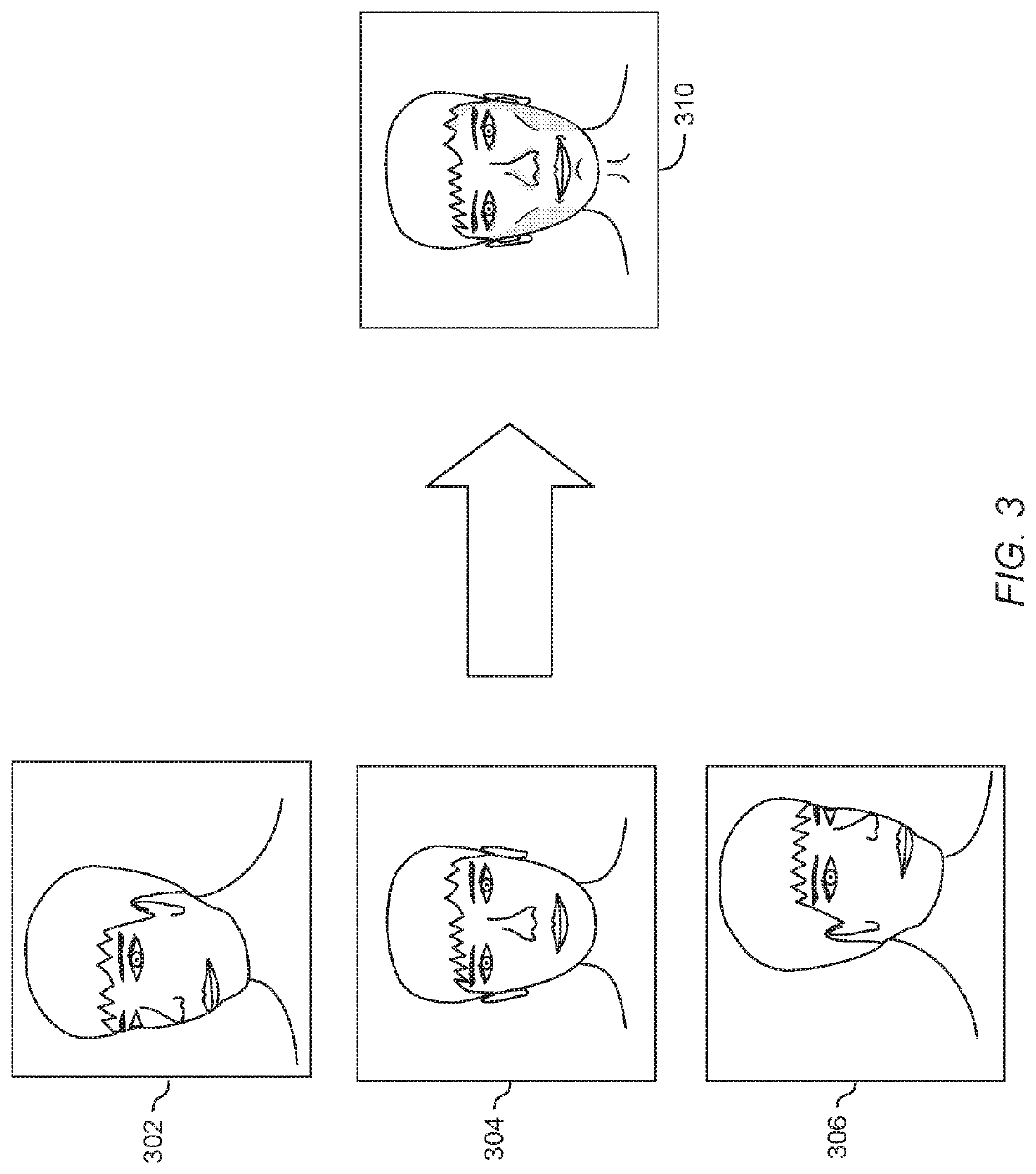
[0017]Some techniques reconstruct a three-dimensional model of a static object from a static burst of two dimensional images by matching key points with a strong edge or gradient. For example, these techniques can be used to reconstruct a three-dimensional model from a series of images reflecting narrow baseline motion. These techniques are sometimes suitable for reconstructing static objects, but are often not suitable for reconstructing three-dimensional facial geometry. This is because many facial areas are smooth and texture-less, and so these techniques do not generate an accurate three-dimensional model of the facial geometry. For example, these techniques are often not suitable for generating three-dimensional facial geometry from a series of self-taken images using a camera on a mobile device.
[0018]As one example, photographers, and particularly mobile device users, sometimes exhibit shaky movements when taking a picture. This can be referred to as a “shaky cam” effect. This...
PUM
 Login to View More
 Abstract
Description
Claims
Application Information
 Login to View More