
Timepiece resonator comprising at least one flexure bearing
a timepiece and bearing technology, applied in the field of timepiece resonators, can solve the problems of limited precision of traditional mechanical watches and errors of the order of 100 seconds per day of operation, and achieve the effect of limiting anticlastic curvature and stiffening
- Summary
- Abstract
- Description
- Claims
- Application Information
AI Technical Summary
Benefits of technology
Problems solved by technology
Method used
Image

Examples
Embodiment Construction
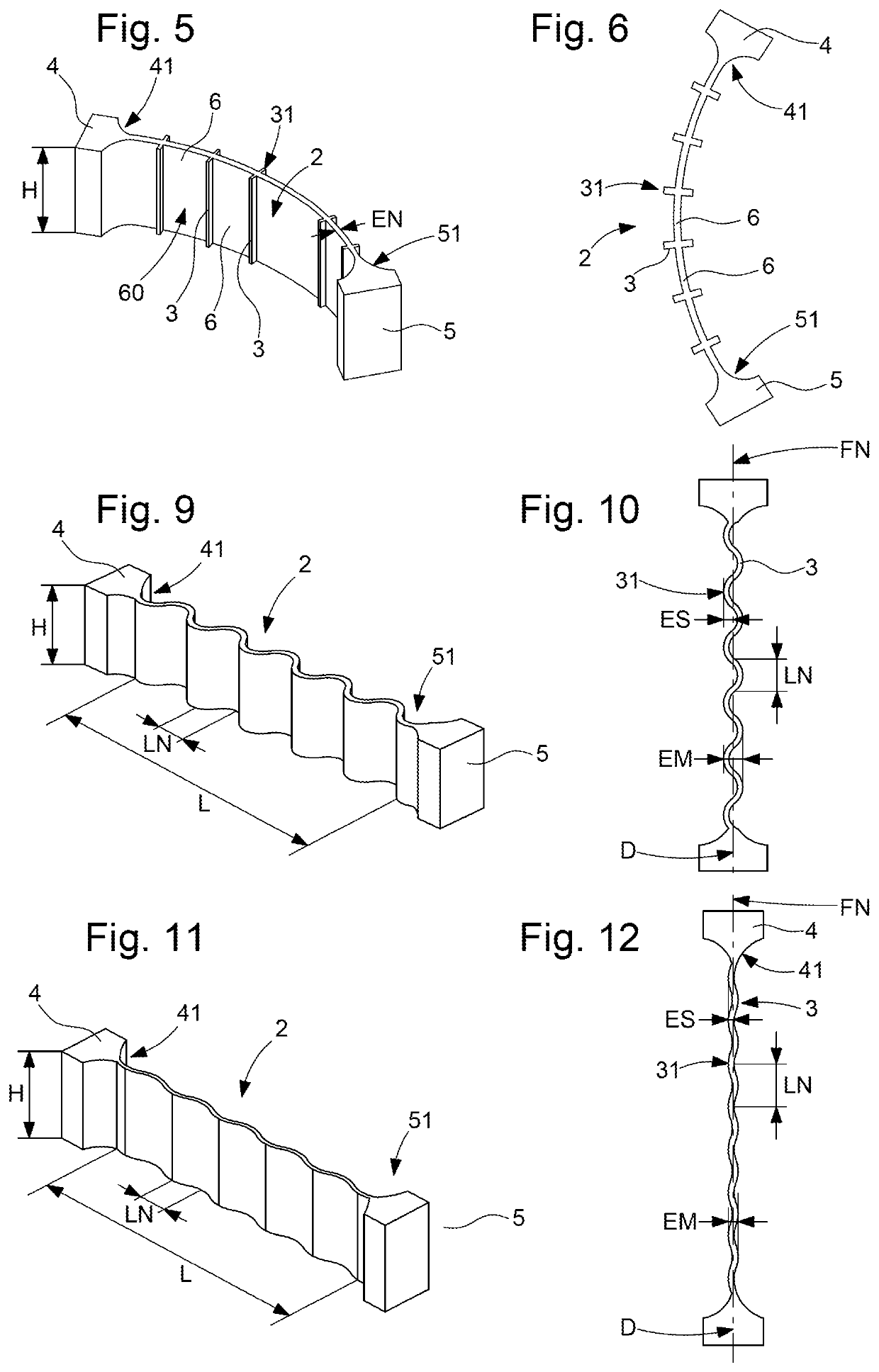
[0069]The invention proposes to provide the flexible strip with relief, and more particularly ribs, to control anticlastic curvature.
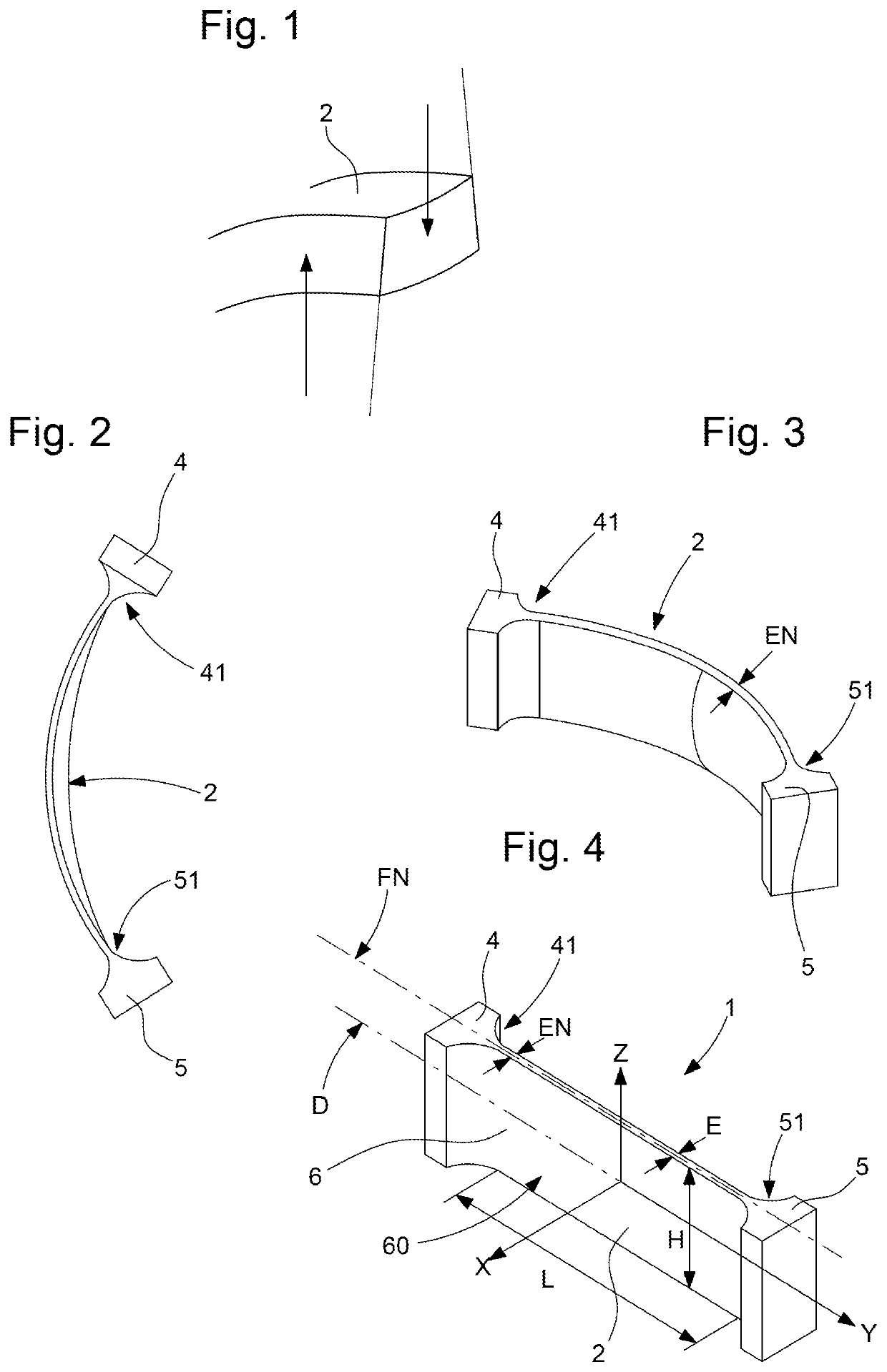
[0070]FIGS. 1 to 3 represent a conventional flexible strip subject to anticlastic curvature.
[0071]FIG. 4 defines the geometric reference elements used in the following description and represents a flexible strip 2 joining a first embedment 41 of a first element 4 to a second embedment 51 of a second element 5. The first embedment 41 defines with the second embedment 51 a strip direction D. First element 4 and second element 5 are each stiffer than each flexible strip 2. Flexible strip 2 is arranged to deform essentially in a plane XY, parallel to strip direction D, and having a first dimension L, called the length, along a first longitudinal axis Y parallel to strip direction D and defined by first embedment 41 and second embedment 51, a second dimension E, called the thickness, along a second transverse axis X orthogonal to first axis Y in plane XY, a...
PUM
 Login to View More
 Abstract
Description
Claims
Application Information
 Login to View More