Unlock instant, AI-driven research and patent intelligence for your innovation.

Assays for detecting multiple tick-borne pathogens

a technology for detecting ticks and pathogens, applied in the field of kits for identifying tickborne pathogens, can solve problems such as reducing productivity, tick bites, mechanical damage, irritation,

Pending Publication Date: 2021-07-29
US SEC AGRI +1
View PDF0 Cites 0 Cited by
  • Summary
  • Abstract
  • Description
  • Claims
  • Application Information

AI Technical Summary

Problems solved by technology

Tick bites cause mechanical damage, irritation, inflammation and hypersensitivity.
Infestation with a large number of ticks may cause anemia and reduced productivity.
Salivary secretions of some ticks cause toxicosis and paralysis.
Tick-borne diseases are becoming a serious problem.
No diagnostic assay currently exists which allows for quick and inexpensive detection and identification of TBRF pathogens.
Further, prior art qPCR assays are unable to detect and identify Borrelia turnicatae.
Current assays to detect these pathogens are inadequate either because the assays are not sensitive enough, not specific enough, not fast enough, and / or are unable to determine if an infection is currently occurring or if the infection occurred days, weeks, or years ago.
Prior art qPCR assays conduct multiple qPCR panels in multiple wells, and use multiple DNA samples in order to screen for all of the pathogens—a process that is costly and extremely time consuming.

Method used

the structure of the environmentally friendly knitted fabric provided by the present invention; figure 2 Flow chart of the yarn wrapping machine for environmentally friendly knitted fabrics and storage devices; image 3 Is the parameter map of the yarn covering machine
View more

Image

Smart Image Click on the blue labels to locate them in the text.
Viewing Examples
Smart Image
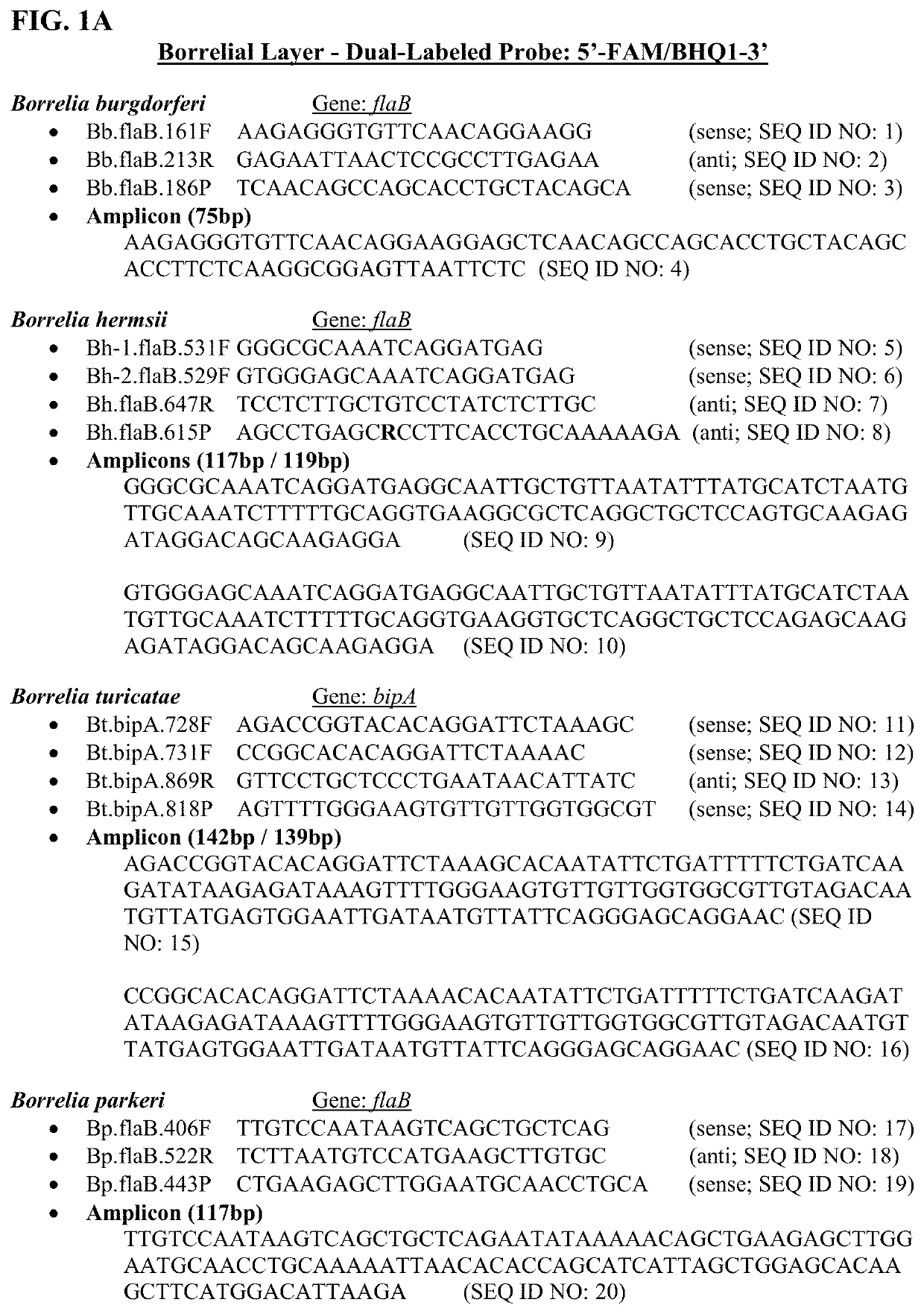
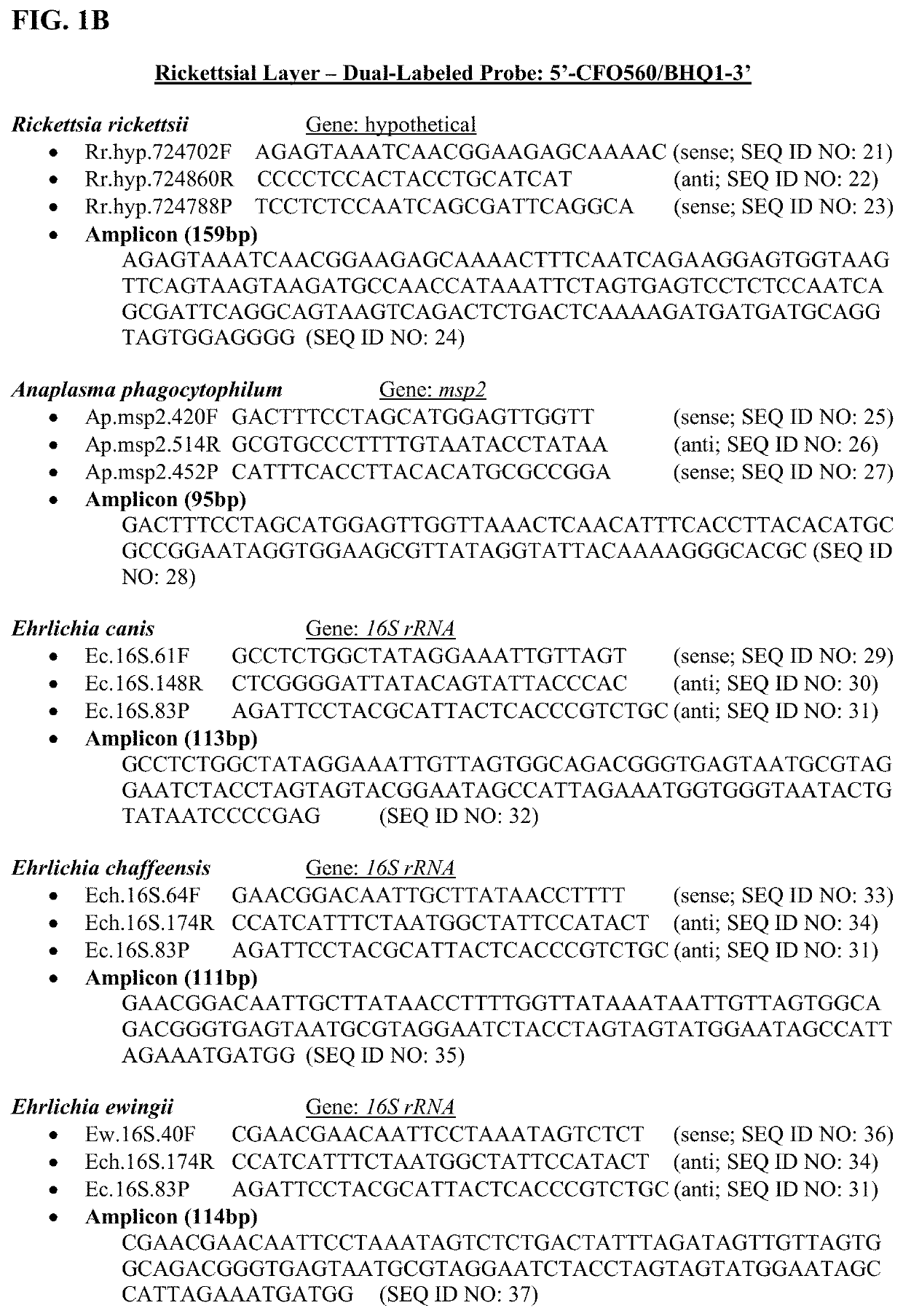
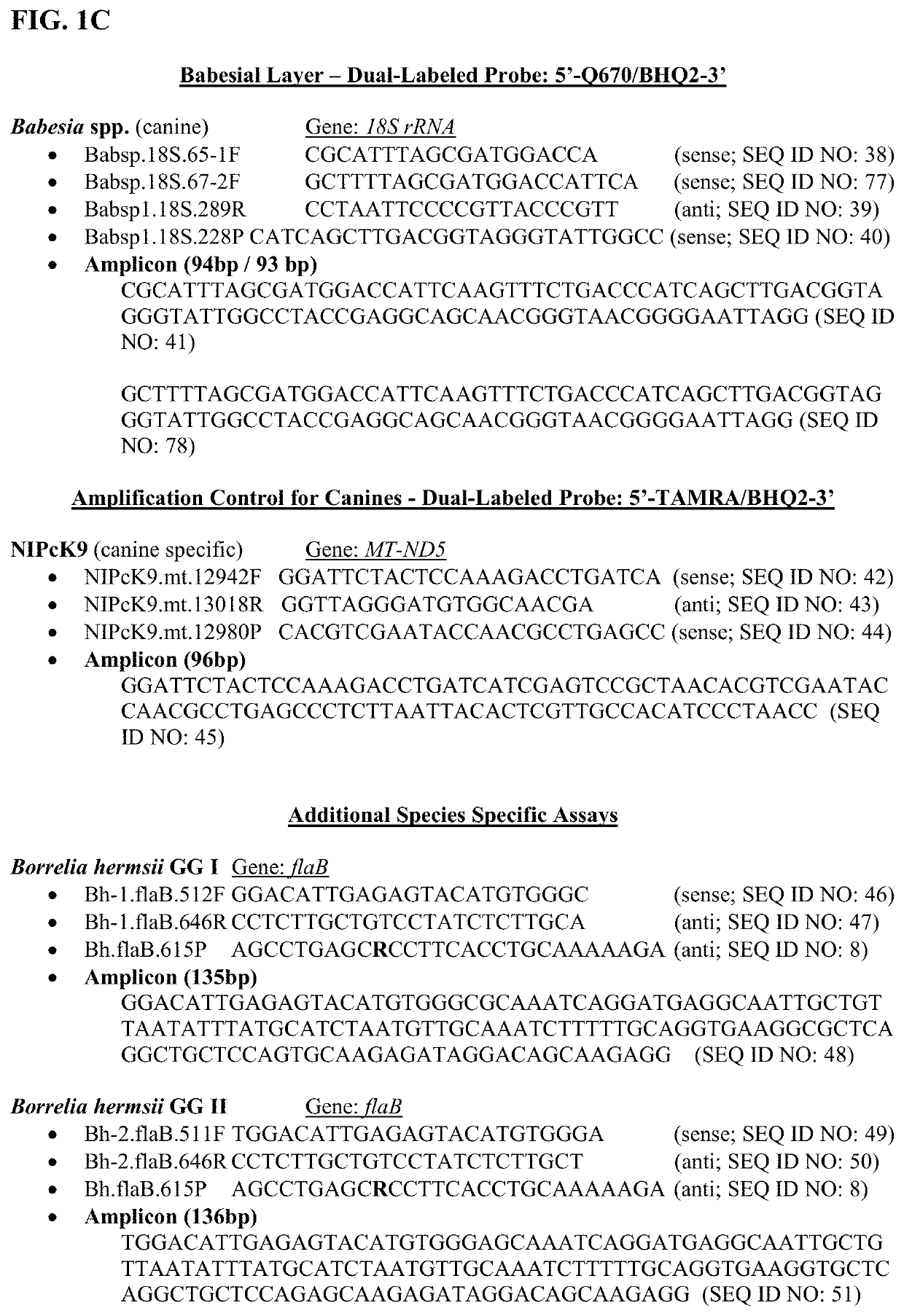
  • Assays for detecting multiple tick-borne pathogens
  • Assays for detecting multiple tick-borne pathogens
  • Assays for detecting multiple tick-borne pathogens

Examples

Experimental program
Comparison scheme
Effect test

example 2

ion of Amplification Control Plasmids

[0141]The amplification control plasmid for multiplex PCR assays were cloned individually utilizing the cloning vector pCR2.1 TOPO system (ThermoFischerScientific, Waltham, Mass.) using the primers disclosed in Table 1. PCR amplicons corresponding to each amplification control were ligated into pCR2.1 TOPO plasmid vector following manufacturer's recommendations using conditions provided in Table 4.

TABLE 4Ligation reaction used for TOPO-TA cloningReagentVolFresh PCR product4 μlSalt Solution1 μlTOPO ™ Vector1 μlFinal Volume6 μl

[0142]For Ap, a synthetic fragment of the gene msp2 (locus APH_1017, gene location: 1076720-1075449 A. phagocytophilum HZ) cloned into the plasmid pIDTSMARTkan (Integrated DNA Technologies, Inc.) was ordered. msp2 was subcloned with EcoRV flanking cut sites into the cloning vector pCR2.1, TOPO system (ThermoFischerScientific, Waltham, Mass.).

[0143]Vectors containing the fragments of interest were chemically transformed into E...

example 3

ction

[0153]DNA was extracted from the tick samples using Wizard™ SV Genomic DNA Purification kit (Promega Corp., Madison, Wis.) following manufacturer's recommendations with modifications. For optimal DNA extraction, adult individual ticks were homogenized utilizing the bead mill Bead Ruptor 24 (Omni International, Inc., Kennesaw, Ga.) in 200 μl of Nuclei Lysis Solution, plus 50 μl of 0.5 M EDTA, 40 μl of a 20 mg / ml Proteinase K solution, and 5 μl RNase A solution. The mixture was incubated at 70° C. for 10 minutes. After the initial incubation, un-engorged ticks were homogenized with 1.4 mm ceramic beads while 2.8 mm ceramic beads were used with engorged ticks. After homogenization, tubes were centrifuged at 10,000 g to eliminate tick debris. Supernatants were collected, and 250 μl of Wizard™ SV Lysis Buffer was added to each sample and the mixture. The mixture was run through filter columns at 13,000 g for 3 minutes. DNA bound to the filter was washed and eluted following manufact...

example 4

PCR

[0155]The PCR was done in 25 μl volume, using AccuStart™ SuperMix (Quanta Bioscience Inc., Gaithersburg, Md.). Table 2, supra, shows the composition and concentration of the reagents utilized in such reaction. A master mix was prepared in a PCR clean bench to avoid contamination. After the reaction tubes were prepared, PCR was performed in an Eppendorf AG Master Cycler following the cycling condition described in Table 3, supra. The amplification products were separated on a 1.5% agarose gel (Bio-Rad Laboratories Inc., Hercules, Calif.) at 90 volts for 40-60 minutes and imaged using the ChemiDoc touch Imaging System (Bio-Rad Laboratories Inc., Hercules, Calif.). Positive bands were excised from the gel and purified using the Wizard™ SV Gel and PCR clean up system (Promega Corp., Madison, Wis.) following manufacturer's recommendations. The purified products were sent for sequencing (Eton Biosciences, San Diego, Calif.). Sequences were analyzed through BLAST using MacVector 12.6 so...

the structure of the environmentally friendly knitted fabric provided by the present invention; figure 2 Flow chart of the yarn wrapping machine for environmentally friendly knitted fabrics and storage devices; image 3 Is the parameter map of the yarn covering machine
Login to View More

PUM

PropertyMeasurementUnit
concentrationaaaaaaaaaa
Login to View More

Abstract

Kits, methods, and material for use in detecting tick-borne microorganism(s) are provided herein. One is able to detect DNA from several different species of microorganisms from samples (bodily fluid, tissue, etc.) from ticks and / or mammals to determine if one or more of the microorganisms has infected the tick and / or mammal. The assay uses PCR techniques with a multiple primers and probes. The microorganisms can be in the Borrelial Layer, the Rickettsiales Layer, and / or the Babesial Layer.

Description

CROSS REFERENCE TO RELATED APPLICATIONS[0001]This patent application is a continuation of U.S. Ser. No. 16 / 130,177, filed Sep. 13, 2018, which claims priority to U.S. Patent Application 62 / 563,780 filed on Sep. 27, 2017, contents of which are expressly incorporated by reference herein.BACKGROUND OF THE INVENTIONSequence Listing[0002]The Sequence Listing submitted via EFS-Web as ASCII compliant text file format (.txt) filed on Sep. 13, 2018, named “SequenceListing_ST25”, (created on Sep. 12, 2017, 19 KB), is incorporated herein by reference. This Sequence Listing serves as paper copy of the Sequence Listing required by 37 C.F.R. § 1.821(c) and the Sequence Listing in computer-readable form (CRF) required by 37 C.F.R. § 1.821(e). A statement under 37 C.F.R. § 1.821(f) is not necessary.Field of the Invention[0003]This invention relates to kits for identifying tick-borne pathogens in a sample, components for those kits, and methods of identifying tick-borne pathogens.Description of the ...

Claims

the structure of the environmentally friendly knitted fabric provided by the present invention; figure 2 Flow chart of the yarn wrapping machine for environmentally friendly knitted fabrics and storage devices; image 3 Is the parameter map of the yarn covering machine
Login to View More

Application Information

Patent Timeline
no application Login to View More
Patent Type & Authority Applications(United States)
IPC IPC(8): C12Q1/689C12Q1/6806C12Q1/686
CPCC12Q1/689C12Q1/6806C12Q2600/166C12Q2600/112C12Q2600/16C12Q1/686
Inventor PEREZ DE LEON, ADALBERTO A.ESTEVE-GASENT, MARIA D.FERRO, PAMELA J.MODARELLI, JOSEPH J.
Owner US SEC AGRI