
Compositions containing diesters or polyesters of naphthalene dicarboxylic acid and methods for imparting hair gloss and to provide hair color and hair dye stabilization
a technology of naphthalene dicarboxylic acid and diesters or polyesters, which is applied in the field of compositions containing diesters or polyesters of naphthalene dicarboxylic acid and methods for imparting hair gloss, can solve the problems of skin elasticity and wrinkle reduction, burns that are detrimental to the development of a good sun tan, etc., and achieves high spf, easy application, and effective hair color protection
- Summary
- Abstract
- Description
- Claims
- Application Information
AI Technical Summary
Benefits of technology
Problems solved by technology
Method used
Image

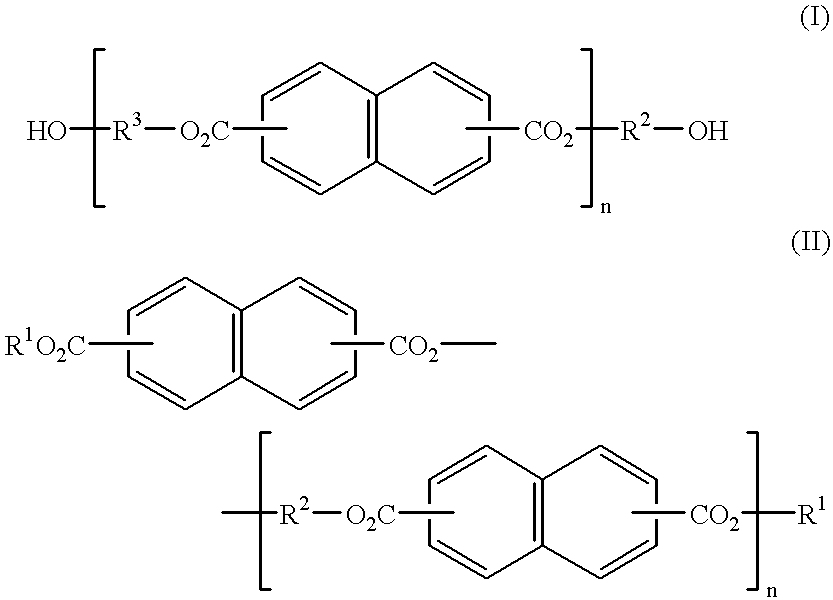
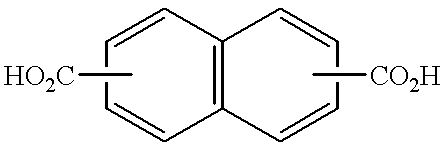
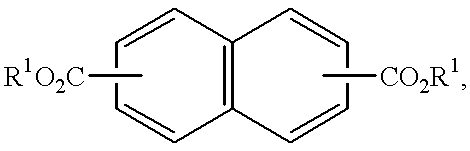
Examples
example 1
The photostabilizing effect of a polyester of 2,6-naphthalene dicarboxylic acid and tripropylene glycol with a 2-butyloctanol terminator was determined as follows. First, the following formulations containing 1% PARSOL.RTM. 1789 were prepared in the usual way by dissolving the PARSOL.RTM. 1789 in the oily phase and premixing the water phase, then emulsifying the oil by adding it to the water phase:
The photostability of the PARSOL.RTM. 1789 was determined by spreading measured amounts of the emulsions on 5 cm square slides of Vitro-skin, then irradiating the slides with a solar simulator. Absorbance measurements in the UV-A range (315-380 nm) were taken by a Labsphere UV Transmittance Analyzer before and after irradiation and the results compared.
After irradiation with 5 MED (minimal erythermal dose), the loss of UV-A absorbance by the PARSOL.RTM. 1789 was considerably lower in the formulations containing the PARSOL.RTM. 1789 in combination with 4% and 8% of the naphthalene dicarboxy...
example 2
The photostabilizing effect of a polyester of 2,6-naphthalene dicarboxylic acid, tripropylene glycol, and diethylene glycol with a 2-ethylhexanol terminator was compared to octocrylene, a well known photostabilizer for PARSOL.RTM. 1789. The following formulations were prepared in the usual manner, each containing 1% PARSOL.RTM. 1789 and 4% of either octocrylene or a polyester of 2,6-naphthalene dicarboxylic acid:
After following the protocol described above in Example 1, the following results were obtained:
The test demonstrated that the naphthalene dicarboxylic acid derived polyester is comparable to octocrylene in its ability to photostabilize PARSOL.RTM. 1789.
example 3
The following example is a preferred formulation for topical application to human hair to impart hair gloss and to stabilize natural and synthetically dyed hair from fading:
PUM
| Property | Measurement | Unit |
|---|---|---|
| Fraction | aaaaa | aaaaa |
| Fraction | aaaaa | aaaaa |
| Fraction | aaaaa | aaaaa |
Abstract
Description
Claims
Application Information
 Login to View More