[0007]The preferred embodiments of the present invention can collect ubiquitous ambient
radio frequency (RF) electromagnetic energy, convert it to a form useful for powering electronic devices, and store it for reuse. Thus, perpetual self contained subsystems or modules can be realized by using the reclaimed RF energy to power
active antenna components, low
power circuits, modules and other components such as transceivers, amplifiers, filters, etc. Hence, the preferred embodiments of the present invention can be applicable for any antenna or
antenna array, for any antenna
physical design (e.g.,
dipole, monopole, parabolic shape or dish, Yagi, etc.) and any
frequency band. In some applications, this technology could be used advantageously and conveniently to transfer power remotely, without a physical connection, using a RF
energy source intended for that purpose. In other applications, this technology could be used to maintain devices in a standby
sleep mode indefinitely without ancillary power source. Then an RF
signal could be used as a triggering mechanism to activate the device. Finally, for low power devices, this technology could provide primary power to the device and eliminate or reduce the traditional
battery charge cycle.
[0008]Accordingly, the preferred embodiments of the present invention provide an integration of classical antenna physical materials and construction concepts with
semiconductor and
microprocessor technology to create an antenna structure capable of transforming electromagnetic
waves into DC power. This antenna method and
system collects and processes RF energy for reuse while simultaneously performing its primary function, such as
signal reception, for a specific application. Furthermore, by using either a single
antenna element or an array of elements configured to receive a broad range of frequencies in the present invention, energy collection and antenna transmit / receive performance can be maximized and optimized at the same time. The preferred embodiments of the present invention also provide an Energy Reclamation
System (ERS) that collects, converts and stores energy for use from selected frequency bands over the entire
electromagnetic spectrum. These selected frequency bands are not required to be contiguous and may based on the operational environment, the application, any physical size limitations, and the technology available to cost effectively integrate an ERS into a device or application. An ERS of the present invention is not restricted to a single
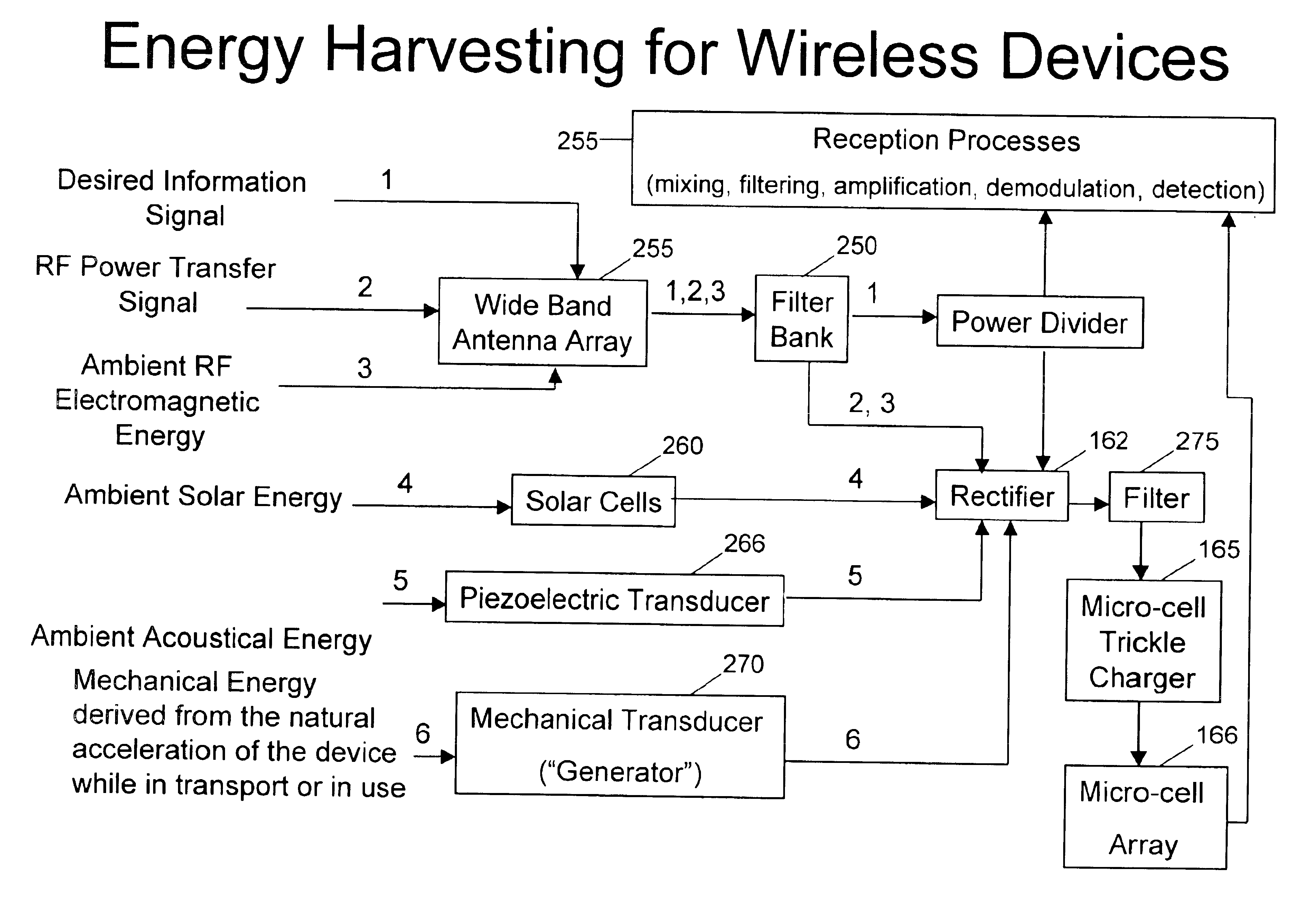
energy source because technologies like micro electromechanical systems (MEMS) can be used to integrate the collection of other types of energy, such as electromagnetic energy,
solar energy,
acoustic energy and / or casual motion energy. Thus, energy diversity enhances an ERS' ability to provide power consistent with the demands of modern devices and applications.
[0010]The preferred embodiments of the present invention also provide a method and
system for harvesting
electromagnetic spectrum energy using efficient
wideband omnidirectional antennas for maximizing the collection of RF energy. The antennas can be of any design such as monopole,
dipole, Yagi, or contrawound.
[0012]The preferred embodiments of the present invention also provide a method and system for transferring low power levels from an intentional power source advantageously and conveniently. This may be done remotely without a physical connection by using a RF
energy source with a focused or
blanket radiation pattern and an ERS at the target device. This may be used for numerous applications, including autonomous sensor or communication type applications in any environment (e.g., ground, air,
underwater) where the device may use the ERS as its power source or
backup power source. For example, for
underwater sensor locations, energy may come from
sonar or other types of energy sources that can propagate with tolerable losses through the water and / or from RF energy delivered to a remote antenna extended above the surface of the water. If remaining operational for extended periods of time requires additional power, the device can be wirelessly and remotely supplied with power for storage and future use.


 Login to View More
  Login to View More