Methods for fabricating three-dimensional all organic interconnect structures
What is AI technical title?
AI technical title is built by PatSnap AI team. It summarizes the technical point description of the patent document.
a three-dimensional all organic, interconnected technology, applied in the direction of thermal polymer dielectrics, inductances, printed circuit assembling, etc., can solve the problems of high density requirements for multi-layer circuits, unresolved need for a low cost multi-layer process, and increasing high frequency applications. , to achieve the effect of high frequency and high bandwidth applications
Inactive Publication Date: 2007-08-28
GEORGIA TECH RES CORP
View PDF105 Cites 34 Cited by
Summary
Abstract
Description
Claims
Application Information
AI Technical Summary
This helps you quickly interpret patents by identifying the three key elements:
Problems solved by technology
Method used
Benefits of technology
Benefits of technology
This approach enables the fabrication of high-frequency and high-bandwidth multilayer circuits with fine line geometries and embedded passive components, supporting applications beyond 6 GHz, while avoiding the use of adhesives that can degrade performance due to moisture uptake and providing homogeneous electrical and mechanical properties.
Problems solved by technology
The requirements for multilayer circuits in high density, high performance applications are becoming ever more demanding for high frequency applications.
As a result there exists an unresolved need for a low cost multilayer process that can support both high frequency and high density (e.g., fine line and spaces, small via sizes) multilayer circuit constructions.
Method used
the structure of the environmentally friendly knitted fabric provided by the present invention; figure 2 Flow chart of the yarn wrapping machine for environmentally friendly knitted fabrics and storage devices; image 3 Is the parameter map of the yarn covering machine
View more
Image
Smart Image Click on the blue labels to locate them in the text.
Viewing Examples
Smart Image
Click on the blue label to locate the original text in one second.
Reading with bidirectional positioning of images and text.
Smart Image
Examples
Experimental program
Comparison scheme
Effect test
Embodiment Construction
[0022]The present inventions now will be described more fully hereinafter with reference to the accompanying drawings, in which some, but not all embodiments of the invention are shown. Indeed, these inventions may be embodied in many different forms and should not be construed as limited to the embodiments set forth herein; rather, these embodiments are provided so that this disclosure will satisfy applicable legal requirements. Like numbers refer to like elements throughout.
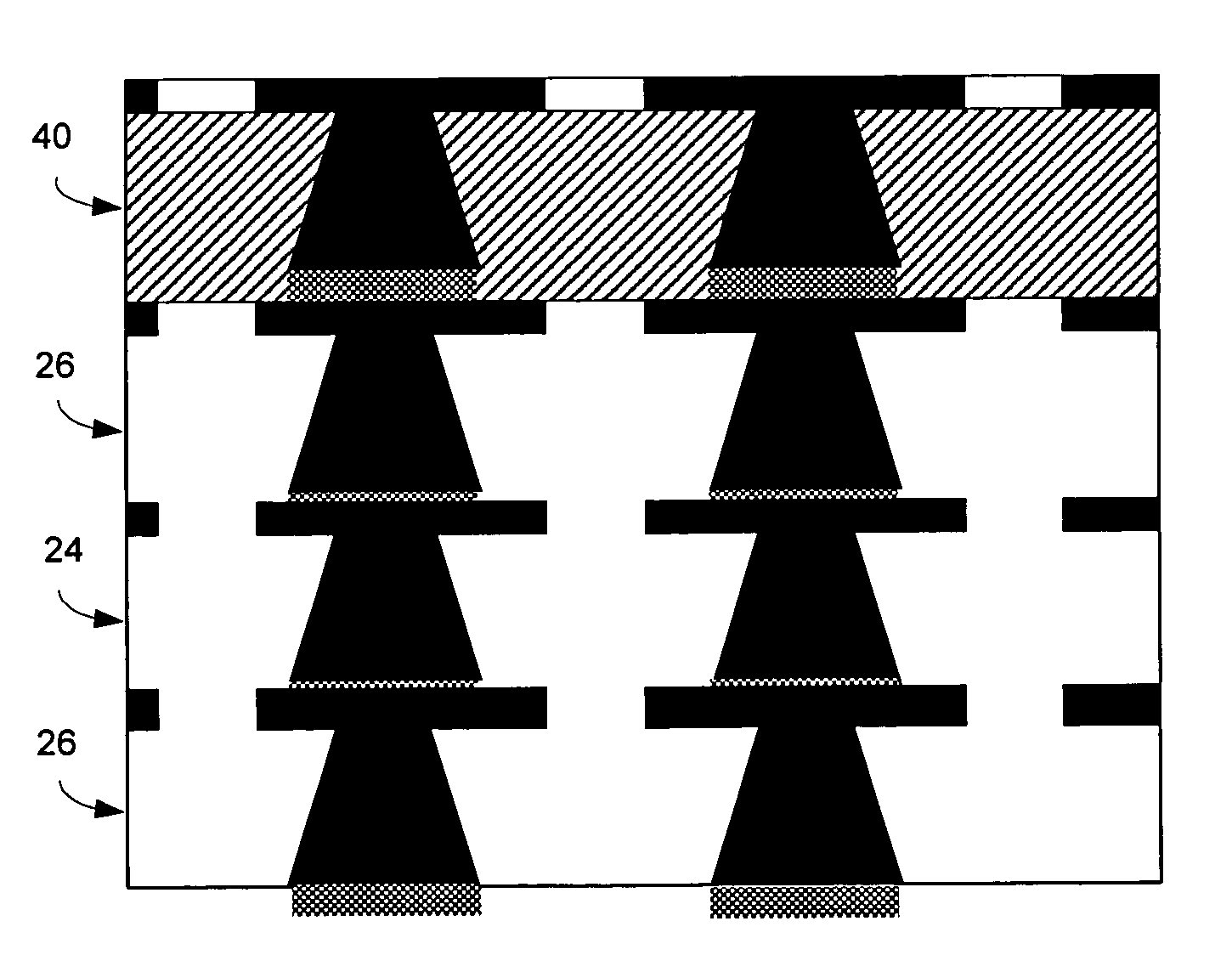
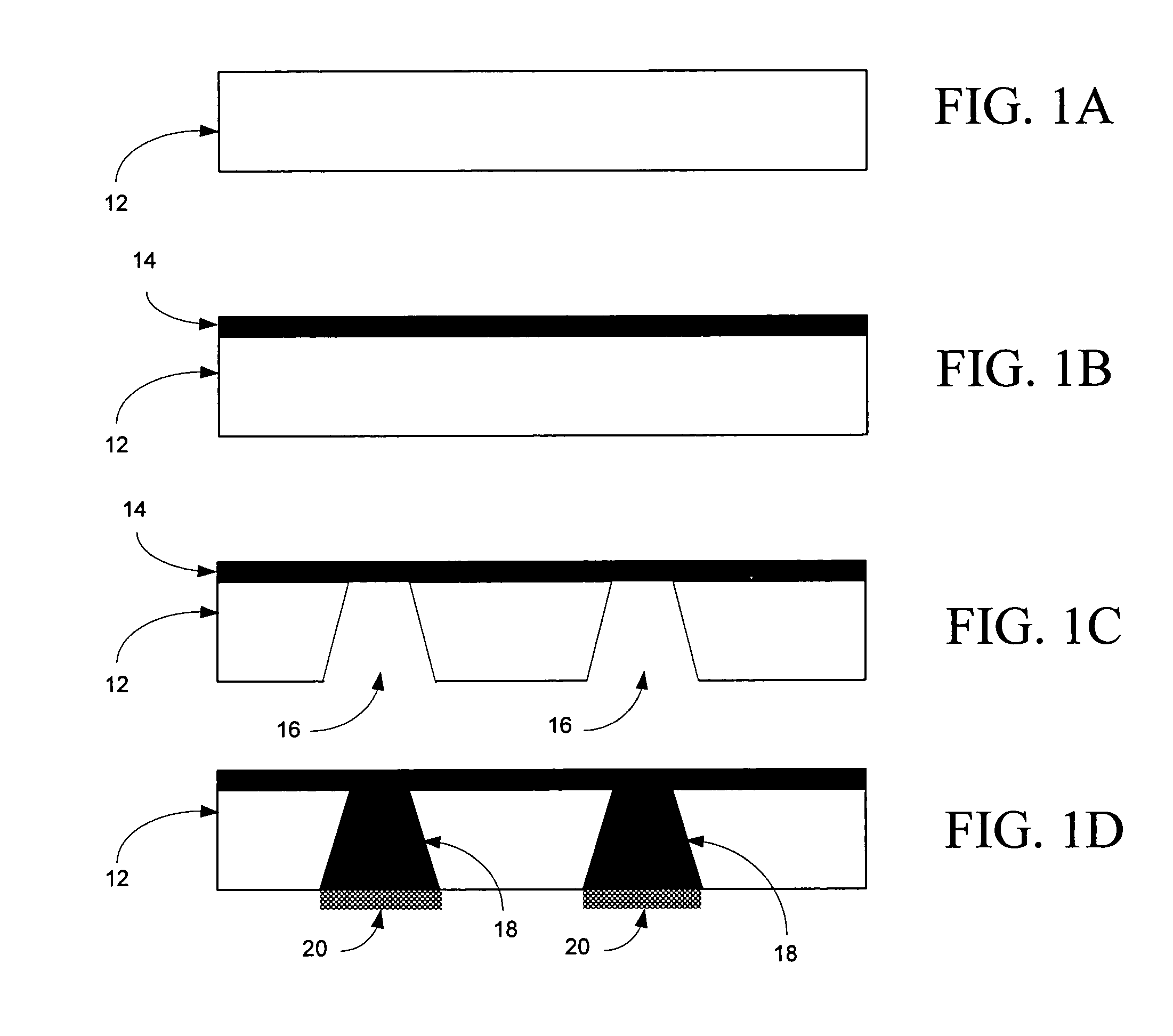
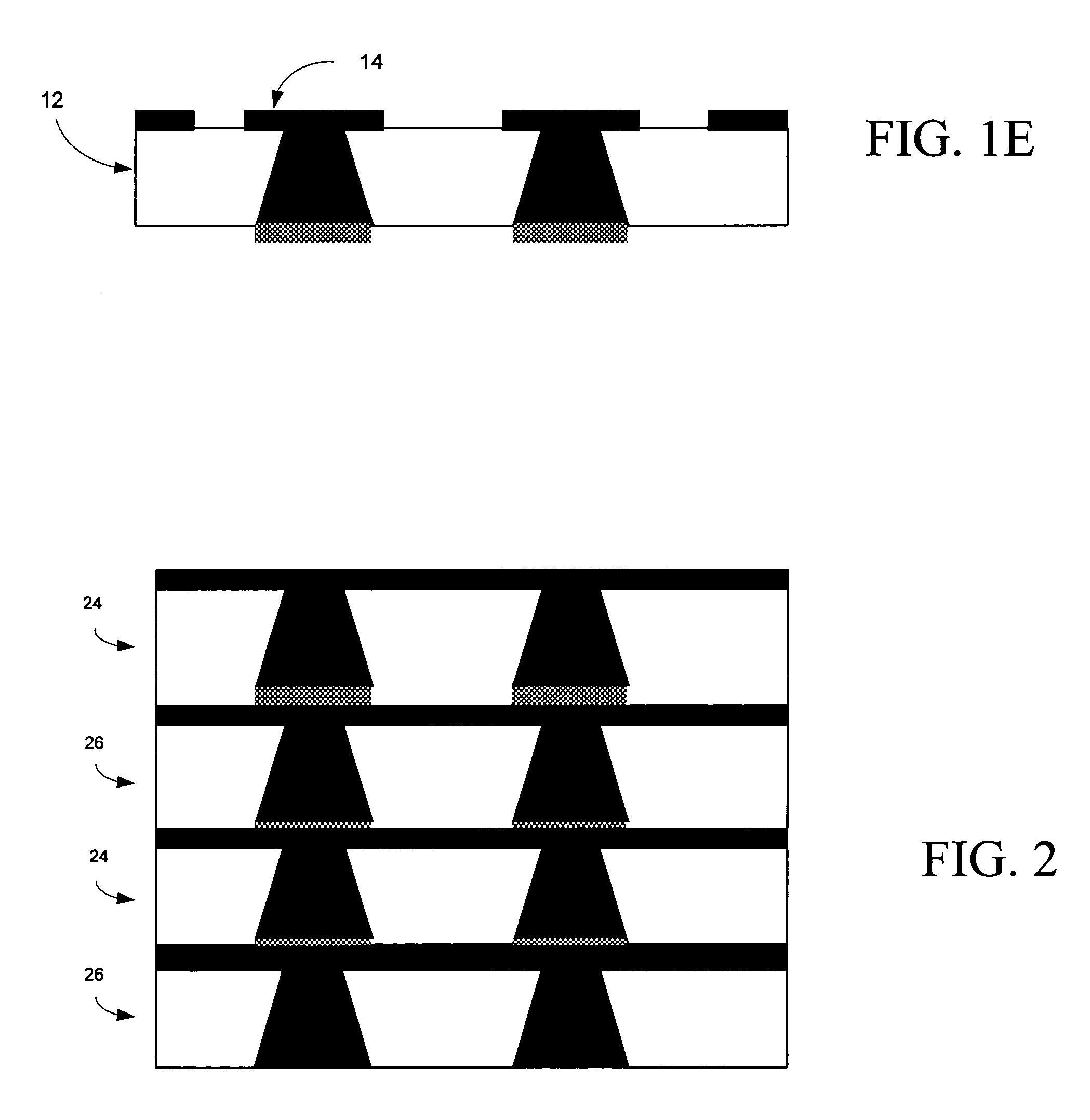
[0023]The present invention comprises three-dimensional (3-D) multilayer structures having at least one low temperature organic layer and at least one high temperature organic layer that are processed in a parallel fashion that provides for individual layers to be independently fabricated and tested prior to lamination into a multilayer 3-D circuit. Metal to metal bonding is formed by incorporating a high temperature alloy that melts at a temperature slightly above the fusion point of the low temperature organi...
the structure of the environmentally friendly knitted fabric provided by the present invention; figure 2 Flow chart of the yarn wrapping machine for environmentally friendly knitted fabrics and storage devices; image 3 Is the parameter map of the yarn covering machine
Login to View More
PUM
Property
Measurement
Unit
thickness
aaaaa
aaaaa
dielectric constants
aaaaa
aaaaa
volume fraction
aaaaa
aaaaa
Login to View More
Abstract
The present invention includes methods for making liquid crystallinepolymer (LCP) interconnect structures using a high temperature and low temperature single sided liquid crystallinepolymer LCP where both the high and low temperature LCP are drilled to form a z-axis connection. The single sided conductive layer is a bus layer to form z axis conductive stud within the high and low temperature LCP, followed by a metallic capping layer of the stud that serves as the bonding metal between the conductive interconnects to form the z-axis connection. High and low temperature LCP layers are etched or built up to form circuit patterns and subsequently bonded together to form final multilayer circuit pattern where the low temperature LCP melts to form both dielectric to dielectric bond to high temperature LCP circuit layer, and dielectric to conductive bond, whereas metal to metal bonding occurs with high temperature metal capping layer bonding to conductive metal layer.
Description
CROSS-REFERENCE TO RELATED APPLICATIONS[0001]This application claims benefit of co-pending U.S. Provisional Application No. 60 / 391,742, filed Jun. 26, 2002, which is entirely incorporated herein by reference. In addition, this application is related to the following co-pending, commonly assigned U.S. applications, each of which is entirely incorporated herein by reference: “Integrated Passive Devices Fabricated Utilizing Multilayer, Organic Laminates” filed Mar. 28, 2003, and accorded application Ser. No. 10 / 402,313, which issued on May 31, 2005 as U.S. Pat. No. 6,900,708; and “Stand-Alone Organic-Based Passive Devices” filed Mar. 28, 2003, and accorded application Ser. No. 10 / 405,024, which issued on Jan. 17, 2006 as U.S. Pat. No. 6,987,307.STATEMENT OF GOVERNMENT INTEREST[0002]The work that led to this invention has been supported in part by a grant from the U.S. Army, Contract No. DAAH01-99-D-R002-0032. Thus, the United States Government may have certain rights to this invention....
Claims
the structure of the environmentally friendly knitted fabric provided by the present invention; figure 2 Flow chart of the yarn wrapping machine for environmentally friendly knitted fabrics and storage devices; image 3 Is the parameter map of the yarn covering machine
Login to View More
Application Information
Patent Timeline
Application Date:The date an application was filed.
Publication Date:The date a patent or application was officially published.
First Publication Date:The earliest publication date of a patent with the same application number.
Issue Date:Publication date of the patent grant document.
PCT Entry Date:The Entry date of PCT National Phase.
Estimated Expiry Date:The statutory expiry date of a patent right according to the Patent Law, and it is the longest term of protection that the patent right can achieve without the termination of the patent right due to other reasons(Term extension factor has been taken into account ).
Invalid Date:Actual expiry date is based on effective date or publication date of legal transaction data of invalid patent.



 Login to View More