
Control apparatus for internal combustion engine and method of controlling internal combustion engine
a control apparatus and internal combustion engine technology, applied in the direction of engine starters, electric control, instruments, etc., can solve the problems of suppressing the decrease in heating capacity, reducing the heating capacity of the air conditioner, and not conditioned (heated) to the desired level in the vehicle cabin
- Summary
- Abstract
- Description
- Claims
- Application Information
AI Technical Summary
Benefits of technology
Problems solved by technology
Method used
Image

Examples
Embodiment Construction
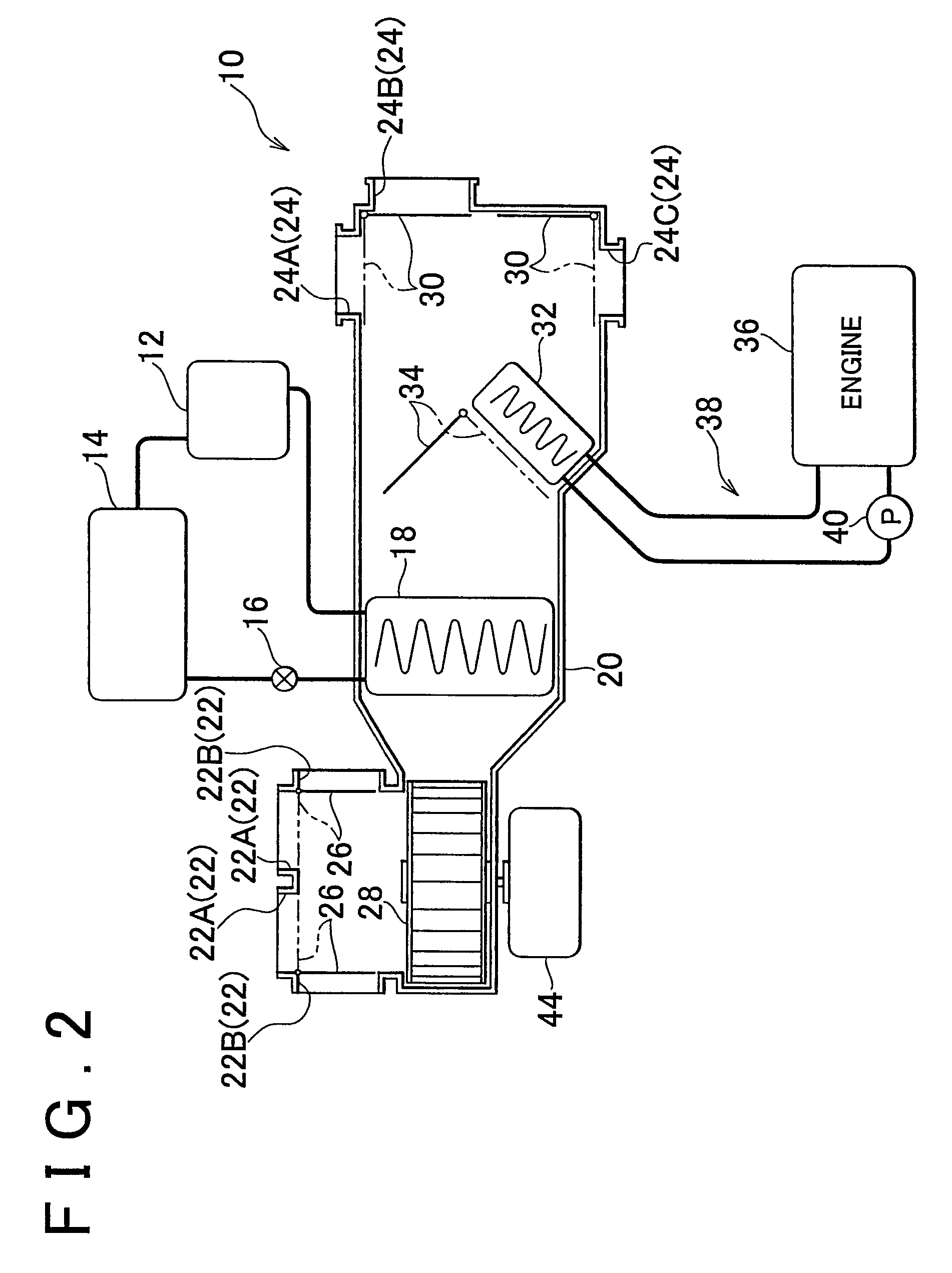
[0032]Hereinafter, an example embodiment of the invention will be described in detail with reference to the drawings. FIG. 2 schematically shows the configuration of the air conditioner 10 that is used as the vehicular air conditioning device in the embodiment.
[0033]In the air conditioner 10, a compressor 12, a condenser 14, an expansion valve 16, and an evaporator 18 form a refrigeration-cycle system. Cooling medium circulates in the refrigeration-cycle system. The cooling medium is compressed by rotating the compressor 12, and then the cooling medium is liquefied. The liquefied cooling medium is supplied to the evaporator 18, and is evaporated in the evaporator 18. At this time, heat is transferred from air that passes through the evaporator 18 to the cooling medium in the air conditioner 10. As a result, the air that passes through the evaporator 18 is cooled.
[0034]The air conditioner 10 includes an air-conditioning duct 20. The evaporator 18 is provided in the air-conditioning d...
PUM
 Login to View More
 Abstract
Description
Claims
Application Information
 Login to View More