System and method for locating a three-dimensional object using machine vision

a machine vision and object technology, applied in the field of machine vision systems, can solve the problem that the single affine transformation cannot be trusted to provide the registered pattern, and achieve the effect of minimizing the total error and minimizing the error

US8126260B2Active Publication Date: 2012-02-28COGNEX CORP
151 Cites 49 Cited by

Patent Information

Authority / Receiving Office
US · United States
Patent Type
Patents(United States)
Current Assignee / Owner
Publication Date
2012-02-28

Smart Images

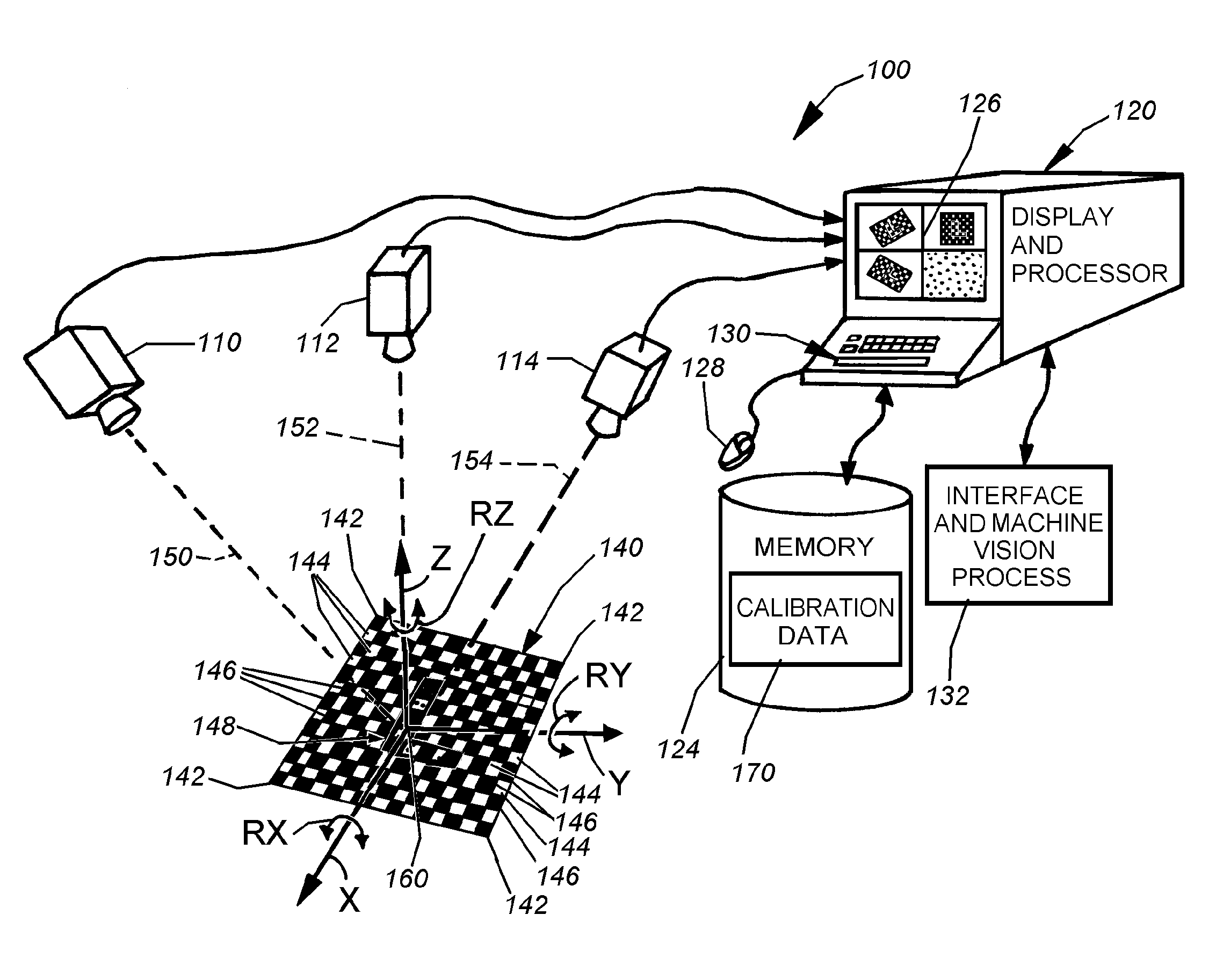
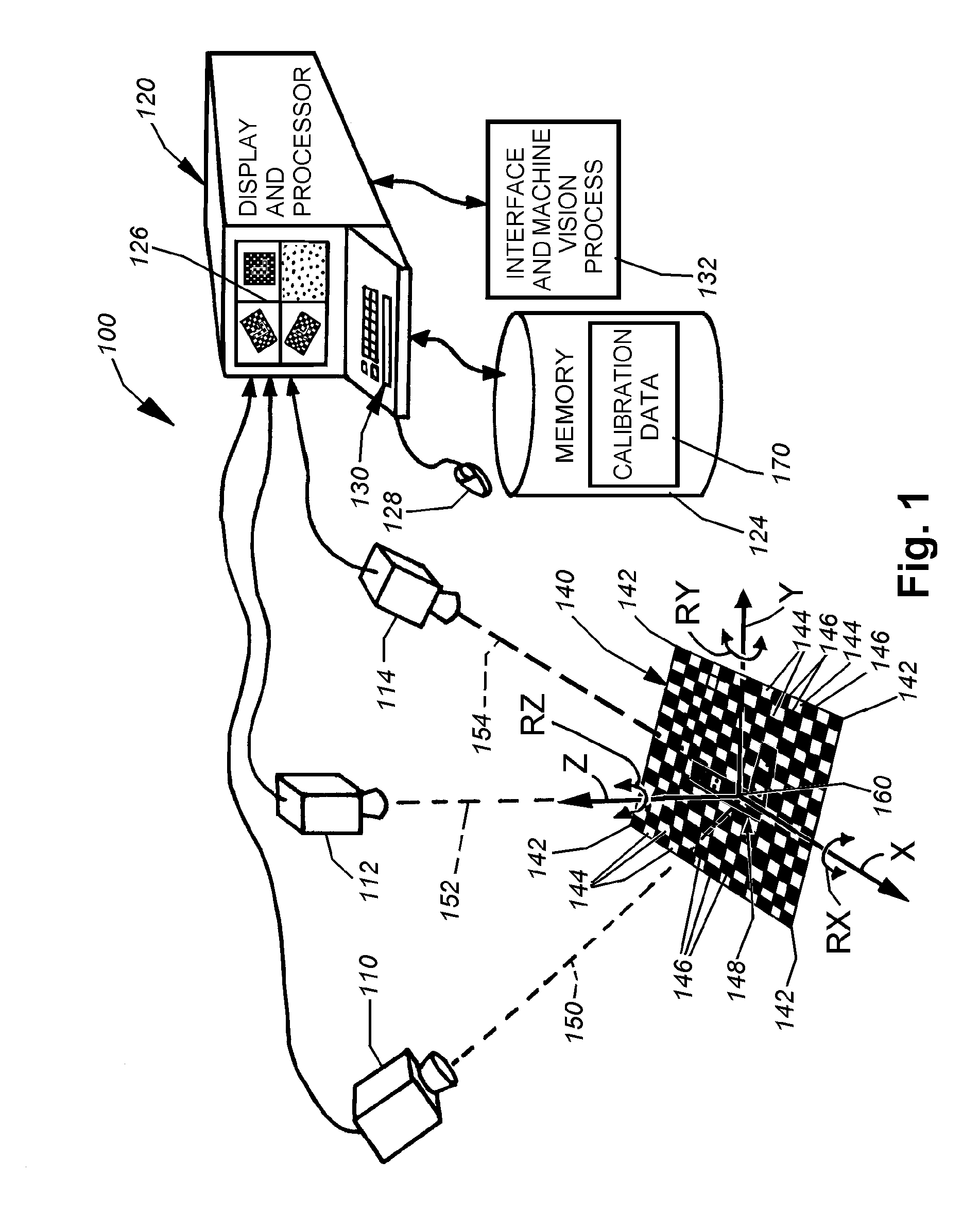
  • Figure 1
    Figure 1
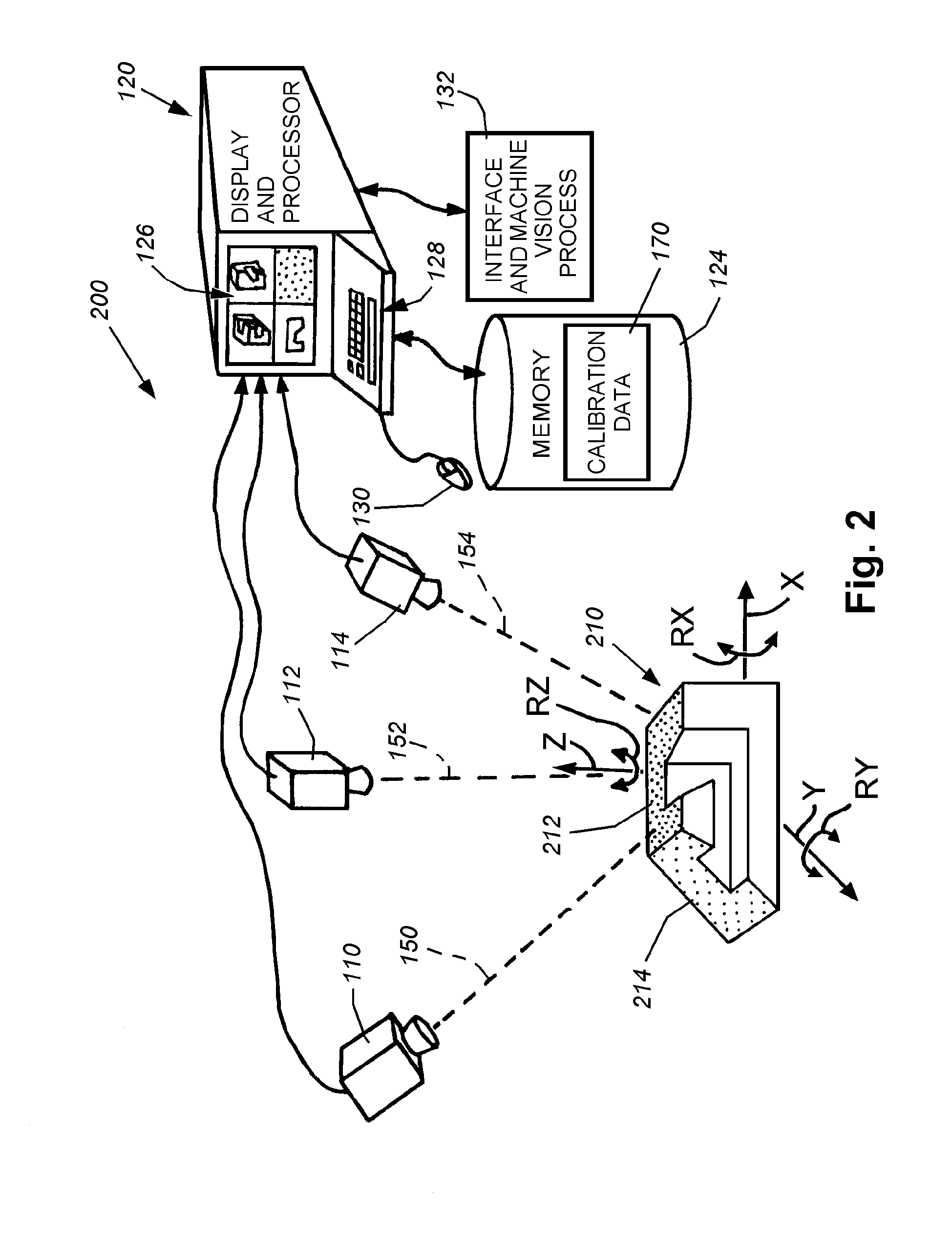
  • Figure 2
    Figure 2
  • Figure 3
    Figure 3
Patent Text Reader

Abstract

This invention provides a system and method for determining position of a viewed object in three dimensions by employing 2D machine vision processes on each of a plurality of planar faces of the object, and thereby refining the location of the object. First a rough pose estimate of the object is derived. This rough pose estimate can be based upon predetermined pose data, or can be derived by acquiring a plurality of planar face poses of the object (using, for example multiple cameras) and correlating the corners of the trained image pattern, which have known coordinates relative to the origin, to the acquired patterns. Once the rough pose is achieved, this is refined by defining the pose as a quaternion (a, b, c and d) for rotation and a three variables (x, y, z) for translation and employing an iterative weighted, least squares error calculation to minimize the error between the edgelets of trained model image and the acquired runtime edgelets. The overall, refined / optimized pose estimate incorporates data from each of the cameras' acquired images. Thereby, the estimate minimizes the total error between the edgelets of each camera's / view's trained model image and the associated camera's / view's acquired runtime edgelets. A final transformation of trained features relative to the runtime features is derived from the iterative error computation.
Need to check novelty before this filing date? Find Prior Art

Description

FIELD OF THE INVENTION

[0001] This invention relates to machine vision systems, and more particularly to machine vision systems that locate viewed objects having three-dimensional characteristics.BACKGROUND OF THE INVENTION

[0002] The use of advanced machine vision systems and their underlying software is increasingly employed in a variety of manufacturing and quality control processes. Machine vision enables quicker, more accurate and repeatable results to be obtained in the production of both mass-produced and custom products. Typical machine vision systems include one or more cameras (typically having solid-state charge couple device (CCD) or CMOS-based imaging elements) directed at an area of interest, a frame grabber / image processing elements that capture and transmit CCD images, a computer or onboard processing device, and a user interface for running the machine vision software application and manipulating the captured images, and appropriate illumination on the area of interest....

Examples

Embodiment Construction

[0024]I. Calibration of the Cameras

[0025]FIG. 1 details an exemplary setup for a machine vision system 100 capable of registering objects in three dimensions (3D) using six degrees of freedom (three translational degrees and three rotational degrees). The system 100 includes a plurality of cameras 110, 112 and 114 in this embodiment that are each oriented to derive a different view of an underlying subject. The number of cameras and their positioning with respect to a subject is highly variable. In alternate embodiments, only two camera's can be employed, or even a single camera with a sufficiently wide field of view, and some inherent distortion (for example a camera equipped with a fish-eye lens) so that, either, at least two discrete poses of a subject can be derived from a single image (if no coarse pose estimate is supplied) or at least four features on the image occur along non-parallel rays (described below) from the camera (if a coarse pose estimate is supplied). For the pur...