System and method for designing of dictionaries for sparse representation

a sparse representation and signal technology, applied in the field of system and method for sparse representation of signals, can solve the problems of dictionaries having the potential to outperform commonly used pre-determined dictionaries, and achieve the effect of accelerating convergen

US8165215B2Active Publication Date: 2012-04-24TECHNION RES & DEV FOUND LTD
7 Cites 18 Cited by

Patent Information

Authority / Receiving Office
US · United States
Patent Type
Patents(United States)
Current Assignee / Owner
Publication Date
2012-04-24

Smart Images

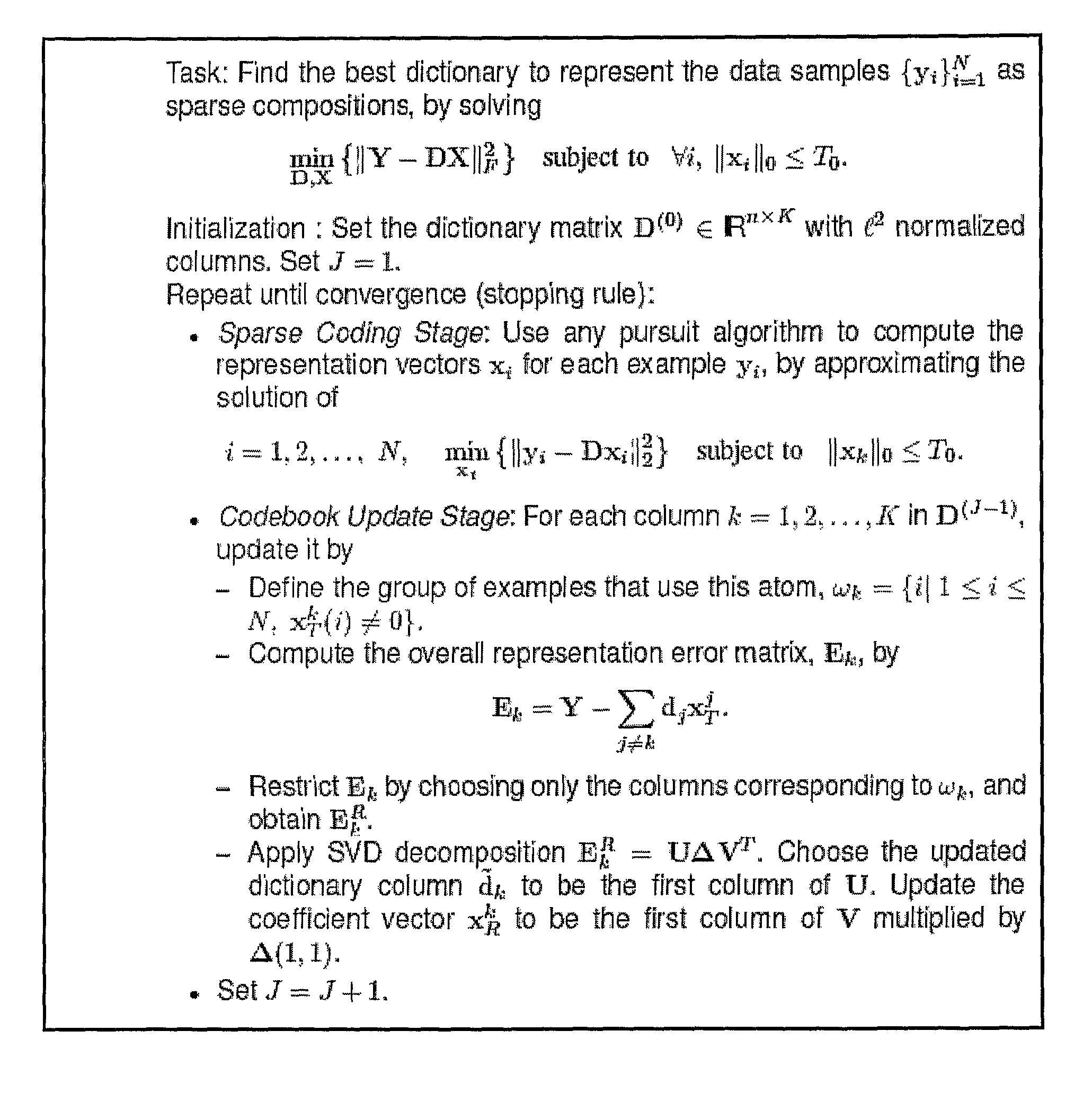
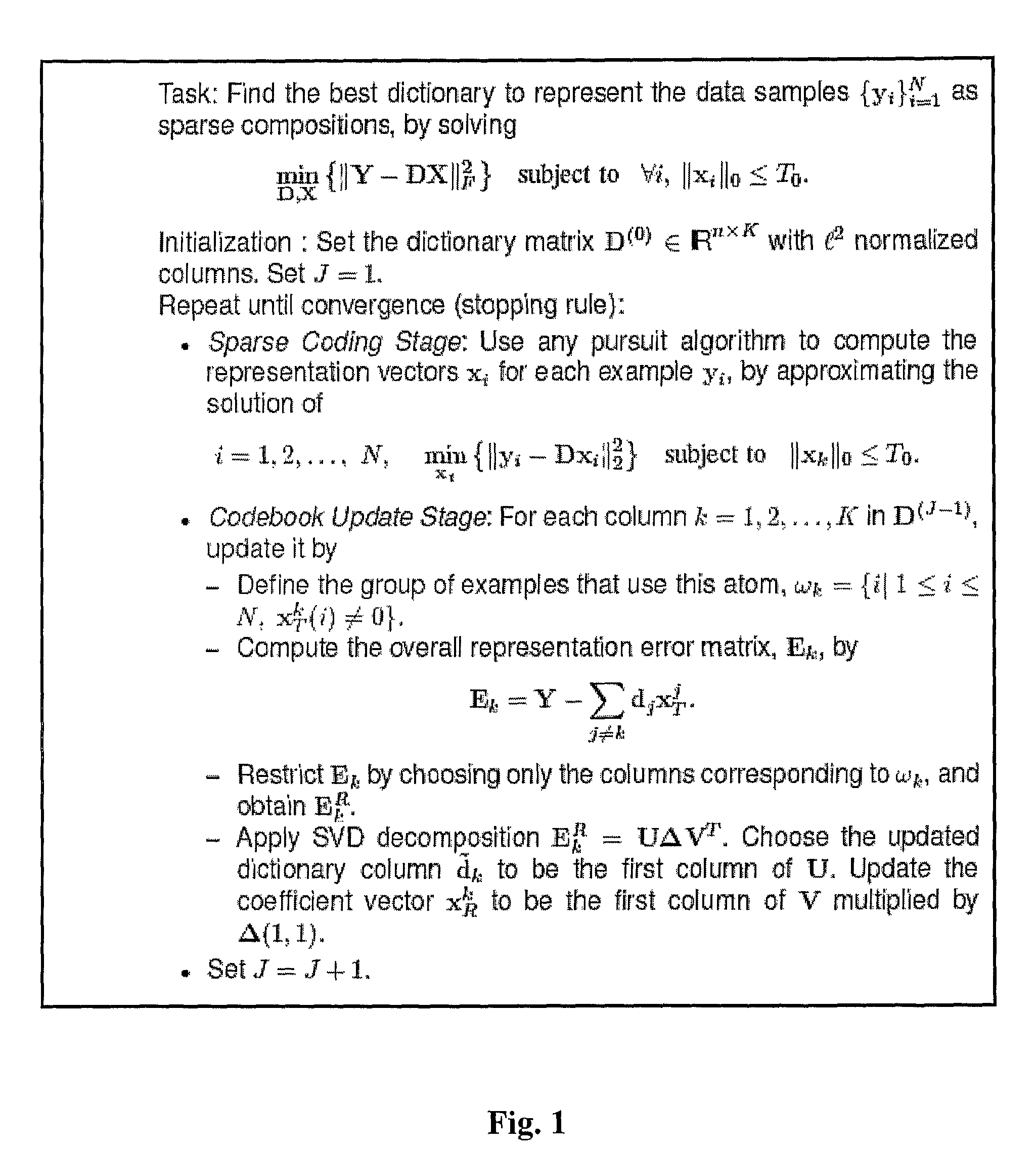
  • Figure 1
    Figure 1
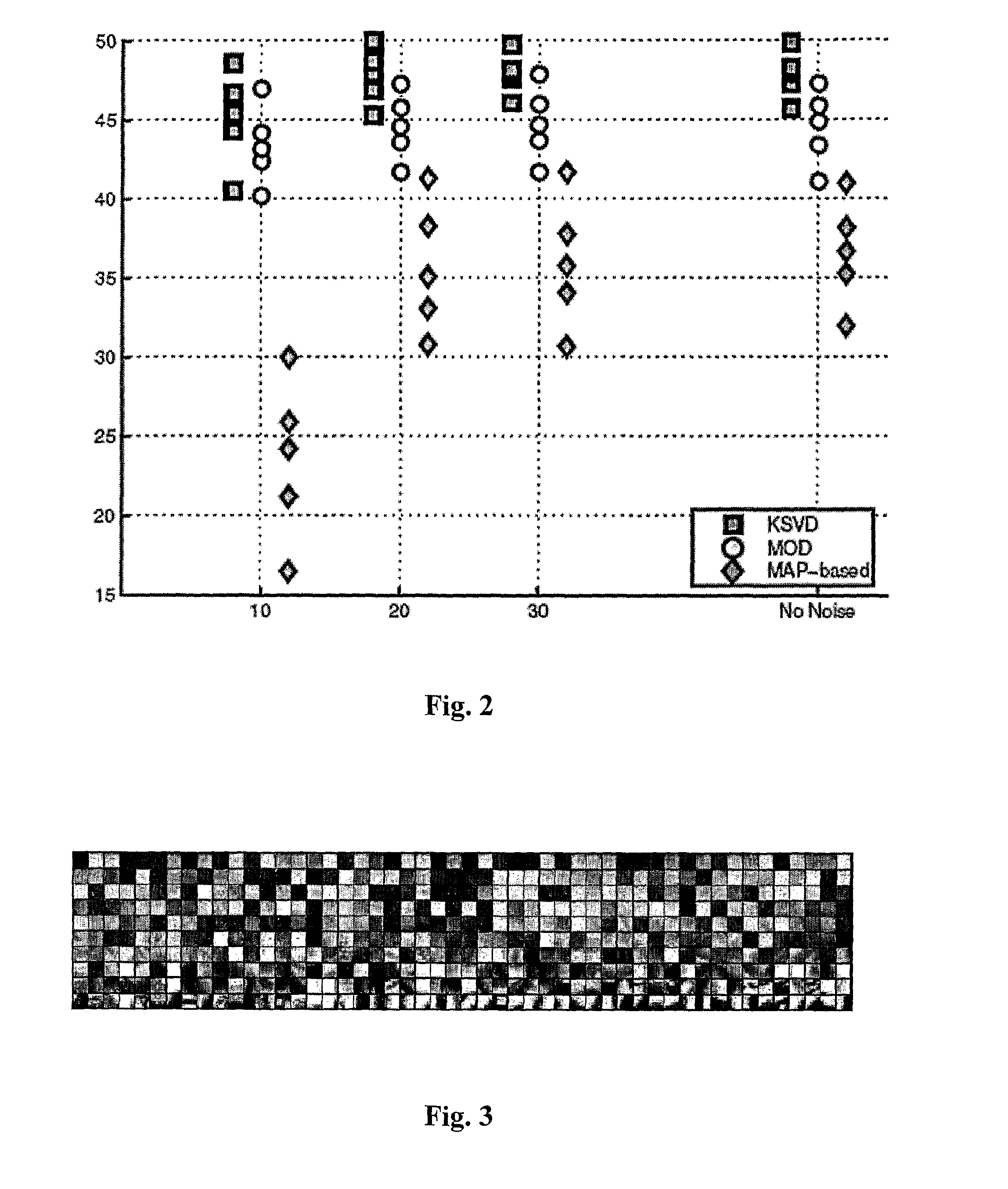
  • Figure 2
    Figure 2
  • Figure 3
    Figure 3
Patent Text Reader

Abstract

A signal processing system adapted for sparse representation of signals is provided, comprising: (i) one or more training signals; (ii) a dictionary containing signal-atoms; (iii) a representation of each training signal using a linear combination of said dictionary's signal-atoms; (iv) means for updating the representation of the training signal; (v) means for updating the dictionary one group of atoms at a time, wherein each atom update may include all representations referring to said updated atom; and (vi) means for iterating (iv) and (v) until a stopping rule is fulfilled. The system uses the K-SVD algorithm for designing dictionaries for sparse representation of signals.
Need to check novelty before this filing date? Find Prior Art

Description

FIELD OF THE INVENTION

[0001] The present invention relates to a system and method for the sparse representation of signals. The invention is particularly relevant for applications such as compression, regularization in inverse problems, feature extraction, denoising, separation of texture and cartoon content in images, signal analysis, signal synthesis, inpainting and restoration.BACKGROUND OF THE INVENTIONSparse Representation of Signals

[0002] In recent years there has been a growing interest in the study of sparse representation of signals. Using an overcomplete dictionary that contains prototype signal-atoms, signals are described as sparse linear combinations of these atoms. Applications that use sparse representation are many and include compression, regularization in inverse problems, feature extraction, and more. Recent activity in this field concentrated mainly on the study of pursuit algorithms that decompose signals with respect to a given dictionary. Designing dictionaries ...

Examples

Embodiment Construction

[0105]In the following detailed description of various embodiments, reference is made to the accompanying drawings that form a part thereof, and in which are shown by way of illustration specific embodiments in which the invention may be practiced. It is understood that other embodiments may be utilized and structural changes may be made without departing from the scope of the present invention.

[0106]In the present invention, we address the problem of designing dictionaries, and introduce the K-SVD algorithm for this task. We show how this algorithm can be interpreted as a generalization of the K-Means clustering process, and demonstrate its behavior in both synthetic tests and in applications on real data.

[0107]The present invention relates to a signal processing method adapted for sparse representation of signals and a system for implementing said method, said system comprising:[0108](i) one or more training signals;[0109](ii) a dictionary containing signal-atoms;[0110](iii) a rep...