
Metal powder for metal laser-sintering and metal laser-sintering process using the same
a metal laser sintering and metal laser sintering technology, applied in the field of metal powder, can solve the problems of inability to uniformly form a thin metal layer, formation of sintered materials, and inability to form such subsequent powder layers, so as to and reduce the machining resistance. effect of unnecessary removal of metal powder
- Summary
- Abstract
- Description
- Claims
- Application Information
AI Technical Summary
Benefits of technology
Problems solved by technology
Method used
Image

Examples
examples
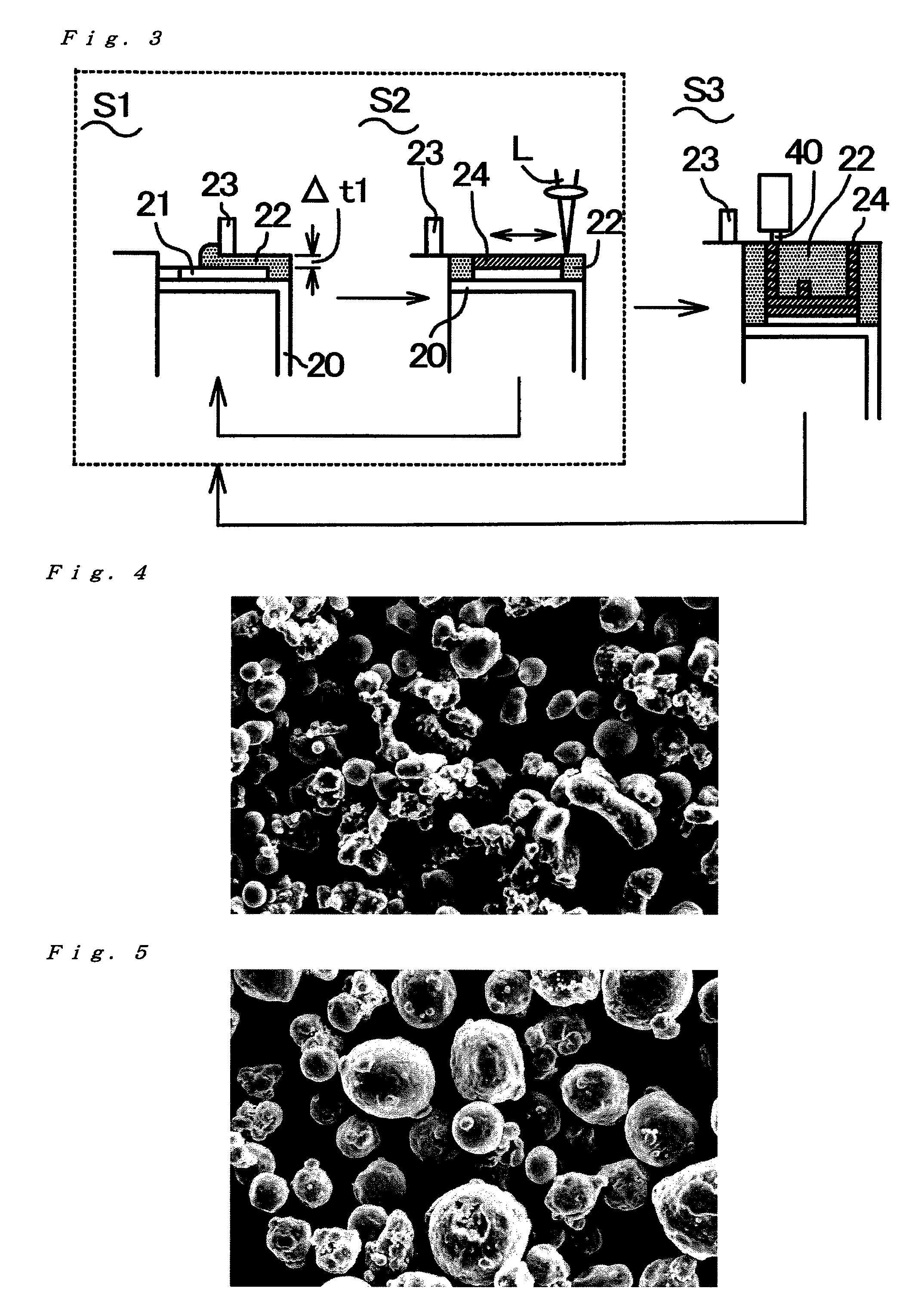
[0080]An annealing treatment of an iron-based powder used as a raw powder of the metal powder for metal-laser sintering was performed. In this treatment, the annealing conditions were studied for the following reasons:[0081]When the iron-based powder is heated, the surfaces of powder particles are activated, and thus mutual contacting portions of such particles turn into more stable shape. Namely, the metal atoms of the particles are caused to move in such directions that the surface area of the particles becomes smaller, and thereby there is occurred a sintering phenomenon allowing the powder particles to unite with each other. The smaller particle diameter of the powder provides the larger surface area of the powder, causing the sintering phenomenon to proceed at a lower temperature due to a larger contacting surface between the particles. Also, a higher temperature of the heating induces an occurrence of the sintering phenomenon. Accordingly, in a case of the powder with a large ...
PUM
| Property | Measurement | Unit |
|---|---|---|
| mean particle diameter | aaaaa | aaaaa |
| temperature | aaaaa | aaaaa |
| temperature | aaaaa | aaaaa |
Abstract
Description
Claims
Application Information
 Login to View More