Method and apparatus for assessing the health of an infant by estimating average growth velocity using an exponential model

an exponential model and growth velocity technology, applied in the field of health care, can solve the problems of inability of many physicians to calculate gv, inability to compare therapeutic practices across settings and studies, and inconvenient use, etc., to achieve accurate and uniform way of estimating average growth velocity, simple use, accuracy and ease of us

US8747310B2Inactive Publication Date: 2014-06-10RUSH UNIV MEDICAL CENT
13 Cites 0 Cited by

Patent Information

Authority / Receiving Office
US · United States
Patent Type
Patents(United States)
Current Assignee / Owner
Publication Date
2014-06-10
Estimated Expiration
Not applicable · inactive patent

Smart Images

  • Figure 1
    Figure 1
  • Figure 2
    Figure 2
  • Figure 3
    Figure 3
Patent Text Reader

Abstract

The invention covers a method and apparatus for assessing the health of an infant by accurately estimating the average growth velocity of the infant. The invention employs an exponential model to estimate growth velocity based on at least two weight measurements from different days of life of an infant. The exponential model provides the accuracy and ease of use that are lacking in current methods applied to growth research. The exponential model has numerous features that make it a desirable and powerful model, i.e., (1) it is extremely accurate; (2) it is simple to use, requiring only weight and day of life at 2 time points; (3) it is robust under various testing conditions; and (4) it is unaffected by clinical factors found commonly among ELBW infants, which allows its broad application for the study of infant growth. The exponential model closely approximates the accurate standard GVs, regardless of starting point or time interval used. An exponential model assumes that growth occurs at a fraction of the previous weight. Although growth does not occur at a constant rate of change, the average GV smoothes the variability in weight gain observed clinically, thereby providing an estimate of a theoretically constant rate of change. The average growth velocity is thus a useful in assessing the health of an infant.
Need to check novelty before this filing date? Find Prior Art

Description

FIELD OF INVENTION

[0001] The subject patent is in the area of health care, specifically techniques for assessing health of an individual and determining proper care practices. It is intended to be used primarily as a tool for assessing the health of an infant through determination of an estimated average growth velocity of the infant and using this estimated average growth velocity to derive other relevant information useful in assessing health.BACKGROUND

[0002] In the United States, at least 22845 extremely low birth weight infants (ELBW, birth weight<1000 g) were born in the most recent year for which data are available. These infants account for a significant percentage of the mortality associated with prematurity, and suffer the majority of short and long-term morbidities, including poor postnatal growth. In fact, most of these infants are below the 10th percentile for weight at discharge when compared to intrauterine reference fetuses of similar gestational ages. Several invest...

Examples

Embodiment Construction

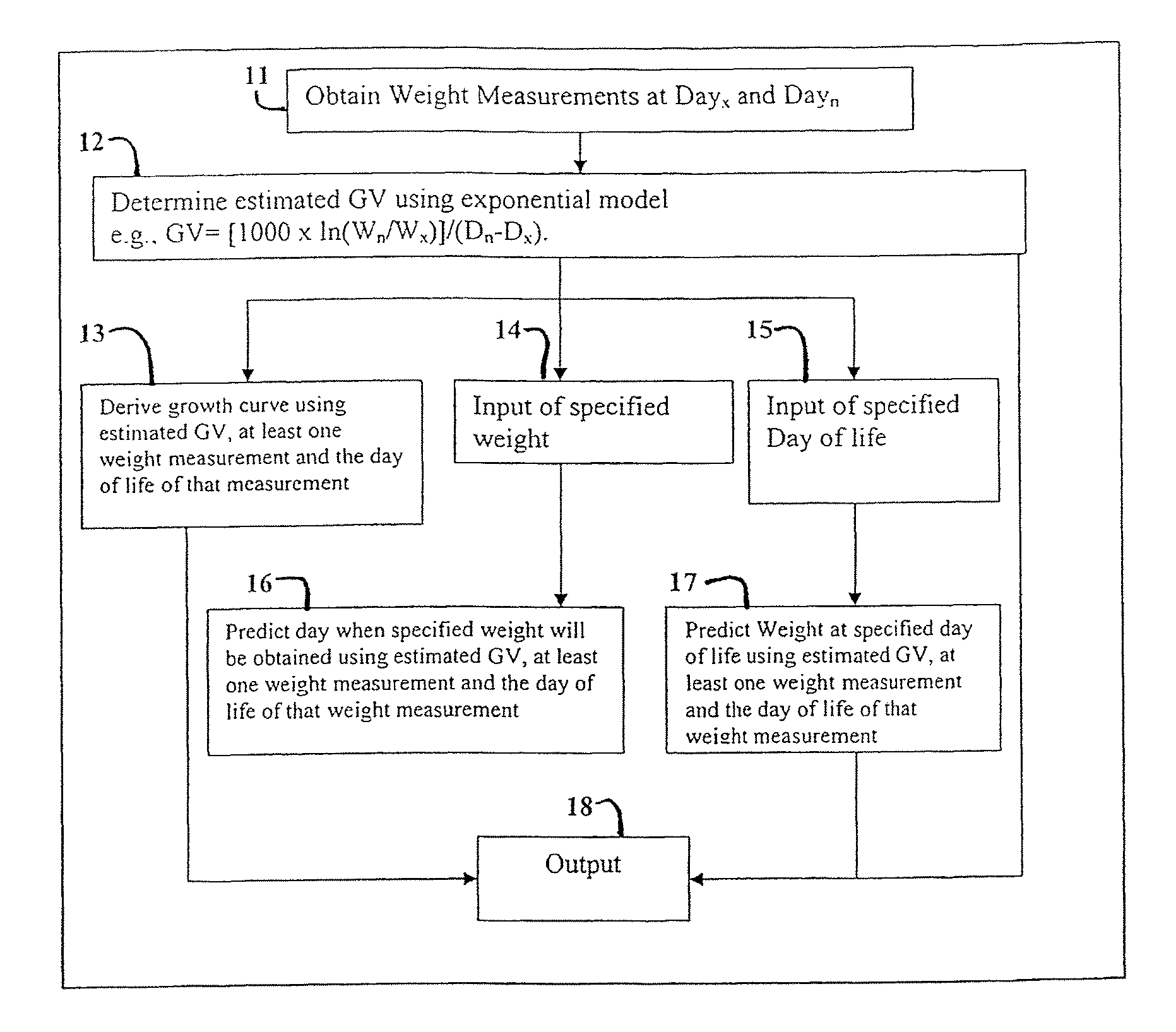
[0011]The present invention recognizes that two weight measurements from different days can be used to estimate the average growth velocity of an individual using an exponential model.

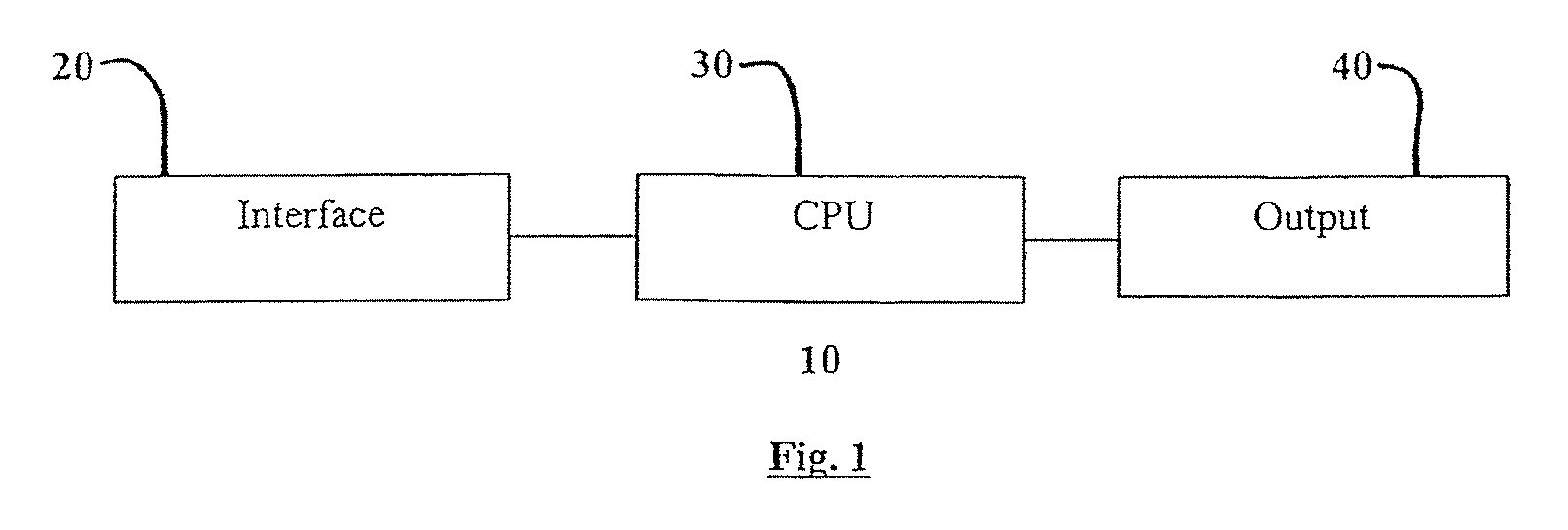
[0012]FIG. 1 depicts a system 10 that estimates the average growth velocity in accordance with an illustrated embodiment of the invention. Referring to FIG. 1, weight measurements and the respective day of life of those weight measurements can be entered into the CPU 30 through an interface 20 configured to communicate data to the CPU 30. The interface 20 may be any device capable of transmitting data to the CPU 30, including but not limited to a keypad, keyboard, or any other interface designed for manual input of the day of life and corresponding weight measurements. Alternatively, the interface 20 may be integrated with a weight measurement and input device. For example, in one embodiment, the CPU 30 may be connected physically or wirelessly to a weight measurement device which serves as the interfa...