[0008]In the aspect of the invention, the light receiving device is provided with the first and second light shields, which form the light incident slit, the width of which increases as the angle with respect to the central optical axis of the light receiving device increases. As a result, even when the light receiving device has a directional characteristic of sensitivity in which the light receiving device is highly sensitive to light squarely incident thereon whereas being not very sensitive to light obliquely incident thereon, the directional characteristic of the sensitivity is canceled out by the slit. The light detector to which the invention is applied is therefore equally sensitive to the light squarely incident thereon and the light obliquely incident thereon, whereby the light detector can detect light with the same sensitivity irrespective of the direction of incident light even in a situation in which the light detector detects the intensity of light incident in a wide range of directions.
[0009]In the aspect of the invention, it is preferable that the first light shield is formed on a first holder member that holds the light receiving device on one side in the first direction, and that the second light shield is formed on a second holder member that is placed over the first holder member so that the light receiving device is sandwiched between the first and second holder members. According to the configuration described above, the light receiving device held in the holder member (first and second holder members) can conveniently be incorporated in a variety of apparatus. Further, since the first and second light shields can be formed only by changing the configuration of the first and second holder members, only a small amount of extra cost is required to improve the directional characteristic of sensitivity.
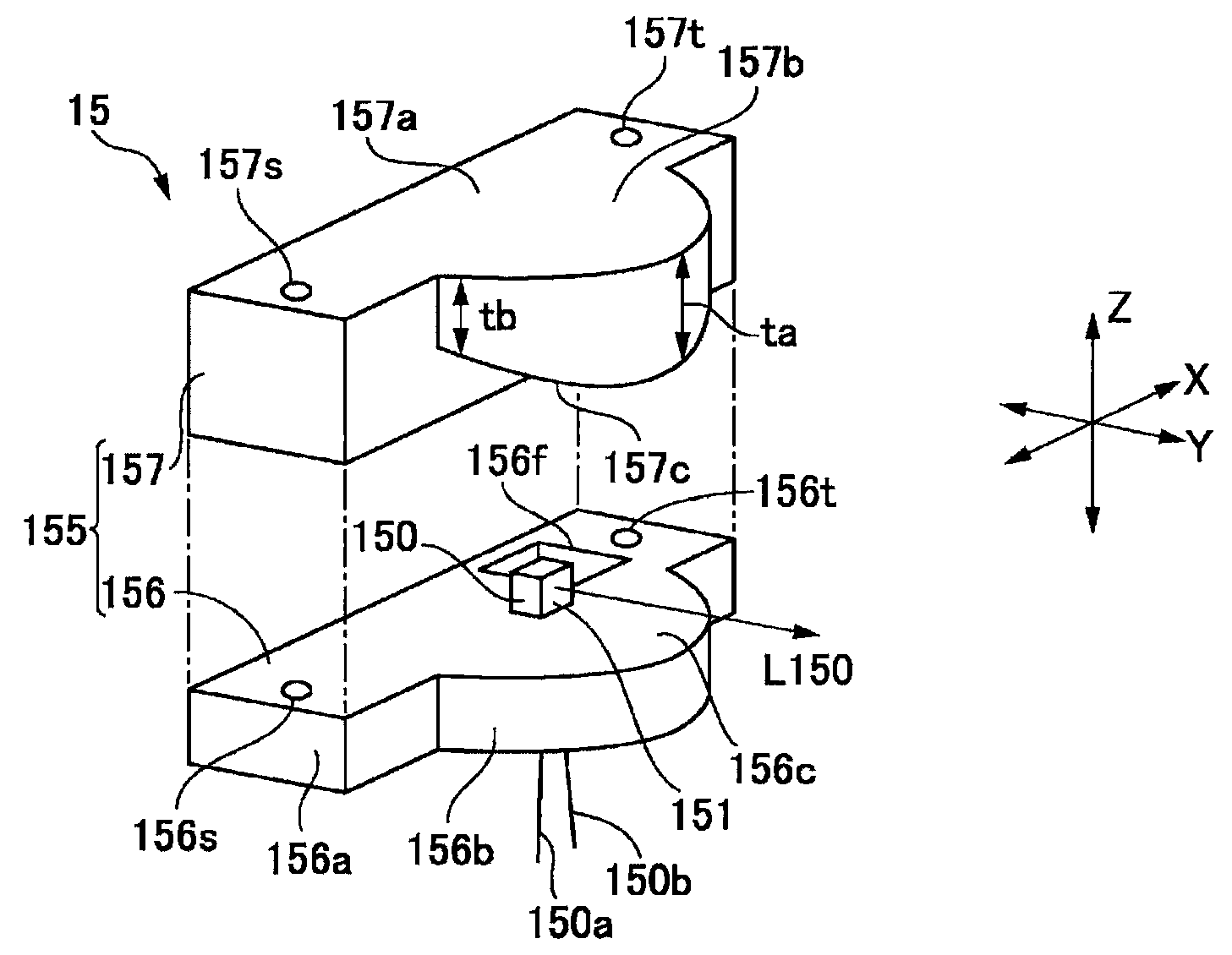
[0010]In the aspect of the invention, each of the first and second holder members is preferably made of a light shielding material. It is also preferable that the first holder member includes a first holder member-side base and a first holder member-side protrusion, the first holder member-side protrusion protruding forward with respect to the light receiving device from the first holder member-side base to form the first light shield, and that the second holder member includes a second holder member-side base and a second holder member-side protrusion, the second holder member-side base connected to the first holder member-side base and the second holder member-side protrusion protruding forward with respect to the light receiving device from the second holder member-side base to form the second light shield. The configuration described above allows the first and second holder members to be readily formed of portions to be connected to each other (first holder member-side base and second holder member-side base) and portions for forming the first and second light shields (first holder member-side protrusion and second holder member-side protrusion).
[0011]In the aspect of the invention, it is preferable that the first holder member-side protrusion, when viewed in the first direction, protrudes from the first holder member-side base and has a semi-circular shape whose center is located on the side where the light receiving device is present, and that the second holder member-side protrusion, when viewed in the first direction, protrudes from the second holder member-side base and has a semi-circular shape whose center is located on the side where the light receiving device is present. According to the configuration described above, the first holder member-side protrusion and the second holder member-side protrusion can be small in size even when a slit-shaped light incident portion is formed over an angular range including the direction in which the central optical axis of the light receiving device extends. The size of the light detector can therefore be reduced.
[0014]In this case, the light-transmissive member is preferably a lens having a convex curved surface facing forward when viewed in the first direction. The configuration described above allows light traveling toward the light detector to be efficiently guided to the light receiving device, whereby the sensitivity itself of the light detector can be increased.





 Login to View More
  Login to View More