
Master cylinder device
a master cylinder and cylinder body technology, applied in the direction of rotary clutches, braking systems, fluid couplings, etc., can solve the problems of deterioration of operational feeling and deterioration of operation feeling, so as to enhance the utility of the master cylinder device, the effect of reducing the operation amount of the brake operation member in the brake operation and reducing the operation difficulty
- Summary
- Abstract
- Description
- Claims
- Application Information
AI Technical Summary
Benefits of technology
Problems solved by technology
Method used
Image

Examples
first embodiment
Structure of Vehicle
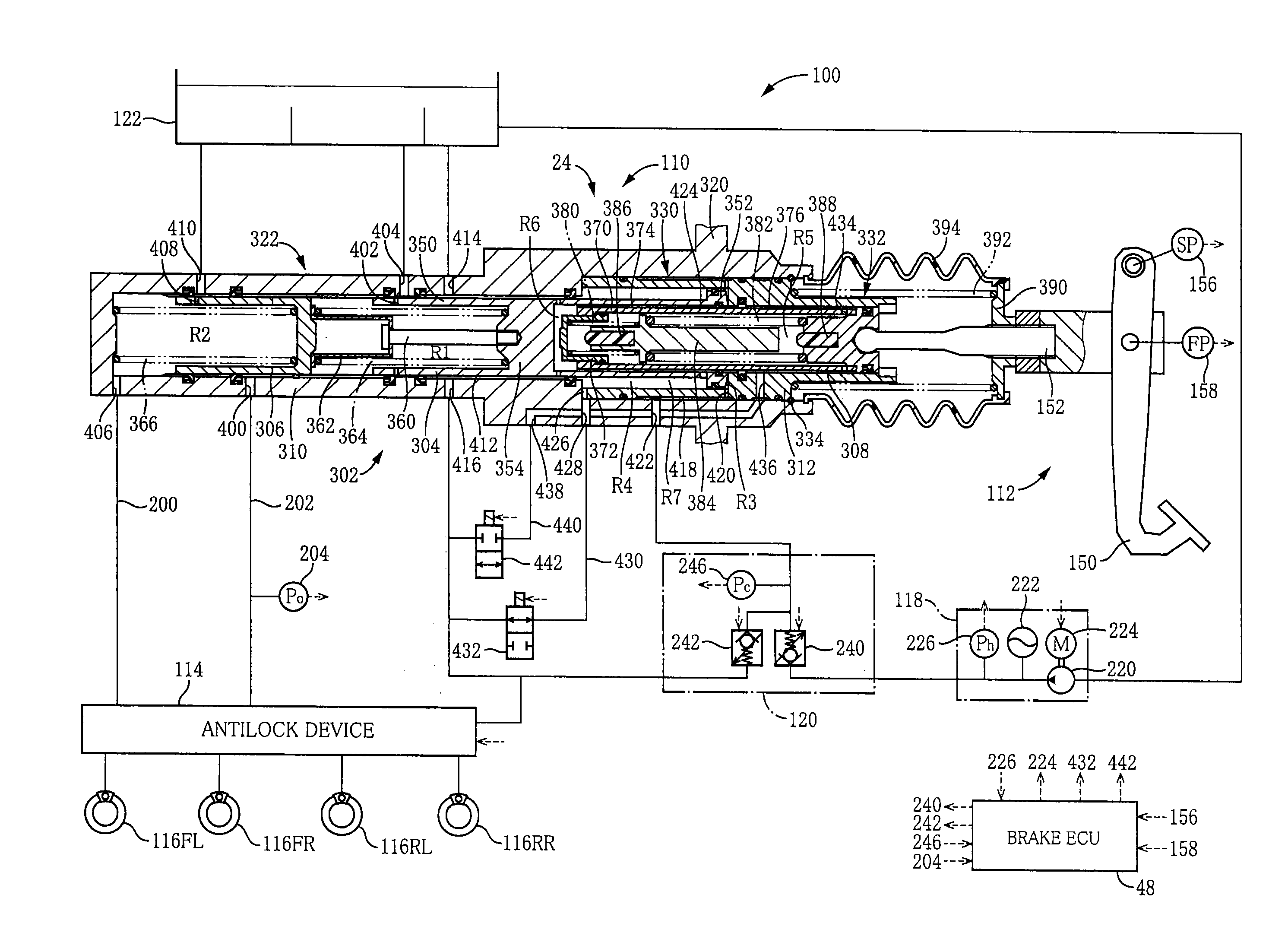
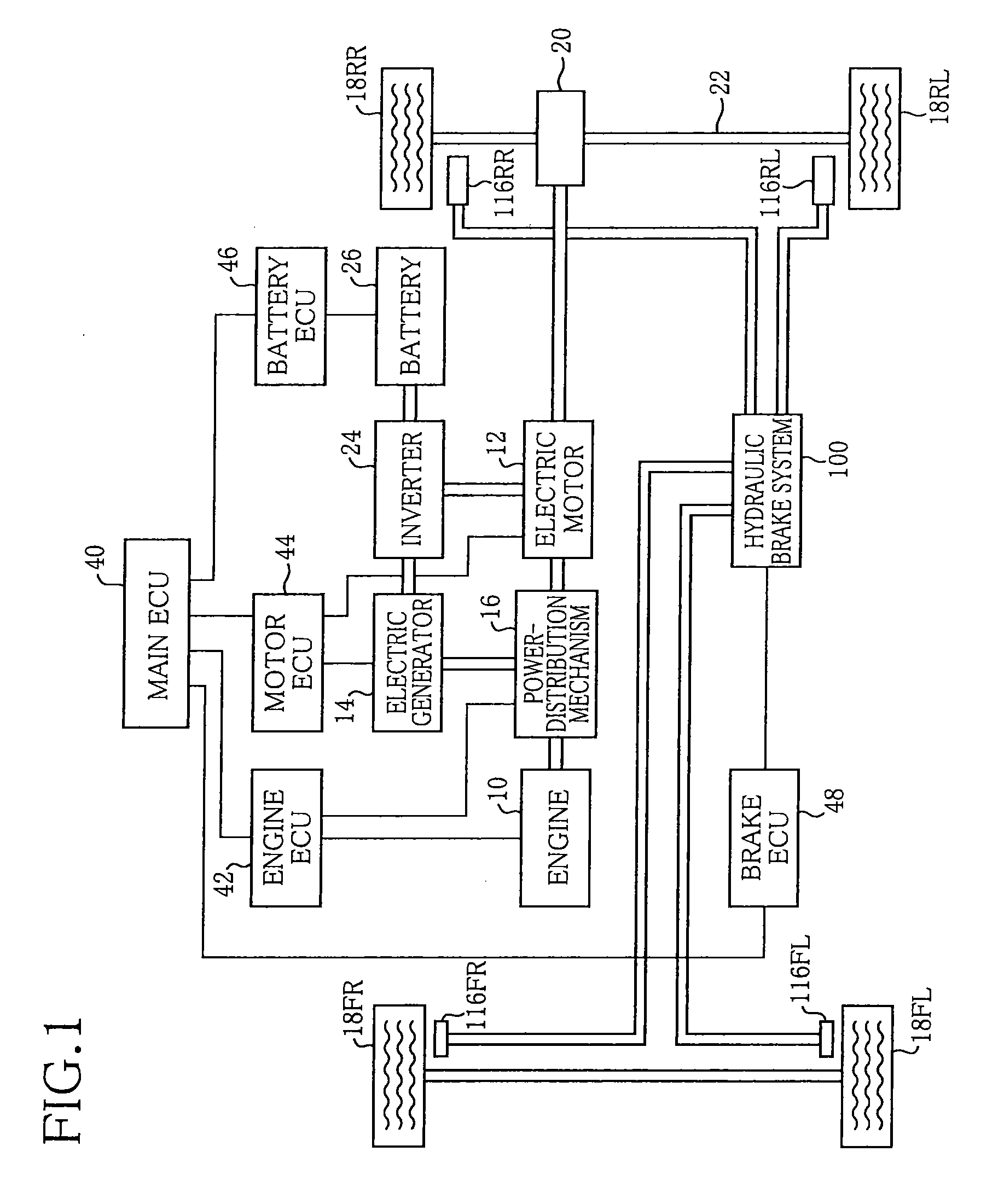
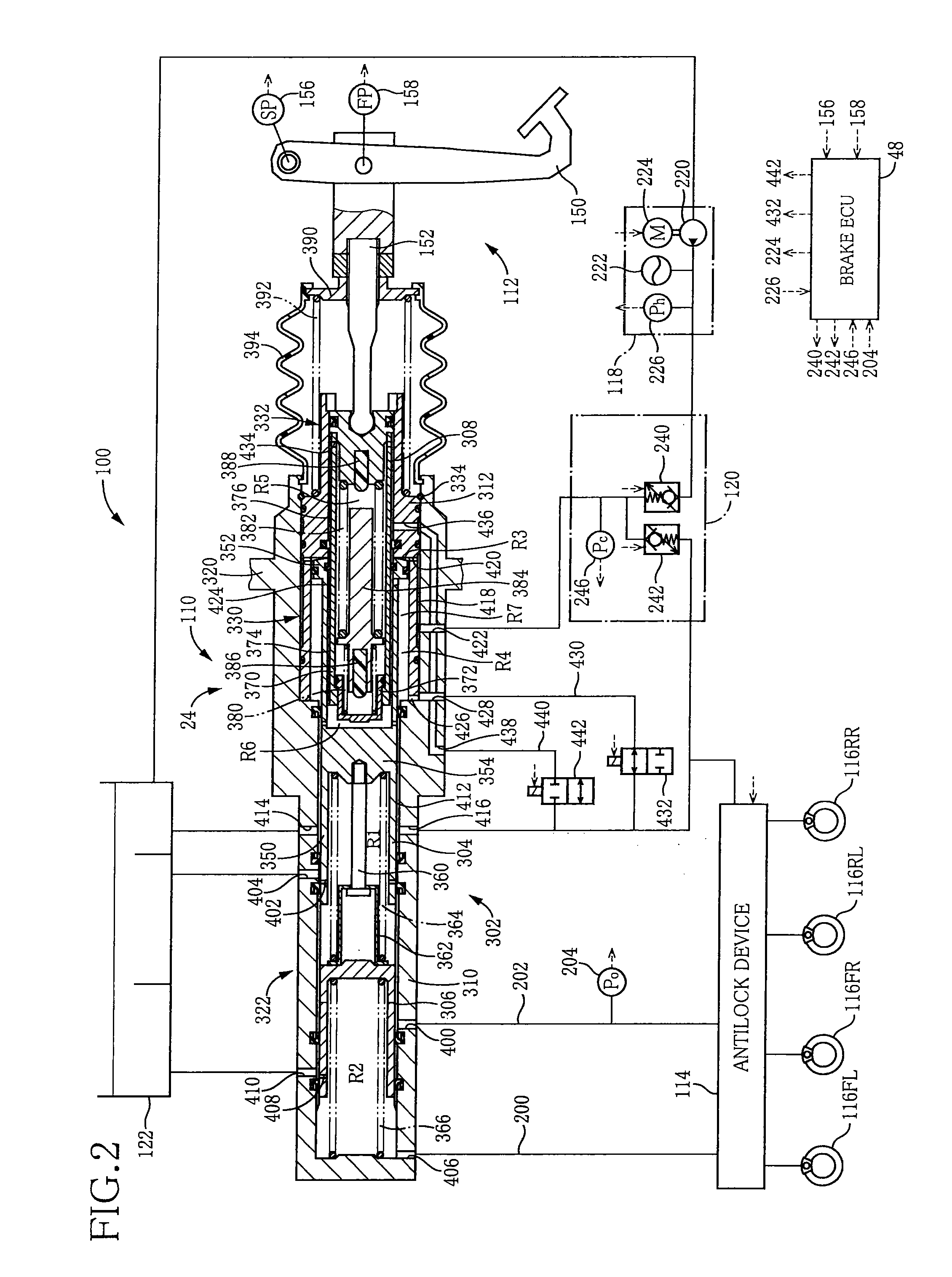
[0073]FIG. 1 schematically illustrates a drive system and a brake system of a hybrid vehicle which is equipped with a master cylinder device of a first embodiment. The vehicle is equipped with an engine 10 and an electric motor 12 as sources of power, and also equipped with an electric generator 14 which generates electricity by an output power of the engine 10. The engine 10, the electric motor 12, and the electric generator 14 are connected to one another via a power-distribution mechanism 16. By controlling the power-distribution mechanism 16, the power of the engine 10 can be divided into a power for driving the electric generator 14 and a power for rotating drive wheels among four wheels 18, and a power of the electric motor 12 can be transmitted to the drive wheels. In other words, the power-distribution mechanism 16 functions as a speed-change mechanism with respect to a driving power which is transmitted to the drive wheels via a speed reducer 20 and a dr...
modified embodiment
[0113]FIG. 4 illustrates the hydraulic brake system 100 having a master cylinder device 500 of the modified embodiment substituting for the master cylinder device 110 of the first embodiment. Generally speaking, the master cylinder device 500 has the same structure as the master cylinder device 110 of the first embodiment except for having a mechanical open / close valve 502 substituting for the electromagnetic open / close valve 442 provided in the middle of the external communication passage 440 of the master cylinder device 110 of the first embodiment. In the following explanation, centering on the open / close valve 502, only structure and actuation different from the master cylinder device 110 of the first embodiment are explained.
[0114]The open / close valve 502 is provided in the middle of the external communication passage 440. FIG. 5 is a cross sectional view of the open / close valve 502. The open / close valve 502 includes a housing 510 which is a casing, and a valve body member 512 ...
second embodiment
[0123]FIG. 6 illustrates the hydraulic brake system 100 having a master cylinder device 600 of the second embodiment substituting for the master cylinder device 110 of the first embodiment. Generally speaking, the master cylinder device 600 has the same structure as the master cylinder device 110 of the first embodiment. In the following explanation, in the interest of brief description, only structure and actuation different from the master cylinder device 110 of the first embodiment are explained
[0124]An input piston 602 of the master cylinder device 600 has a structure in which the springs etc. provided in the input piston 308 of the master cylinder device 110 of the first embodiment are removed. Additionally, in the master cylinder device 600, on the external communication passage 440, there are provided an electromagnetic open / close valve 606 being a normally close valve and an electromagnetic open / close valve 608 being a normally open valve. In the master cylinder device 600, ...
PUM
 Login to View More
 Abstract
Description
Claims
Application Information
 Login to View More