Unlock instant, AI-driven research and patent intelligence for your innovation.

Intuitive eco-driving assistance method and system

a technology of intuitive eco-driving and assistance method, applied in the direction of control device, external condition input parameters, vehicle components, etc., can solve the problems of increasing exhaust emission standards, increasing fuel cost of vehicles, and unsatisfactory overall fuel consumption and exhaust emission of vehicles, so as to achieve the effect of increasing fuel consumption

Active Publication Date: 2015-06-02
AUTOMOTIVE RES & TESTING CENT
View PDF12 Cites 6 Cited by
  • Summary
  • Abstract
  • Description
  • Claims
  • Application Information

AI Technical Summary

Benefits of technology

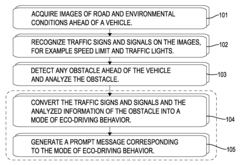
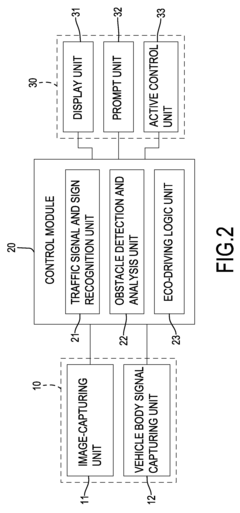
[0025]Another objective of the present invention is to provide an intuitive eco-driving assistance system having active control over vehicle speed. To achieve the objective, the intuitive eco-driving assistance system further has an active control unit. The active control unit is electrically connected to the accelerator of the vehicle and a brake circuit. According to signals of the eco-driving instructions or the driving limits on the road outputted from the eco-driving logic unit, the active control unit controls the accelerator and the brake of the vehicle to avoid the issue of increasing fuel consumption due to fast acceleration.

Problems solved by technology

Nowadays, vehicles consuming gas all face problems of skyrocketing fuel cost and increasingly strict exhaust emission standards.
Although the type of techniques pertinent to improvement on manufacturing techniques of vehicles, such as engine systems with high combustion efficiency, low energy-consuming transmission system, lightweight materials for building vehicle body, hybrid gas-electric cars, kinetic energy recovery systems under braking, idle stop / start systems and the like, can reduce the fuel consumption and exhaust emission upon driving or at idle, the overall fuel consumption and exhaust emission of vehicles are still unsatisfactory if driving behaviors of drivers run counter to the rules of energy-saving operation, and the complication and production cost of vehicles is increased.
On the other hand, although the type of techniques providing prompt notices to remind drivers of their fuel-wasting driving behaviors, such as prompting drivers for instantaneous fuel consumption of vehicles and warning of high fuel-consuming driving behaviors through acquisition of vehicle body signals, engine signals, dynamic signals and analysis of driver's behavior model, allows drivers to be aware of current fuel-consuming condition of vehicles, suggestion or rearrangement in response to traffic conditions on the road fail to be immediately and accurately performed.
Hence, such fuel-wasting driving behaviors still keep happening throughout the driving process.
Besides, when a driver accelerates the car to overtake another car, it may trigger a false warning for a high fuel-consuming driving behavior.
The vehicle is structurally complicated arising from many sensors mounted thereon.
As only passively receiving information of those sensors, the prompting system is unable to provide instruction for conserving fuel according to actual road condition.
However, the tradeoff is the requirement of multiple sensors mounted on vehicles to detect the states of vehicles, which causes the issue of structural complication and overall cost buildup.
Additionally, the fuel-wasting conditions of conventional vehicles still depend on driving behaviors of drivers, and their fuel-wasting behavior prompting device can only passively provide fuel-wasting prompts according to road conditions and fails to immediately respond to road conditions and adjust the fuel-wasting driving behaviors of drivers.
Therefore, the fuel-wasting drawback still exists.

Method used

the structure of the environmentally friendly knitted fabric provided by the present invention; figure 2 Flow chart of the yarn wrapping machine for environmentally friendly knitted fabrics and storage devices; image 3 Is the parameter map of the yarn covering machine
View more

Image

Smart Image Click on the blue labels to locate them in the text.
Viewing Examples
Smart Image
  • Intuitive eco-driving assistance method and system
  • Intuitive eco-driving assistance method and system
  • Intuitive eco-driving assistance method and system

Examples

Experimental program
Comparison scheme
Effect test

Embodiment Construction

[0038]Latest literatures have pointed out that the following four conditions should be met to ensure driving behaviors with optimal energy-saving effect.

[0039]1. Drive a car at constant speed and do not quickly accelerate or decelerate at will to prevent the engine from running at a high speed range, and the saved energy can reach 5˜33% (information from US Department of Energy).

[0040]2. Classify driving speed into high driving speed and low driving speed. Drive at an optimal high driving speed about 90 kilometers / hour and at an optimal low driving speed (urban area) about 50 kilometers / hour, and the saved energy can reach 7˜23% (information from US Department of Energy).

[0041]3. Gently accelerate and avoid more fuel consumption arising from quick acceleration during vehicle starting, and the saved energy can reach 23˜20% (information from US Environmental Protection Agency).

[0042]4. Ease off accelerator in advance and smoothly slow down speed until the vehicle is fully stopped when...

the structure of the environmentally friendly knitted fabric provided by the present invention; figure 2 Flow chart of the yarn wrapping machine for environmentally friendly knitted fabrics and storage devices; image 3 Is the parameter map of the yarn covering machine
Login to View More

PUM

No PUM Login to View More

Abstract

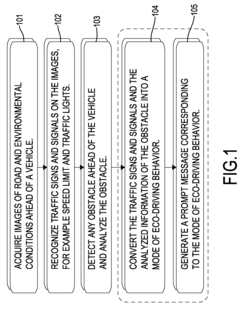
An intuitive eco-driving assistance system is mounted on a vehicle and has an input module, a control module and an output module. The control module is electrically connected to the input module and the output module. The output module acquires images ahead of the vehicle and speed signals for the control module to recognize a speed limit, traffic lights and a speed and distance of any obstacle on the images. Furthermore, according to the driving limits of the road and actual vehicle speed, the output module prompts for an eco-driving instruction and the speed limit meeting the road condition visually or audibly. Accordingly, the issue of conventional vehicles being structurally complicated and costly for conserving energy, only passively prompting fuel consumption, and consuming more fuel can be solved without requiring any additional and complicated system.

Description

BACKGROUND OF THE INVENTION[0001]1. Field of the Invention[0002]The present invention relates to an eco-driving assistance system and more particularly to an intuitive eco-driving assistance system directly prompting drivers to save energy according to road conditions.[0003]2. Description of the Related Art[0004]Nowadays, vehicles consuming gas all face problems of skyrocketing fuel cost and increasingly strict exhaust emission standards. Hence, without exception, every car manufacturer aggressively develops new technique seeking to increase the utilization efficiency of gas and to reduce the exhaust emission of vehicles.[0005]In this regard, latest techniques can be generally classified into two types, namely, one type of techniques focusing on improvement on manufacturing techniques of vehicles and the other type focusing on providing prompt notices to remind drivers of their fuel-wasting driving behaviors.[0006]Although the type of techniques pertinent to improvement on manufactu...

Claims

the structure of the environmentally friendly knitted fabric provided by the present invention; figure 2 Flow chart of the yarn wrapping machine for environmentally friendly knitted fabrics and storage devices; image 3 Is the parameter map of the yarn covering machine
Login to View More

Application Information

Patent Timeline
no application Login to View More
Patent Type & Authority Patents(United States)
IPC IPC(8): B60Q1/00B60W30/14B60W30/18B60W50/14
CPCB60W30/14B60W50/14B60W30/18163B60W2420/403B60W2550/10B60W2550/12B60W2550/22B60W2550/302B60W2554/00B60W2554/804B60W2555/20B60W2555/60
Inventor CHEN, YU-SUNGSU, YI-FENGCHEN, SHUNG-HUANGCHANG, YU-LONGYANG, CHIA-HAO
Owner AUTOMOTIVE RES & TESTING CENT