Check patentability & draft patents in minutes with Patsnap Eureka AI!

Generation of multilevel signals using correlative coding

a multi-level signal and correlative coding technology, applied in the field of communication equipment, can solve the problems that the circuits for generating polybinary signals for these and other applications are not yet sufficiently developed

Inactive Publication Date: 2015-06-02
ALCATEL LUCENT SAS
View PDF9 Cites 0 Cited by
  • Summary
  • Abstract
  • Description
  • Claims
  • Application Information

AI Technical Summary

Benefits of technology

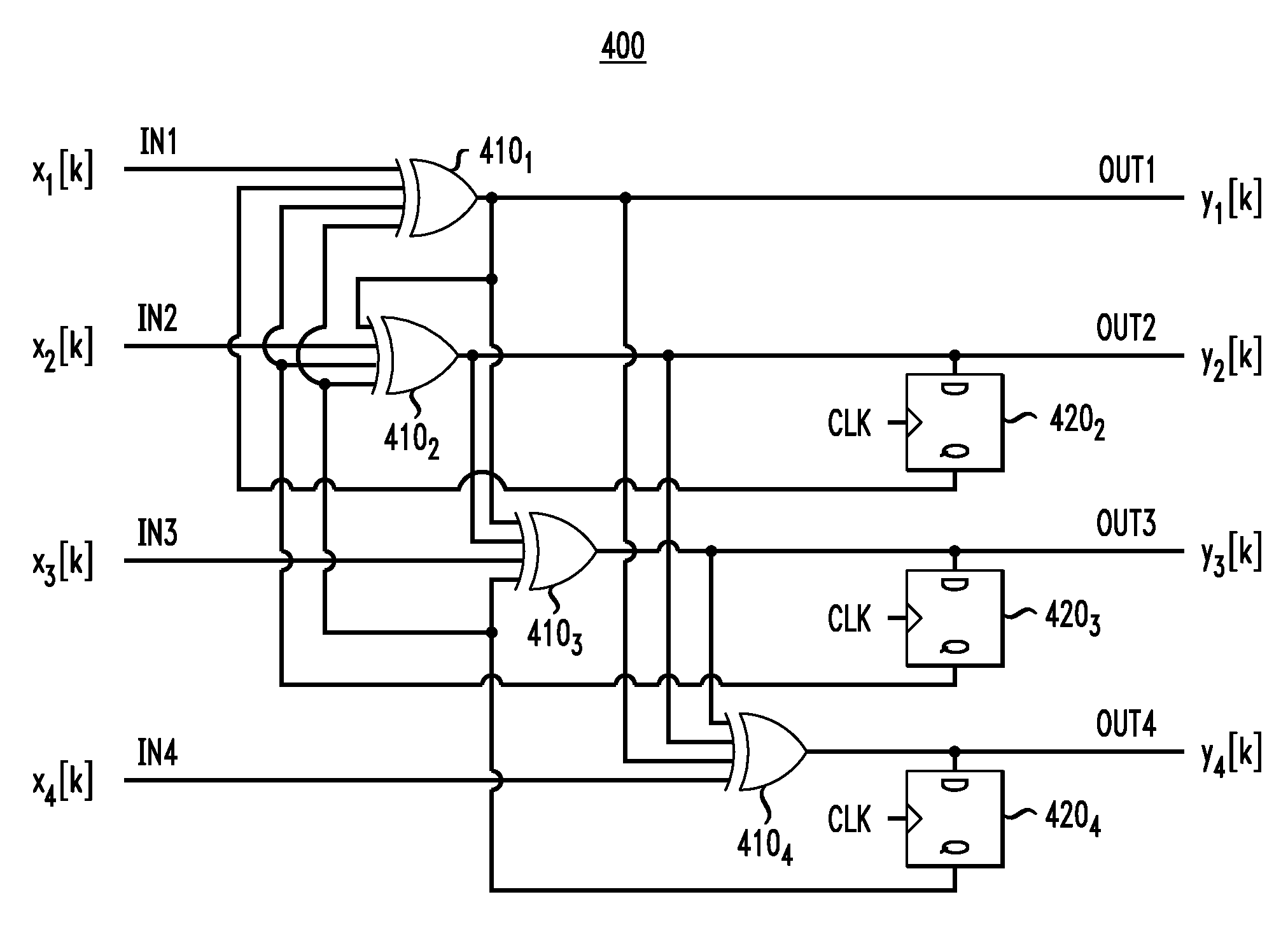
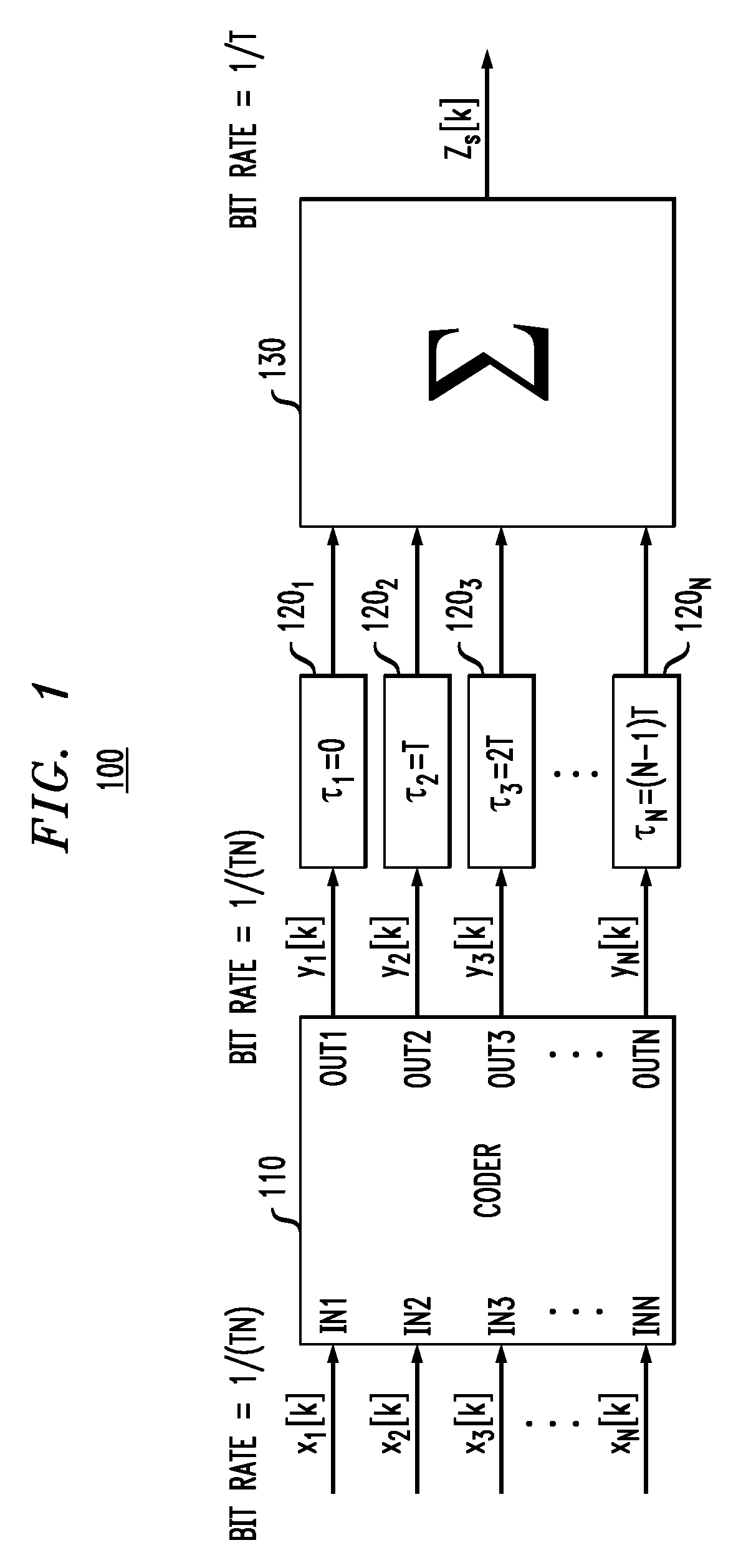
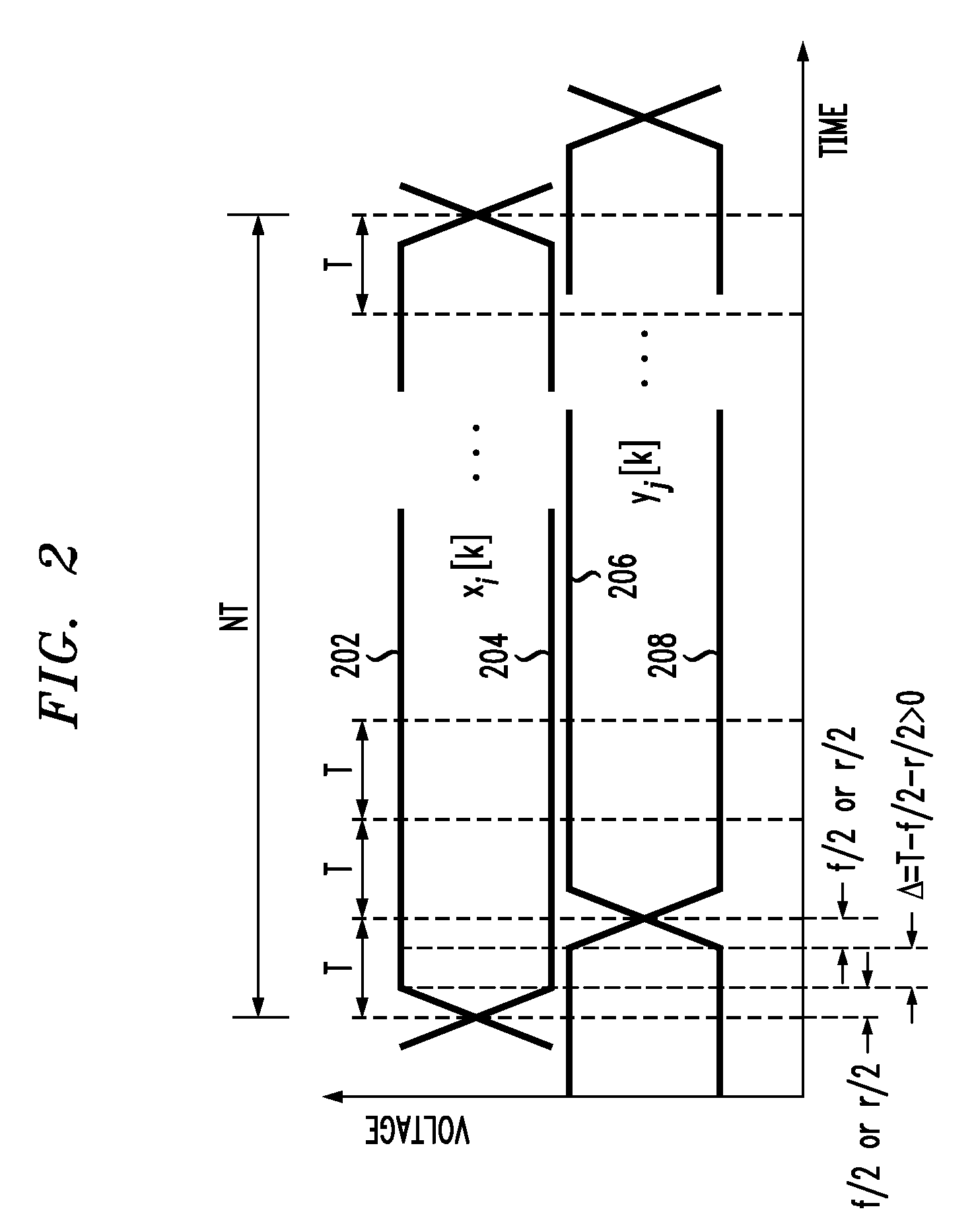
[0006]Disclosed herein are various embodiments of a polybinary-signal generator in which correlative coding is applied to a plurality of fractional-bit-rate signals instead of being applied to a corresponding multiplexed full-bit-rate signal. The resulting coded fractional-bit-rate signals are variously delayed with respect to one another and then summed to generate a polybinary output signal. One beneficial feature of this architecture is that most circuit components of the polybinary-signal generator operate at the fractional bit rate, which helps to alleviate at least some of the technical difficulties associated with the design of radio-frequency circuits intended for relatively high bit rates. Another beneficial feature of this architecture is that the polybinary-signal generator also serves as a signal multiplexer.

Problems solved by technology

However, circuits for generating polybinary signals for these and other applications are not yet sufficiently developed.

Method used

the structure of the environmentally friendly knitted fabric provided by the present invention; figure 2 Flow chart of the yarn wrapping machine for environmentally friendly knitted fabrics and storage devices; image 3 Is the parameter map of the yarn covering machine
View more

Image

Smart Image Click on the blue labels to locate them in the text.
Viewing Examples
Smart Image
  • Generation of multilevel signals using correlative coding
  • Generation of multilevel signals using correlative coding
  • Generation of multilevel signals using correlative coding

Examples

Experimental program
Comparison scheme
Effect test

Embodiment Construction

[0006]Disclosed herein are various embodiments of a polybinary-signal generator in which correlative coding is applied to a plurality of fractional-bit-rate signals instead of being applied to a corresponding multiplexed full-bit-rate signal. The resulting coded fractional-bit-rate signals are variously delayed with respect to one another and then summed to generate a polybinary output signal. One beneficial feature of this architecture is that most circuit components of the polybinary-signal generator operate at the fractional bit rate, which helps to alleviate at least some of the technical difficulties associated with the design of radio-frequency circuits intended for relatively high bit rates. Another beneficial feature of this architecture is that the polybinary-signal generator also serves as a signal multiplexer.

[0007]According to one embodiment, provided is an apparatus comprising a coder circuit having a plurality of input ports and a plurality of output ports and configur...

the structure of the environmentally friendly knitted fabric provided by the present invention; figure 2 Flow chart of the yarn wrapping machine for environmentally friendly knitted fabrics and storage devices; image 3 Is the parameter map of the yarn covering machine
Login to View More

PUM

No PUM Login to View More

Abstract

Disclosed is a polybinary-signal generator in which correlative coding is applied to a plurality of fractional-bit-rate signals instead of being applied to a corresponding multiplexed full-bit-rate signal. The resulting coded fractional-bit-rate signals are variously delayed with respect to one another and then summed to generate a polybinary output signal. One beneficial feature of this architecture is that most circuit components of the polybinary-signal generator operate at the fractional bit rate, which helps to alleviate at least some of the technical difficulties associated with the design of radio-frequency circuits intended for relatively high bit rates. Another beneficial feature of this architecture is that the polybinary-signal generator also serves as a signal multiplexer.

Description

BACKGROUND[0001]1. Field[0002]The present disclosure relates to communication equipment and, more specifically but not exclusively, to equipment for generating multilevel signals, such as polybinary signals.[0003]2. Description of the Related Art[0004]This section introduces aspects that may help facilitate a better understanding of the invention(s). Accordingly, the statements of this section are to be read in this light and are not to be understood as admissions about what is in the prior art or what is not in the prior art.[0005]Duobinary signaling was introduced in the 1960s and since then has found numerous applications in communication systems for transmitting data over wireline, wireless, and optical links. Polybinary signaling can be viewed as a generalization of duobinary signaling to an arbitrary number (s, a positive integer greater than two) of signal levels, with duobinary signaling corresponding to the case of s=3. However, circuits for generating polybinary signals fo...

Claims

the structure of the environmentally friendly knitted fabric provided by the present invention; figure 2 Flow chart of the yarn wrapping machine for environmentally friendly knitted fabrics and storage devices; image 3 Is the parameter map of the yarn covering machine
Login to View More

Application Information

Patent Timeline
no application Login to View More
Patent Type & Authority Patents(United States)
IPC IPC(8): H04L25/49H04L25/497
CPCH04L25/4917H04L25/497
Inventor SINSKY, JEFFREY H.
Owner ALCATEL LUCENT SAS
Features
  • R&D
  • Intellectual Property
  • Life Sciences
  • Materials
  • Tech Scout
Why Patsnap Eureka
  • Unparalleled Data Quality
  • Higher Quality Content
  • 60% Fewer Hallucinations
Social media
Patsnap Eureka Blog
Learn More