Method of preparing alkali lignin modified phenolic resin
What is AI technical title?
AI technical title is built by Patsnap AI team. It summarizes the technical point description of the patent document.
A technology of alkali lignin and phenolic resin is applied in the field of preparation of environment-friendly alkali lignin-modified phenolic resin, which can solve the problems of few varieties of alkali lignin, no application path, limited application range, etc. Low glue cost and energy saving effect
Inactive Publication Date: 2010-09-01
INST OF CHEM IND OF FOREST PROD CHINESE ACAD OF FORESTRY
View PDF3 Cites 4 Cited by
Summary
Abstract
Description
Claims
Application Information
AI Technical Summary
This helps you quickly interpret patents by identifying the three key elements:
Problems solved by technology
Method used
Benefits of technology
Problems solved by technology
[0007] Our country produces tens of thousands of tons of alkali lignin every year, but due to the lack of deep processing, there are few varieties of alkali lignin produced, the performance is poor, and its application range is limited. So far, there is no large-scale specific application path
Method used
the structure of the environmentally friendly knitted fabric provided by the present invention; figure 2 Flow chart of the yarn wrapping machine for environmentally friendly knitted fabrics and storage devices; image 3 Is the parameter map of the yarn covering machine
View more
Image
Smart Image Click on the blue labels to locate them in the text.
Viewing Examples
Smart Image
Click on the blue label to locate the original text in one second.
Reading with bidirectional positioning of images and text.
Smart Image
Examples
Experimental program
Comparison scheme
Effect test
Embodiment 1
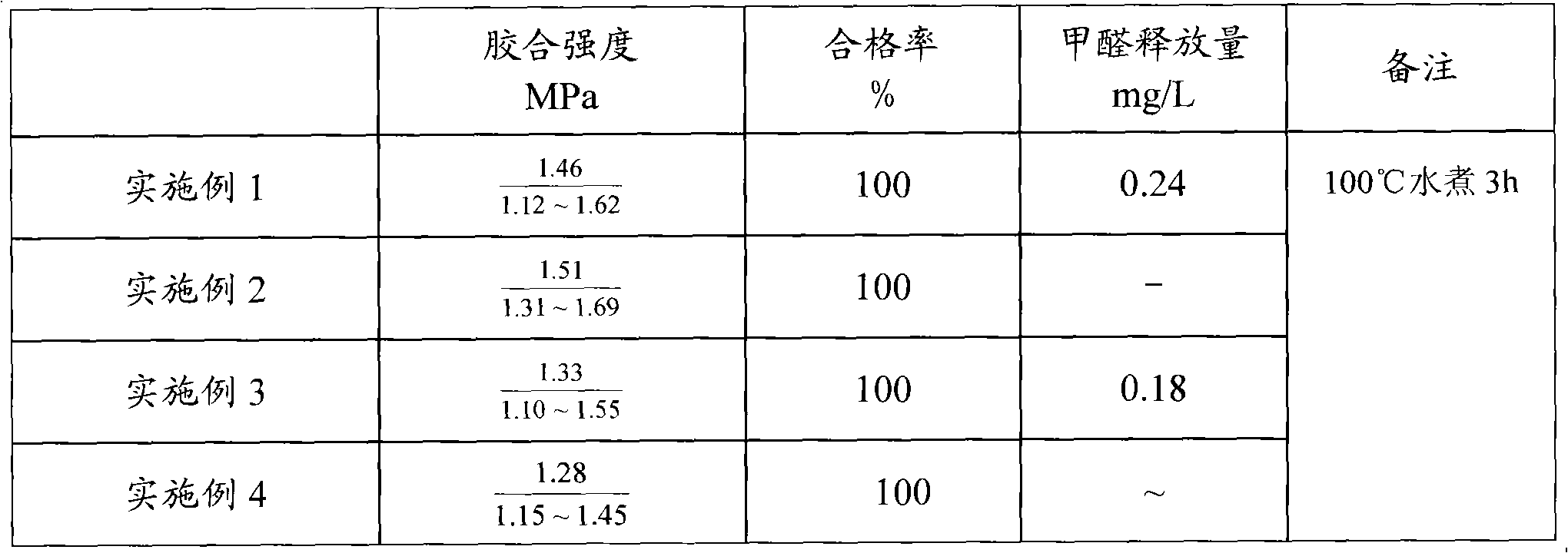
[0022] 1): Add 100g of phenol, 44g of alkali lignin, 80g of the first batch of formaldehyde solution, 0.2g of calciumoxide, and 60g of water into a 500ml four-neck flask, heat up to 80°C, and react for 80min.
[0023] 2): Add the second batch of formaldehyde solution 60g, react at 85°C for 60min.
[0024] 3): Add 60g of the third batch of formaldehyde solution and 10g of the first batch of lye, and react at 85°C for 60min.
[0025] 4): Cool down to 70°C, add 8g of urea and 30g of the second batch of lye, react at 65°C for 30min, cool and discharge. Test their performance respectively, and the results are listed in attached table 2. Press poplar plywood, test its performance, the results are listed in attached table 3.
Embodiment 2
[0027] 1): Add 100g of phenol, 44g of alkali lignin, 75g of formaldehyde solution, 0.5g of calciumoxide, and 60g of water into a 500ml four-neck flask, heat up to 75°C, and react for 70min.
[0028] 2): Add the second batch of formaldehyde solution 60g, react at 80°C for 70min.
[0029] 3): Add 60g of the third batch of formaldehyde solution and 8g of the first batch of lye, react at 85°C for 60min.
[0030] 4): Cool down to 70°C, add 8g of urea and 30g of the second batch of lye, react at 65°C for 20min, cool and discharge. Test their performance respectively, and the results are listed in attached table 2. Press poplar plywood, test its performance, the results are listed in attached table 3.
Embodiment 3
[0032] 1): Add 100g of phenol, 66g of alkali lignin, 80g of formaldehyde solution, 0.2g of calcium oxide, and 90g of water into a 500ml four-neck flask, heat up to 80°C, and react for 60min.
[0033] 2): Add the second batch of formaldehyde solution 60g, react at 85°C for 70min.
[0034] 3): Add 60g of the third batch of formaldehyde solution and 10g of the first batch of lye, and react at 85°C for 60min.
[0035] 4): Cool down to 70°C, add 8g of urea and 30g of the second batch of lye, react at 70°C for 30min, cool and discharge. Test their performance respectively, and the results are listed in attached table 2. Press poplar plywood, test its performance, the results are listed in attached table 3.
the structure of the environmentally friendly knitted fabric provided by the present invention; figure 2 Flow chart of the yarn wrapping machine for environmentally friendly knitted fabrics and storage devices; image 3 Is the parameter map of the yarn covering machine
Login to View More
PUM
Login to View More
Abstract
A method for preparing alkali lignin modified phenol-formaldehyde resin comprises the following steps: phenol, a first batch of formaldehyde solution, alkali lignin, metaloxide and dilution water are added into a reactor; a second batch of formaldehyde solution is added into the reactor; and a third batch of formaldehyde solution and a first batch of alkaline solution are added, formaldehyde trapping agent and a second batch of alkaline solution are added, and then material is discharged after cooling. The invention adopts the copolymerization technique to prepare an alkali ligninphenol formaldehyde adhesive, lignin and the phenol are added simultaneously, obtained hydroxymethylated lignin is reacted with hydroxymethyl phenol, a small part of the obtained hydroxymethylated lignin participates in the polycondensation of the hydroxymethyl phenol to form a main chain, and a large part of the obtained hydroxymethylated lignin forms branch chains through graft copolymerization, therefore, the lignin is introduced into a molecular chain and the aim of modifying phenol-formaldehyde resin is achieved. The invention can replace the use of 30-50 percent of the phenol, realizes stable and easy reaction control and easy industrial production; the bonding strength satisfies the requirements of national I-level plates; formaldehyde release reaches E0 level; therefore, the invention provides a new approach to the development of environment-friendly biomass-based wood adhesive and resource utilization of waste materials.
Description
[0001] -、Technical field [0002] The invention relates to a preparation method of a wood adhesive, in particular to a preparation method of an environment-friendly alkali lignin modified phenolic resin. 2. Background technology [0003] Lignin is the only non-petroleum resource in nature that can provide renewable aromatic compounds. Lignin molecules contain many different types of chemically active functional groups such as aromatic groups, phenolic hydroxyl groups, alcoholic hydroxyl groups, carbonyl groups, methoxyl groups, carboxyl groups, conjugated double bonds, etc., and have the advantages of being renewable, degradable, and non-toxic. The element is derived from the waste liquid of the pulp and paper industry, and the cost is low, so it is regarded as an excellent green and environmentally friendly chemical raw material. The pulp and paper industry needs to separate 140 million tons of cellulose from plants every year, and at the same time obtain about 50 million to...
Claims
the structure of the environmentally friendly knitted fabric provided by the present invention; figure 2 Flow chart of the yarn wrapping machine for environmentally friendly knitted fabrics and storage devices; image 3 Is the parameter map of the yarn covering machine
Login to View More
Application Information
Patent Timeline
Application Date:The date an application was filed.
Publication Date:The date a patent or application was officially published.
First Publication Date:The earliest publication date of a patent with the same application number.
Issue Date:Publication date of the patent grant document.
PCT Entry Date:The Entry date of PCT National Phase.
Estimated Expiry Date:The statutory expiry date of a patent right according to the Patent Law, and it is the longest term of protection that the patent right can achieve without the termination of the patent right due to other reasons(Term extension factor has been taken into account ).
Invalid Date:Actual expiry date is based on effective date or publication date of legal transaction data of invalid patent.
Login to View More
Patent Type & AuthorityPatents(China)
IPC IPC(8): C08G8/08C09J161/06C08G8/10
Inventor储富祥穆有炳王春鹏赵临五金立维
OwnerINST OF CHEM IND OF FOREST PROD CHINESE ACAD OF FORESTRY


 Login to View More
  Login to View More