

Patch for the expulsion of insect poison from the skin after stings from membranous insects (hymenoptera)
A technology of insect toxins and patches, which can be used in animal repellents, applications, biocides, etc., and can solve problems such as non-containing
Inactive Publication Date: 2009-08-12
马丁·温肯斯
View PDF4 Cites 0 Cited by
- Summary
- Abstract
- Description
- Claims
- Application Information
AI Technical Summary
Problems solved by technology
The patch is not suitable for insect bites as it does not contain an agent that detoxifies the insect
Method used
the structure of the environmentally friendly knitted fabric provided by the present invention; figure 2 Flow chart of the yarn wrapping machine for environmentally friendly knitted fabrics and storage devices; image 3 Is the parameter map of the yarn covering machine
View moreImage
Smart Image Click on the blue labels to locate them in the text.
Smart ImageViewing Examples

Examples
Experimental program
Comparison scheme
Effect test
Embodiment 1
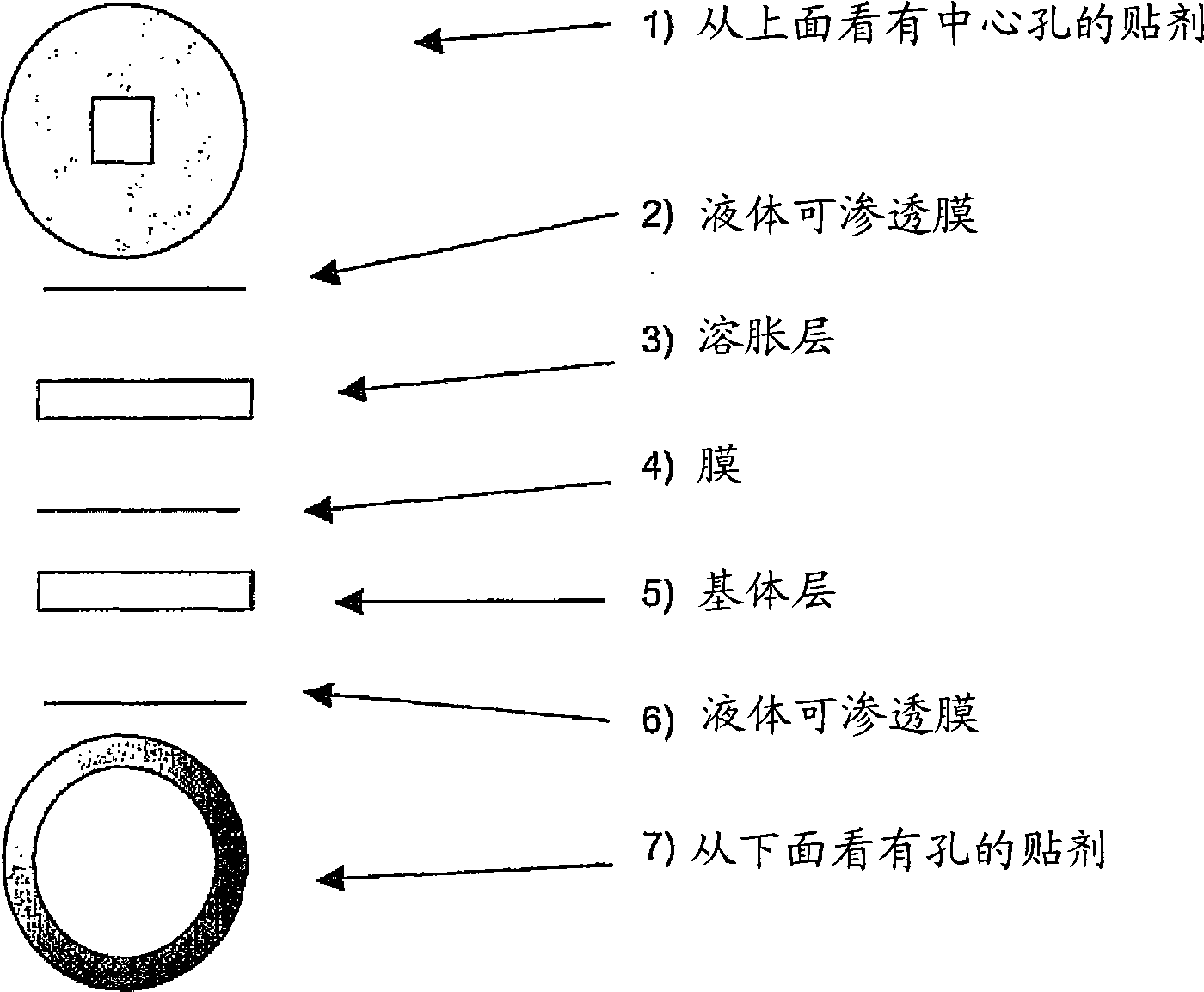
[0051] a kind of like figure 1 Patches designed as described in , where
[0052] the matrix consists of cotton containing sugar crystals;
[0053] • The swelling layer is silica gel.
Embodiment 2
[0055] A patch designed according to Example 1, to which water was added via a hole designed for this purpose in the upper layer of the patch. Thus, the depth of the swelling layer is increased.
Embodiment 3
[0057] A patch designed according to Example 1 was applied to a fresh bee sting. An equivalent patch with a detoxifying agent-free matrix is applied to another fresh bee sting. After the patch was fixed, the time to experience relief occurred faster with the patch according to Example 1 than with the patch without the detoxifying agent.
the structure of the environmentally friendly knitted fabric provided by the present invention; figure 2 Flow chart of the yarn wrapping machine for environmentally friendly knitted fabrics and storage devices; image 3 Is the parameter map of the yarn covering machine
Login to View More PUM
 Login to View More
 Abstract
This invention relates to a patch for the expulsion of insect poison from the skin after stings from membranous insects (Hymenoptera). The patch is characterized in comprising a poison-aspirating matrix comprising an expulsion agent as well as a swell layer, which swells after the addition of a liquid through a hole on the top of the patch and thus adds a light pressure to the poison-aspirating matrix towards the skin, whereby a local and relieving effect is achieved. In one embodiment, the matrix further comprises a local anesthetic. The expulsion agent is e.g. a carbohydrate. The swell layer consists e.g. of a silica gel.
Description
technical field [0001] The present invention relates to a patch comprising an expulsion agent for expulsion of toxins from the skin following stings of insects of the order membranous. Background technique [0002] Among the venomous Danish hymenoptera, there are about 250 different species of bees, 20 different species of bumble bees, and 4000 to 5000 different species of wasps, of which 6 species of hornets, as well as dianthus and spider wasps, have venomous stingers. [0003] Each summer, these hymenopteran insects cause many irritations and fears among children and adults who are afraid of the bites of these insects. In Denmark, 10,000 patients are treated for insect bites each year, of whom an average of 2 patients die. [0004] Hymenopteran insects such as bees, wasps and hornets use their stingers as part of their defense. When an insect bites, the toxin is pumped from the spine and into the skin. Bites are always unpleasant, causing swelling, sudden redness, pain...
Claims
the structure of the environmentally friendly knitted fabric provided by the present invention; figure 2 Flow chart of the yarn wrapping machine for environmentally friendly knitted fabrics and storage devices; image 3 Is the parameter map of the yarn covering machine
Login to View More Application Information
Patent Timeline
 Login to View More
 Patent Type & AuthorityApplications(China)
IPC IPC(8): A01N25/10A01N25/34A61K9/70
Inventor马丁·温肯斯
Owner马丁·温肯斯