
Method for detecting optimal density and time for bacterium suppression of chitosan
A technology for inhibiting bacteria and chitosan, which is applied in the fields of plant protection and microbiology, and can solve the problems of high cost, complicated operation and undetectable
- Summary
- Abstract
- Description
- Claims
- Application Information
AI Technical Summary
Problems solved by technology
Method used
Image

Examples
Embodiment 1
[0020] The preparation of embodiment 1 chitosan
[0021] Chitosan powder (purchased from Sigma company) was dissolved in 1% acetic acid by volume percentage to prepare a chitosan solution with a concentration of 10 mg / mL, adjust the pH to 5.6, and sterilize with an autoclave at 121 ° C for 20 min ,stand-by. At the same time, the acetic acid with a pH of 5.6 and a volume percentage of 1% was sterilized for use.
Embodiment 2
[0022] The preparation of embodiment 2 solanacear bacteria suspension
[0023] The solanacearum Rs-91 used in the present invention is provided by Fujian Academy of Agricultural Sciences. Pick on TZC medium (peptone 10.0g; hydrolyzed casein 1.0g; glucose 5.0g; TTC (2,3,5-triphenyltetrazolium chloride) 0.05g; water 1000mL; pH 7.0-7.2) The grown single colony of R. solanacearum was inoculated in LB medium (yeast extract 5g; peptone 10g; sodium chloride 5g; water 1000mL; pH 7.0-7.2), 30°C, 170r / min shaking culture for 24h.
Embodiment 3
[0024] The mixing of embodiment 3 chitosan and solanacearum bacterium suspension
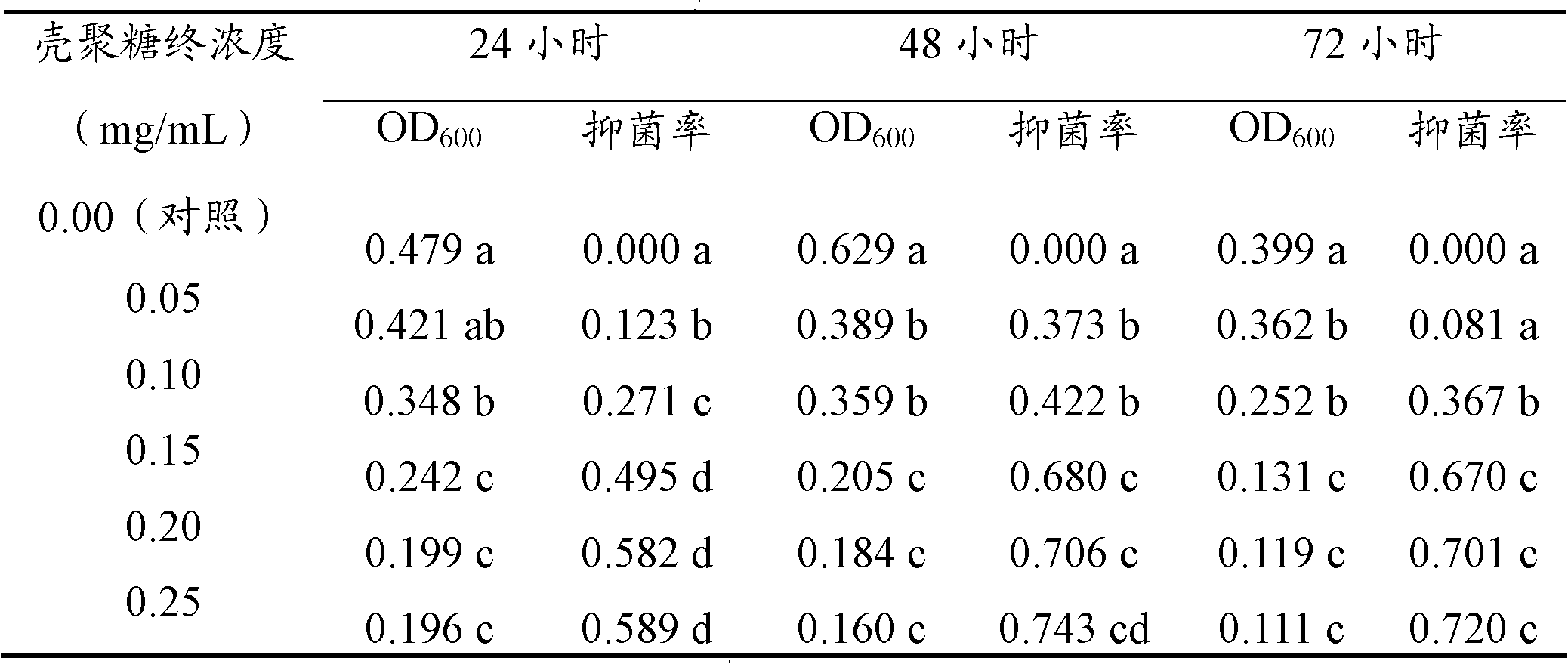
[0025] Prepare 6 sterilized centrifuge tubes, add 10 μL Ralstonia solanacearum suspension (OD 600 =0.3) and 965 μL of LB medium. At the same time, add 5 μL of 10 mg / mL chitosan solution and 20 μL of prepared acetic acid solution to tube 1, add 10 μL of chitosan solution and 15 μL of acetic acid solution to tube 2, add 15 μL of chitosan solution and 10 μL of acetic acid solution to tube 3 20 μL of chitosan solution and 5 μL of acetic acid solution were added to No. 4 tube, only 25 μL of chitosan solution was added to No. 5 tube, and only 25 μL of acetic acid solution was added to No. 6 tube. Finally, in No. 1-5 mixed cultures, the final concentrations of chitosan reached 0.05, 0.10, 0.15, 0.20 and 0.25 mg / mL respectively, while No. 6 tube was used as a control without adding chitosan. 100 μL of each was added to a 96-well culture plate (in order to reduce errors, no culture was added to the edg...
PUM
| Property | Measurement | Unit |
|---|---|---|
| concentration gradient | aaaaa | aaaaa |
Abstract
Description
Claims
Application Information
 Login to View More