Short wave infrared laboratory spectrum calibration and correction method for hyper spectral imager

A short-wave infrared and spectral calibration technology, applied in the field of laboratory spectral calibration, can solve the problems of high spectral resolution of hyperspectral imagers, affecting the accuracy of radiation calibration coefficients, affecting the application accuracy of remote sensing images, etc. The effect of avoiding the effects of spectral line drift

CN102538966AActive Publication Date: 2012-07-04云遥动力科技(苏州)有限公司
4 Cites 18 Cited by

Patent Information

Authority / Receiving Office
CN · China
Current Assignee / Owner
Publication Date
2012-07-04

Smart Images

  • Figure 1
    Figure 1
  • Figure 2
    Figure 2
  • Figure 3
    Figure 3
Patent Text Reader

Abstract

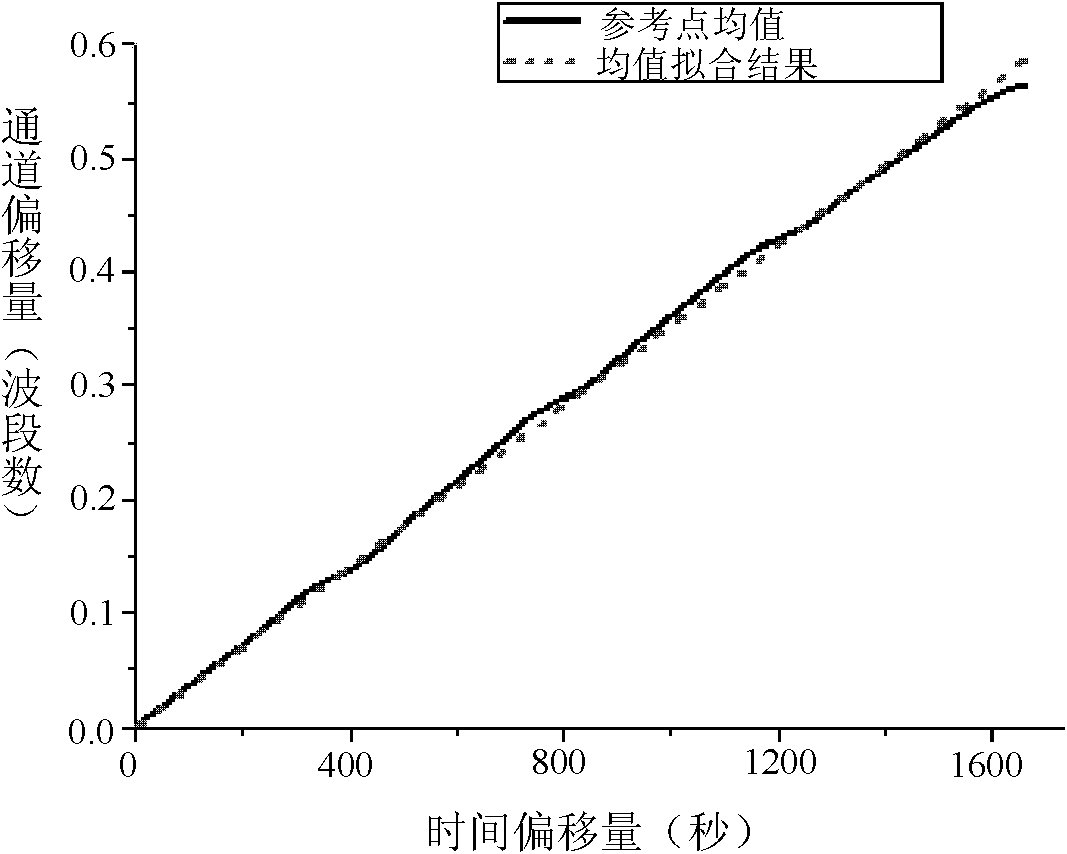
The invention discloses a laboratory spectrum calibration and correction method at the short wave infrared band (1000-2500nm) for a hyper spectral imager. The method includes the steps as follows: based on the scanning method of a monochromator, obtaining the relation between the passage deflection and time migration of correction wave bands through collecting the correction wave bands and adopting numerical calculation and linear regression analysis, building a spectral line drift correction model, and finally performing spectral line drift correction for the data of the entire short wave infrared band as per the characteristics of the spectral line drift correction model. Through the adoption of the laboratory spectrum calibration and correction method for the hyper spectral imager, the problem that the spectral line wave length drifts to long wave caused by interior heat production of the imager is solved, and within the allowable range of the calibration accuracy, the model is reliable, the time migration rule has repeatability, and the utility value is realized. The solution provided by the invention has already been practically applied to the laboratory spectrum calibration and correction method for the hyper spectral imager, and the model provided by the invention can be used for providing a reference frame for other remote sensors of the same type in case of similar conditions.
Need to check novelty before this filing date? Find Prior Art

Description

technical field

[0001] The invention relates to the field of laboratory spectrum calibration. The band range is short-wave infrared band (wavelength 1000-2500nm), and specifically refers to a method for correcting spectral line temperature drift of a hyperspectral imager through a spectral line drift correction model. Background technique

[0002] In order to quantitatively obtain surface object image information, laboratory calibration is required for remote sensing instruments to obtain the performance parameters of the instrument before launch, and laboratory calibration includes spectral calibration and radiometric calibration. Among them, spectral calibration is to obtain the center wavelength and spectral response bandwidth of each band of the remote sensor (generally described by half-wave width); radiometric calibration is to calculate the radiometric calibration coefficient ( including gain and offset). At present, laboratory spectral calibration methods mainly use...

Examples

Embodiment Construction

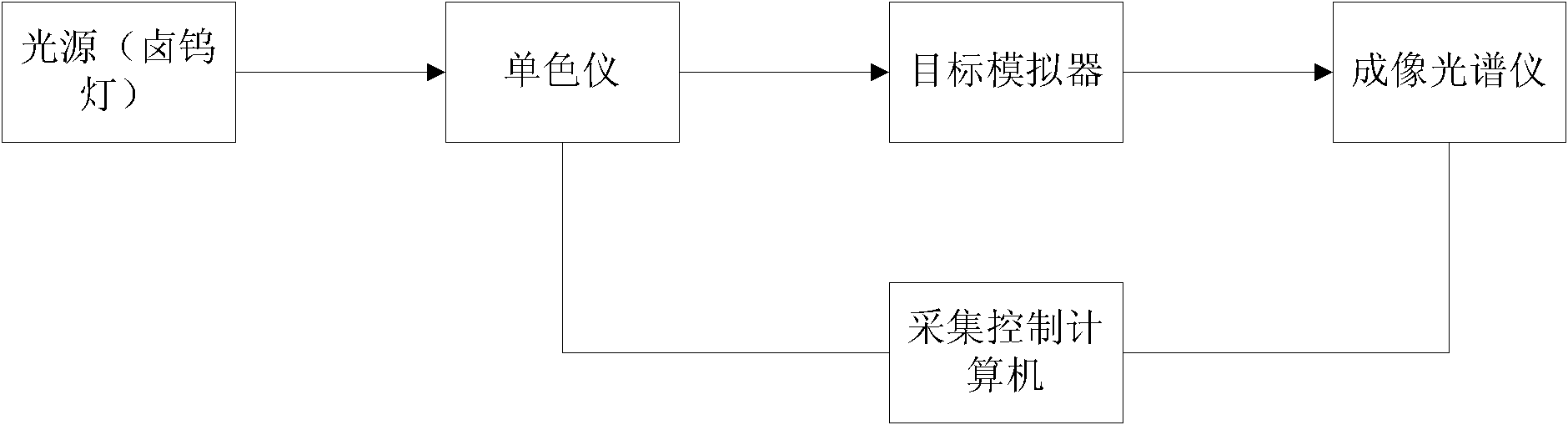
[0028] According to the invention, the spectral line drift correction for spectral calibration is performed on the short-wave infrared band of a dispersion-type hyperspectral imaging spectrometer. according to figure 1 Build a monochromator scanning method laboratory spectral calibration experimental device, adjust the experimental optical path, and ensure that the light from the monochromator imaging to the detector is uniform, stable, and straight. The light source is a 250W halogen tungsten lamp, and the adjusted voltage and current of the light source are: 11.3V / 5.13A. The controlled ambient temperature is 20±0.5°C and the humidity is 60%.

[0029] The details are as follows:

[0030] 1) Adjust the integration time of the imaging spectrometer to 3.6 milliseconds, and the angle of the pointing mirror to 1.885°. In the range of 1000-2500nm, the selected calibration bands are a(1190-1250nm), b(1600-1660nm), c(2330-2390nm), where a, b, and c correspond to the 15th, 29th and...