
Generalized maximum degree random walk graph sampling algorithm
A random walk, sampling algorithm technology, applied in computing, data processing applications, instruments, etc., can solve the problem of poor estimation accuracy of sampling algorithm, aggravating the problem of repeated samples, etc.
- Summary
- Abstract
- Description
- Claims
- Application Information
AI Technical Summary
Problems solved by technology
Method used
Image

Examples
Embodiment Construction
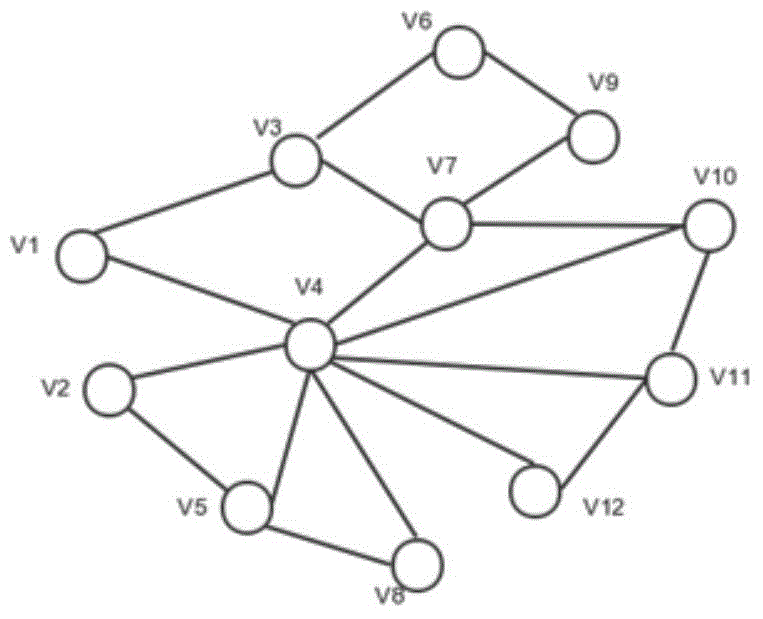
[0019] Specific embodiments of the present invention will be described in detail below in conjunction with specific drawings.
[0020] The present invention provides a new generalized maximum degree random walk algorithm, hereinafter referred to as GMD algorithm.
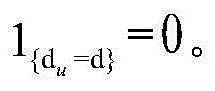
[0021] The GMD algorithm introduces a parameter C (C is a non-negative integer) on top of the MD algorithm to control the number of self-loops. Its probability transition equation is as follows:
[0022]
[0023] where C is a non-negative integer.
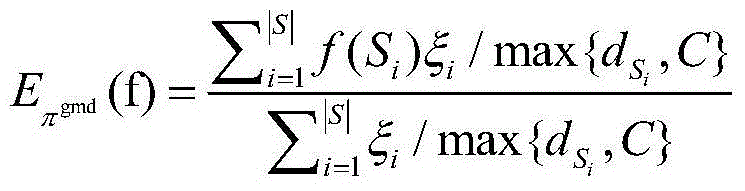
[0024] Specifically, the GMD algorithm includes two steps: firstly, samples are collected by random walk on the graph through the above-mentioned transition probability; secondly, an unbiased estimate is constructed according to the collected samples. Among them, the detailed process of the first step is as follows:
[0025] Input: graph G = (V, E)
[0026] Output: the collected sample point set S
[0027] 1 Randomly select node u in the graph as the initial node,...
PUM
 Login to View More
 Abstract
Description
Claims
Application Information
 Login to View More