On-chip digital temperature sensor with optimized linearity

A digital temperature and sensor technology, used in thermometers, thermometers, and instruments that use electrical/magnetic components that are directly sensitive to heat. Low power consumption, wide measurement temperature range, cost-saving effect

CN104596662BActive Publication Date: 2017-06-13CHIPSEA TECH SHENZHEN CO LTD
6 Cites 0 Cited by

Patent Information

Authority / Receiving Office
CN · China
Patent Type
Patents(China)
Current Assignee / Owner
Publication Date
2017-06-13

Smart Images

  • Figure 1
    Figure 1
  • Figure 2
    Figure 2
  • Figure 3
    Figure 3
Patent Text Reader

Abstract

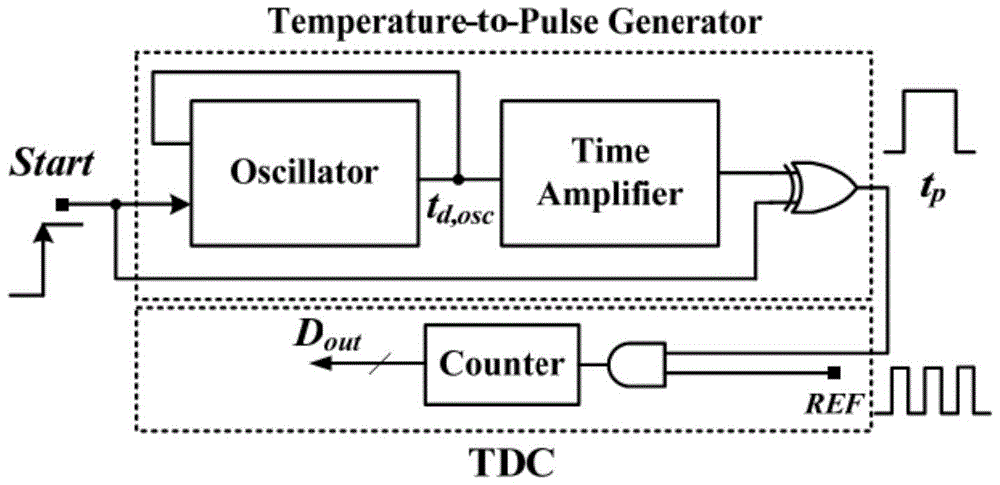
The invention discloses an on-chip digital temperature sensor with optimized linearity, which includes a ring oscillator for outputting a ring oscillator clock signal whose cycle varies with temperature; and also includes a time amplifier whose input is the ring oscillator clock signal , so as to obtain a pulse signal with several cycle lengths of the ring oscillator clock signal; the digital temperature sensor also includes a counter whose input is the above pulse signal and a reference clock signal. When the pulse signal arrives, the reference clock is used to count , until the end of the pulse signal, so a count value with the reference clock period as the unit pulse signal length is obtained; the digital temperature sensor of the present invention has good linearity while retaining the advantages of simple structure, small area and low power consumption. With the advantages of wide measurement temperature range and high precision, the external crystal oscillator can be omitted, which saves the cost.
Need to check novelty before this filing date? Find Prior Art

Description

technical field

[0001] The invention relates to integrated circuits, in particular to a digital temperature sensor. Background technique

[0002] On-chip temperature sensors generally have two architectures. One is to use an analog-to-digital converter (ADC) in the voltage domain to detect a bandgap voltage proportional to absolute temperature to detect temperature; this bandgap voltage is usually the VBE of two triodes (The difference between the emitter and base voltages of the transistor BJT) is the difference ΔVBE. This kind of temperature sensor has the advantages of high precision, good linearity, wide measurement temperature range and low voltage sensitivity. However, due to the use of ADC for detection, its disadvantages are large area and large power consumption; the second is in the time domain , to detect temperature by detecting the on-chip clock whose clock period varies with temperature. Since no ADC is required, this temperature sensor has the advantages of ...

Examples

Embodiment Construction

[0029] In order to make the object, technical solution and advantages of the present invention clearer, the present invention will be further described in detail below in conjunction with the accompanying drawings and embodiments. It should be understood that the specific embodiments described here are only used to explain the present invention, not to limit the present invention.

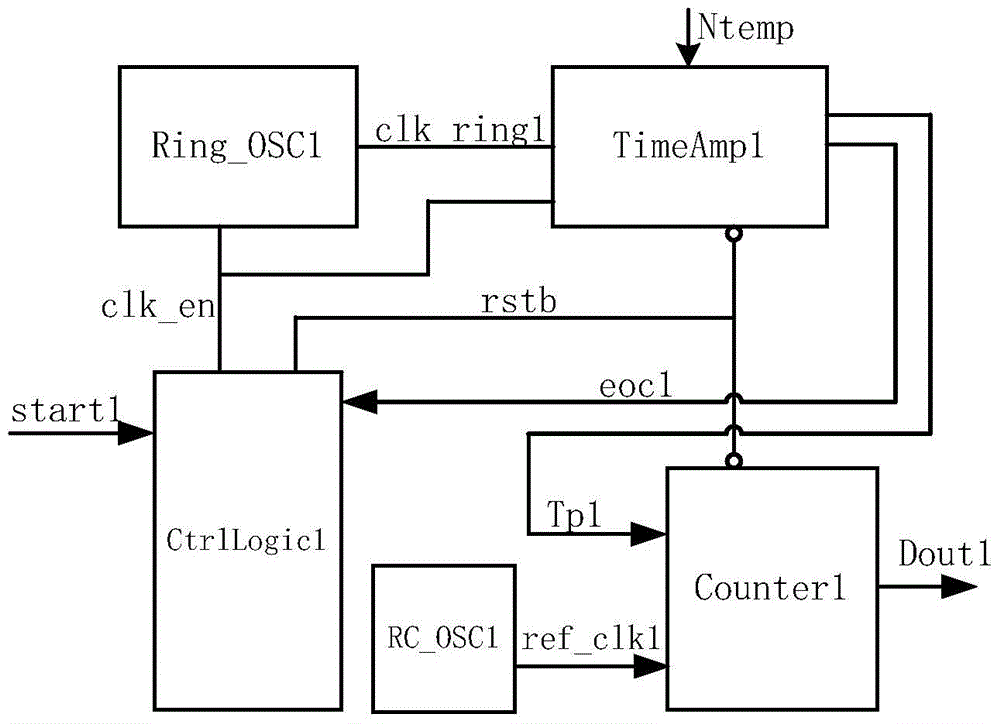
[0030] See attached figure 2 , shows a preferred embodiment of the digital temperature sensor according to the present invention. Including ring oscillator Ring_osc1, time amplifier TimeAmp1, counter Counter1, RC oscillator RC_OSC1, and control logic CtrlLogic1; the ring oscillator module Ring_OSC1 has a simple structure, and when the control logic CtrlLogic1 control signal clk_en is valid, it can generate a ring oscillator with a certain period The clock signal clk_ring1 is output to the time amplifier TimeAmp1; TimeAmp1 is essentially a counter that can pre-design the value, and the count value...