Monocrystalline-diamond continuous wave tunable deep ultraviolet laser

A single crystal diamond and laser technology, applied in lasers, laser parts, phonon exciters, etc., can solve the problems of high price and preheating time of more than one hour, achieve high Raman gain coefficient, reduce insertion Loss, effect of low laser threshold

CN104600552AActive Publication Date: 2015-05-06南光高科(厦门)激光科技有限公司
4 Cites 10 Cited by

Patent Information

Authority / Receiving Office
CN · China
Patent Type
Applications(China)
Current Assignee / Owner
Publication Date
2015-05-06

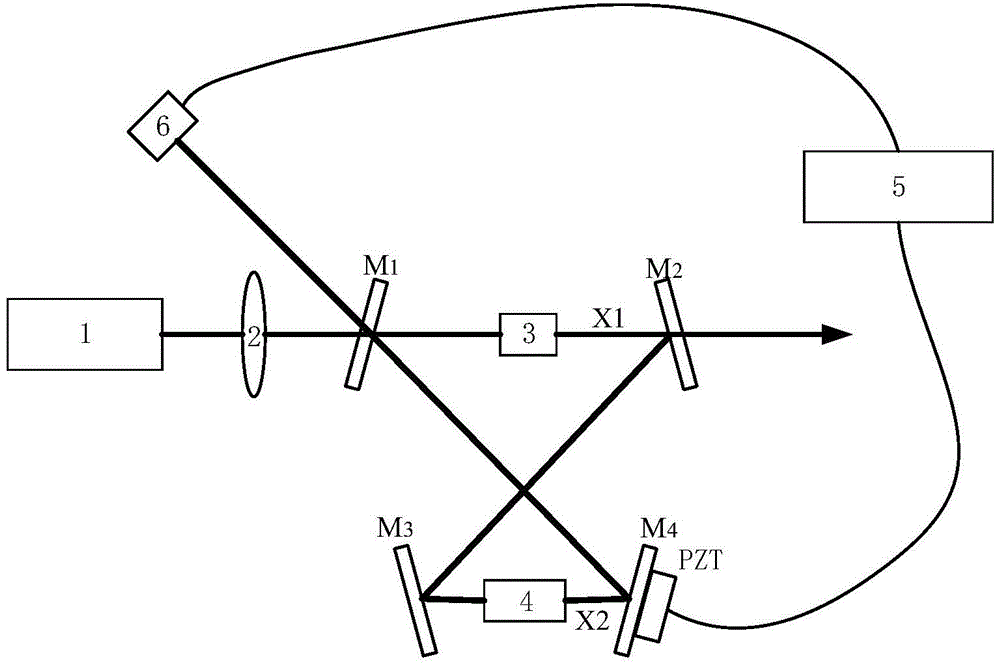
Smart Images

  • Figure 1
    Figure 1
Patent Text Reader

Abstract

The invention relates to an all-solid-state deep ultraviolet laser, in particular to a monocrystalline-diamond continuous wave tunable deep ultraviolet laser. The monocrystalline-diamond continuous wave tunable deep ultraviolet laser is provided with a 456nm single-frequency blue-light laser, a transverse mode matching lens, a first laser resonator mirror, a second laser resonator mirror, a third laser resonator mirror, a fourth laser resonator mirror, a laser gain medium, a frequency doubling crystal, a photodiode and a PDH (Pound-Drever-Hall) controller. The 456nm single-frequency blue-light laser, the transverse mode matching lens, the first laser resonator mirror, the frequency doubling crystal and the second laser resonator mirror are arranged on a first optical axis sequentially from left to right, and the third laser resonator mirror, the laser gain medium and the fourth laser resonator mirror are arranged on a second optical axis sequentially from left to right; the photodiode is located on the left rear side of the first laser resonator mirror, and the PDH controller is connected with the photodiode and the fourth laser resonator mirror; the first optical axis is parallel to the second optical axis. The all-solid-state deep ultraviolet laser is small in size, high in efficiency, long in service life, good in beam quality, easy for system integration and easily practical.
Need to check novelty before this filing date? Find Prior Art

Description

technical field

[0001] The invention relates to an all-solid-state deep-ultraviolet laser, in particular to a single-crystal diamond continuous-wave tunable deep-ultraviolet laser based on single-frequency blue light resonance pumping. Background technique

[0002] Laser Raman Spectroscopy (LRS) is an important tool for studying the molecular vibration and molecular structure of substances. With the significant progress in material science, laser, synchrotron technology and nanotechnology, LRS has become more and more important in physics, chemistry, biology and materials science. and other fields are increasingly widely used. Conventional LRS uses a laser with a wavelength greater than 400nm as the excitation source, which usually faces the problems of fluorescence interference and low sensitivity. However, Deep Ultraviolet Laser Raman Spectroscopy (DUVLRS) uses a deep ultraviolet excitation source. When the excitation wavelength is less than 260nm , it can effectively sol...

Examples

Embodiment Construction

[0022] The following embodiments will further illustrate the present invention in conjunction with the accompanying drawings.

[0023] like figure 1 As shown, the embodiment of the present invention is provided with a 456nm single-frequency blue laser 1, a transverse mode matching lens 2, a first laser resonator mirror M1, a second laser resonator mirror M2, a third laser resonator mirror M3, and a piezoelectric ceramic The fourth laser resonator mirror M4, laser gain medium 4, frequency doubling crystal 3, photodiode 6 and PDH controller 5; the 456nm single-frequency blue laser 1, transverse mode matching lens 2, and the first laser resonator mirror M1, frequency doubling crystal 3, and second laser resonator mirror M2 are sequentially arranged on the first optical axis X1 from left to right. The third laser resonator mirror M3, laser gain medium 4, and fourth laser resonator mirror M4 They are sequentially arranged on the second optical axis X2 from left to right; the photo...