
Tea tree growth-promoting rhizobacterium Serratia marcescens and application thereof
A technology for Serratia marcescens and rhizosphere growth-promoting bacteria, applied in bacteria, applications, microorganisms, etc., can solve the problems of environmental risks, large investment, slow effect, etc., achieve excellent strain resources, and reduce the level of ethylene , the effect of increasing dry matter accumulation
- Summary
- Abstract
- Description
- Claims
- Application Information
AI Technical Summary
Problems solved by technology
Method used
Image

Examples
Embodiment 1
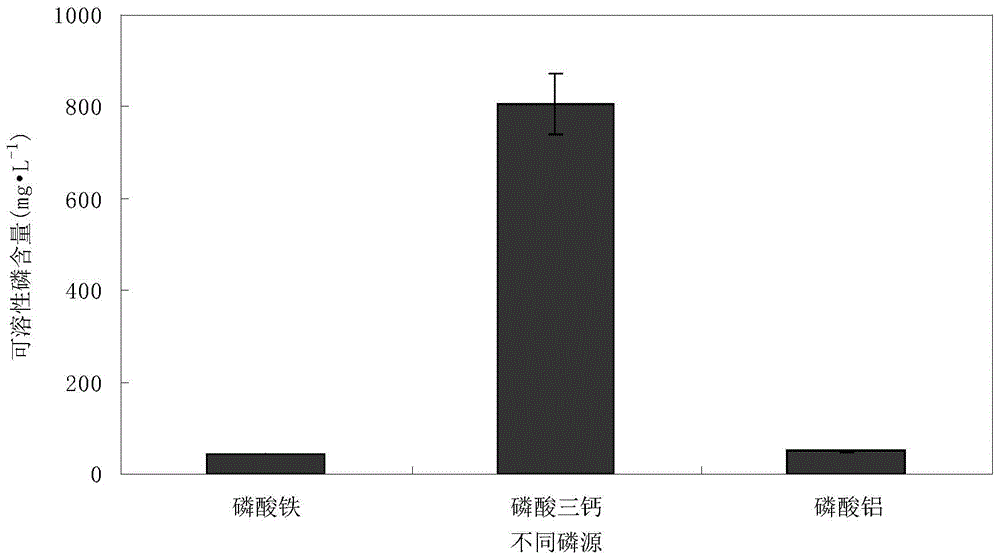
[0024] Example 1: Determination of phosphorus-dissolving ability of JW-CZ2 strain.
[0025] Phosphate Solubilizing Medium A: Glucose 10g, Ca 3 (PO 4 ) 2 5g, MgCl 2 5g, KCl 0.2g, MgSO 4 ·7H 2 O 0.25g, (NH 4 ) 2 SO 4 0.1g, distilled water 1000mL, pH 7.0.
[0026] Phosphate-dissolving medium B: using iron phosphate (FePO 4 ), magnesium phosphate (Mg 3 (PO 4 ) 2 ) instead of tricalcium phosphate (Ca 3 (PO 4 ) 2), the other components and contents are the same. Inoculate the twice activated JW-CZ2 strain into NB medium (3.0g of beef extract, 10.0g of peptone, 5.0g of sodium chloride, 1000mL of distilled water, 18.0g of agar, pH7.2-7.4), and culture at 30°C for 18-24 Make JW-CZ2 seed solution afterward, inoculate in the 100mL Erlenmeyer flask that contains 50mL NBRIP medium by 1% inoculum amount, take the NBRIP medium that inoculates NB medium as control (CK), each process 3 repetitions, After shaking culture at 30°C and 200r / min for 72h, the fermentation broth was ...
Embodiment 2
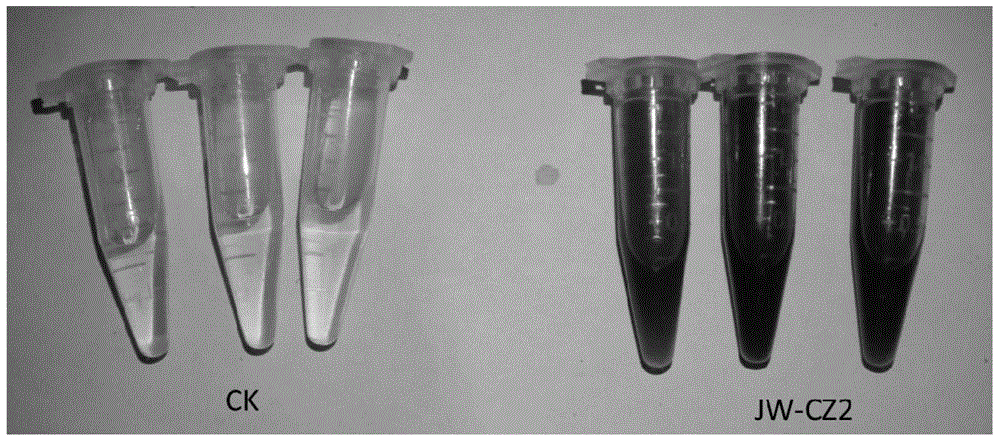
[0028] Example 2: Qualitative analysis of IAA produced by JW-CZ2 strain.
[0029] After inoculating the JW-CZ2 strain in NA liquid medium and culturing for 12 hours (28°C, 120r / min), adjust the OD600 value to 0.05 with sterile water, and take 0.1mL of the test bacteria suspension to receive the In the King culture solution containing 100mg / L tryptophan, each triangular flask was filled with 50mL culture solution, repeated 3 times, and the culture solution with 0.1mL sterile water was used as the blank control, and placed together at 28 Cultivate for 12 days in a temperature-controlled shaker with a rotational speed of 120 r / min. Take 50 μL of the test bacteria suspension and 50 μL of the blank control respectively, add 50 μL of colorimetric solution, put it at room temperature, and observe the color change within 15 minutes. If all three repetitions turn red, it means that IAA can be secreted; the darker the color, the better the secretion of IAA. The number is large; all 3 r...
Embodiment 3
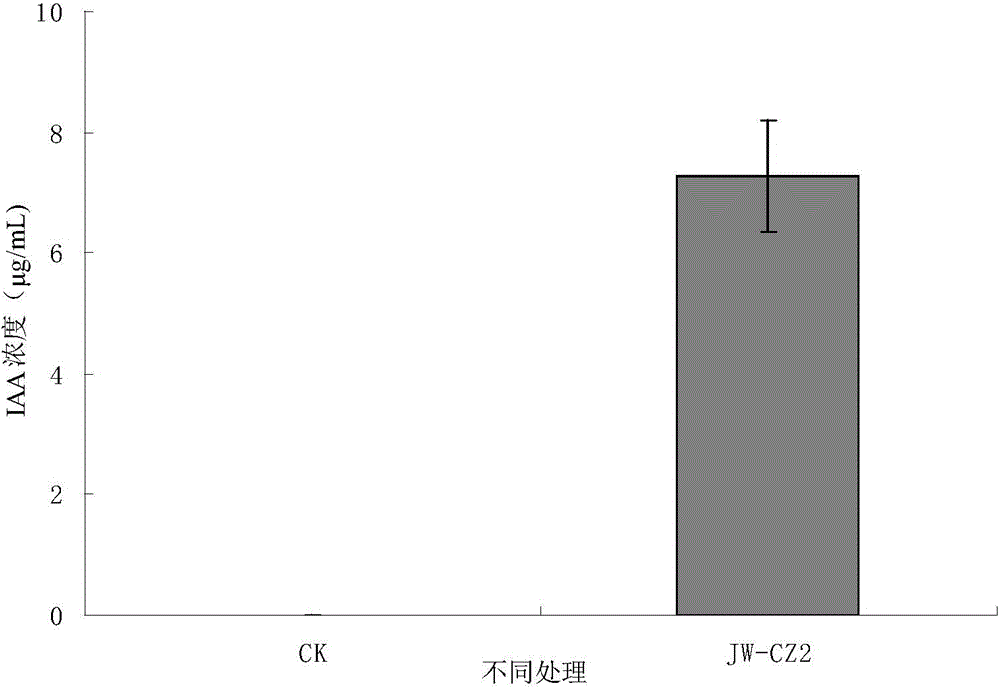
[0030] Example 3: Quantitative analysis of IAA produced by JW-CZ2 strain.
[0031] The tested strains were inoculated in king medium shake flasks and cultured for 3 days. First, measure the OD of the bacterial suspension by spectrophotometry 600 value. Then the bacterial suspension was centrifuged at 10000r / min for 10min, and 1mL of the supernatant was added to an equal volume of Salkowski colorimetric solution, and kept in the dark for 30min for color development. The OD was determined by spectrophotometry 530 value. Calculation of bacterial concentration OD 600 When the value is 1, the amount of IAA secreted by bacteria in a unit volume of bacterial suspension. The standard curve was prepared by gradient dilution of analytically pure IAA.
[0032] Preparation of colorimetric solution: Preparation of S1 colorimetric solution: weigh FeCl 3 12g was dissolved in 300mL distilled water, then slowly added 429.7mL 98% H 2 SO 4 , after cooling down to 1L, the measuring range...
PUM
 Login to View More
 Abstract
Description
Claims
Application Information
 Login to View More