
Preparation and application of amino-functionalized graphene oxide/azo polymer composite waveguide material
A technology of amino functionalization and azo polymers, which is applied in the fields of instruments, optics, nonlinear optics, etc., can solve the problems of unstable two-dimensional crystals of single-layer graphene and difficult compounding, and achieve improved thermo-optical performance and low drive The effect of power, fast response speed
- Summary
- Abstract
- Description
- Claims
- Application Information
AI Technical Summary
Problems solved by technology
Method used
Image

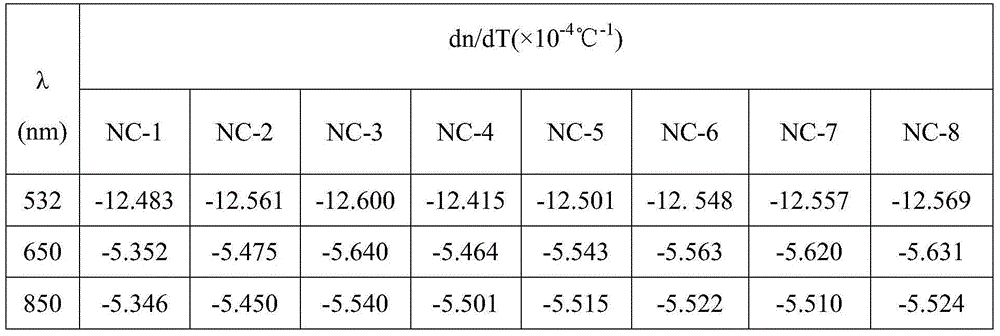
Examples
Embodiment 1
[0027] (1) adopt Hummers method to prepare graphite oxide;
[0028] (2) The azo chromogenic molecule NAPD was prepared by the diazo coupling method;
[0029] (3) Preparation of isocyanate-terminated prepolymer: 1.06 g of NAPD and 2.12 g of IPDI were dissolved in 18.9 g of DMF, and added to a four-neck flask equipped with a stirring bar, a thermometer and a reflux tube. Next, after raising the temperature to 45°C, add 0.5g of T-12 and react for 1 hour to obtain the isocyanate-terminated prepolymer;
[0030] (4) Put 0.012g of graphite oxide in 6gDMF for ultrasonic peeling for 5h, and then centrifuge to obtain a graphene oxide dispersion; place the dispersion in a 250mL round bottom flask, then add 6gEDA into the graphene oxide dispersion, Stir at room temperature for 30 min; then, after heating up to 30°C, add 0.8 mg of 2-(7-azobenzotriazole)-N,N,N',N'-tetramethyluronium hexafluorophosphate ( HATU), continue stirring reaction 3h, obtain the graphene oxide (EAGO) of ethylenedia...
Embodiment 2
[0033] (1) adopt Hummers method to prepare graphite oxide;
[0034] (2) The azo chromogenic molecule NAPD was prepared by the diazo coupling method;
[0035] (3) Preparation of isocyanate-terminated prepolymer: 1.06g of NAPD and 2.12g of IPDI were dissolved in 21.2g of DMF, and added to a four-neck flask equipped with a stirring bar, a thermometer and a reflux tube. Next, after raising the temperature to 50°C, add 0.5g T-12 and react for 2 hours to obtain the isocyanate-terminated prepolymer;
[0036] (4) Put 0.012g of graphite oxide in 7.2g of DMF for ultrasonic peeling for 6h, then centrifuge to obtain the graphene oxide dispersion, put the dispersion in a 250mL round bottom flask, and then add 8.4g of EDA to the graphene oxide dispersion , stirring at room temperature for 30 min; then, after heating up to 40 ° C, adding 0.8 mg HATU, and continuing to stir for 4 h to obtain ethylenediamine-functionalized graphene oxide (EAGO);
[0037] (5) Then add the isocyanate-terminate...
Embodiment 3
[0039] (1) adopt Hummers method to prepare graphite oxide;
[0040] (2) The azo chromogenic molecule NAPD was prepared by the diazo coupling method;
[0041] (3) Preparation of isocyanate-terminated prepolymer: 1.06 g of NAPD and 3.71 g of IPDI were dissolved in 19.08 g of DMF, and added to a four-neck flask equipped with a stirring bar, a thermometer and a reflux tube. Next, after raising the temperature to 80°C, add 0.5g T-12 and react for 4 hours to obtain the isocyanate-terminated prepolymer;
[0042] (4) Put 0.012g of graphite oxide in 9.42g of DMF for ultrasonic peeling for 6h, then centrifuge to obtain the graphene oxide dispersion, put the dispersion in a 250mL round bottom flask, and then add 9g of EDA to the graphene oxide dispersion , stirred at room temperature for 30 min. Next, after raising the temperature to 60°C, add 1 mg HATU, and continue stirring for 6 hours to obtain ethylenediamine-functionalized graphene oxide (EAGO);
[0043] (5) Then, add the isocyan...
PUM
 Login to View More
 Abstract
Description
Claims
Application Information
 Login to View More