
A quasi-universal compensating mirror based on deformable mirror and its design method
A technology of deformable mirror and compensating mirror, applied in measurement devices, instruments, optical devices, etc., can solve problems such as nano-level free-form surface shape errors, and achieve the effects of reducing design difficulty, easy calibration and adjustment, and fewer error sources.
- Summary
- Abstract
- Description
- Claims
- Application Information
AI Technical Summary
Problems solved by technology
Method used
Image

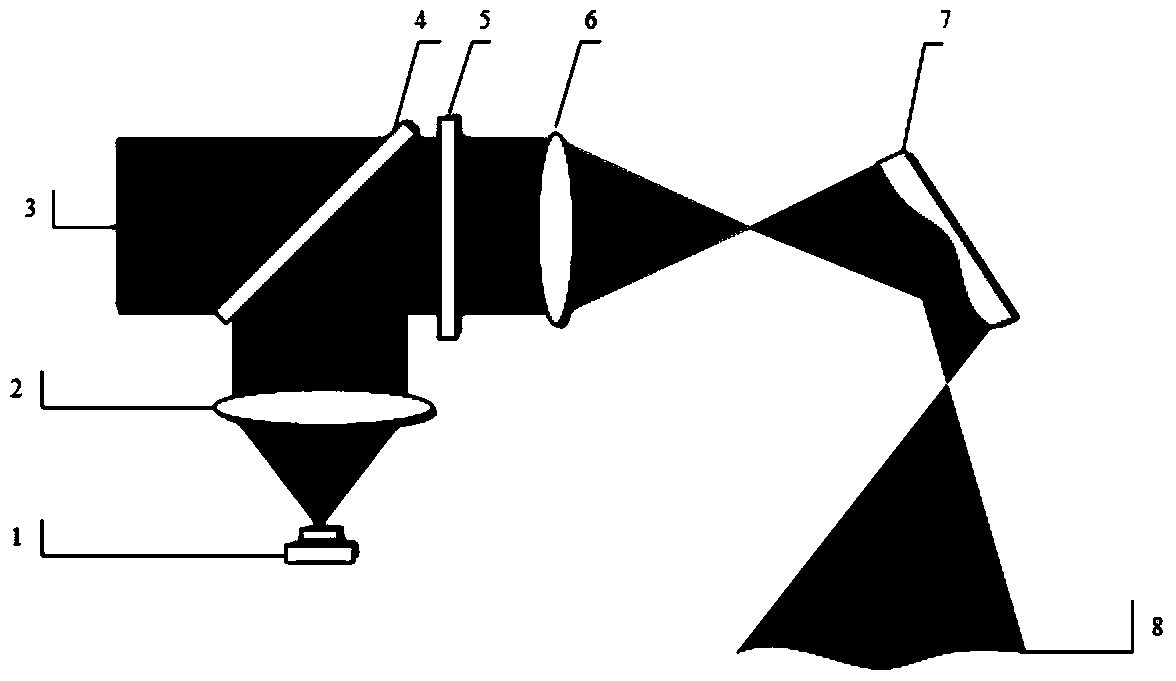
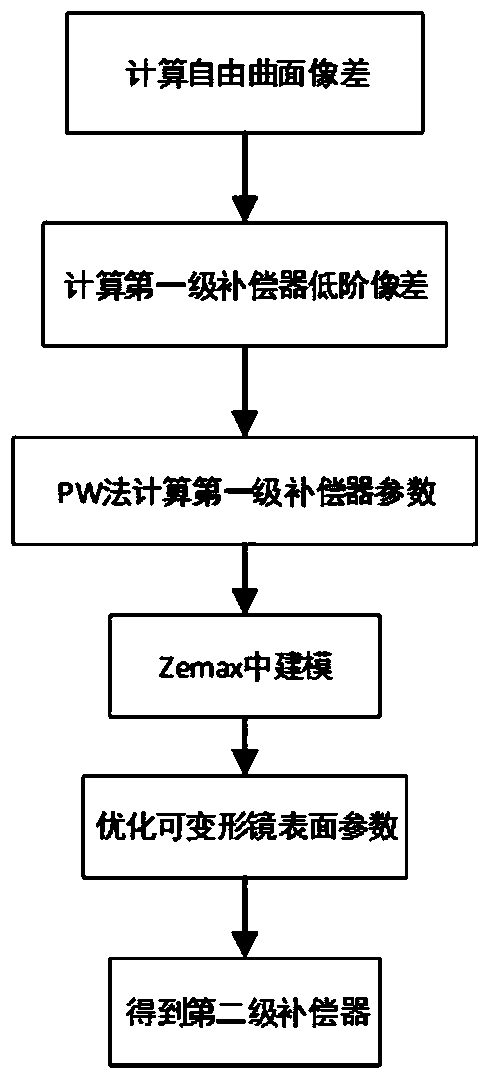

Examples
Embodiment
[0034] The specific parameters of the large-diameter free-form surface measured in this example are as follows:
[0035] Diameter: 110mm; Aspheric coefficient: -1.3; Vertex curvature radius: 500mm;
[0036] Additional Zernike higher-order terms for face shape: Z 4 = -8.2515; Z 5 = -9.789732; Z 9 = -1.271369;
[0037] The first-stage compensator obtained by the above design method is a single lens, and the parameters are as follows:
[0038] R 1 =167.25mm,R 2 =2899.68mm, thickness d=35.6mm, and the material is commonly used K9 glass.
[0039] Add a deformable mirror, model the system in the optical design software Zemax, optimize the surface parameters of the deformable mirror, and finally get the surface type of the second-stage compensator (using the Zernike polynomial Z 4 -Z 29 Characterization):
[0040] Z 4 =-0.1453,Z 5 =0.08622,Z 6 =9.50E-4,Z 7 =-4.69E-3,Z 8 =1.65E-3,Z 9 =0.0379,Z 10 =3.13E-3,Z 11 =0.0448,Z 12 =0.0155,Z 13 =7.51E-4,Z 14 =-2.12E-3,Z 15...
PUM
 Login to View More
 Abstract
Description
Claims
Application Information
 Login to View More